Author: Jason Shubnell
Translation: Deep Tide TechFlow
Deep Tide Insights: At Token2049 Singapore, Krista Lynch, Head of Trading and Capital Markets at Grayscale, revealed that the Grayscale Zcash ETF (ZCSH) attracted over $10 billion in its first 30 trading days, placing it in the top 1% of newly launched ETFs in the past decade based on its first-month AUM. SEC's general listing standards now cover approximately 15 tokens, enabling issuers to become more selective in their coin choices. In our view, this signifies that the competition for altcoin ETFs has shifted from "can it get listed" to "who can attract capital." Funds are likely to concentrate on a small number of assets with strong narratives and demand. With the failure of the Clarity Act, Grayscale is advancing fund tokenization via SEC's innovation exemption, indicating that regulatory compliance is finding paths forward, circumventing legislative gridlock.
Krista Lynch also stated that Grayscale's submission of applications for the tokenization of two covered call funds under the SEC's innovation exemption points to a path forward for the industry following the failure of the Clarity Act.
Key Takeaways
Grayscale's Head of Trading said in an interview with The Starting Block at Token2049 that the SEC's general listing standards now cover approximately 15 tokens, giving issuers greater flexibility in product selection.
According to Grayscale's Head of Trading and Capital Markets, as issuers look beyond Bitcoin and Ethereum and become more selective about which digital assets are robust enough to support investment products, the crypto ETF market is entering a new phase.
Grayscale Managing Director Krista Lynch said the U.S. Securities and Exchange Commission's (SEC) general listing standards have established a framework covering about 15 tokens, allowing issuers to more autonomously choose which products to launch based on investor demand and their own judgment. In January, Grayscale stated it was considering 27 assets across categories such as AI, DeFi, consumer, and infrastructure.
This selectivity is already visible in the market. Lynch said Grayscale's Zcash ETF (ticker ZCSH) attracted over $10 billion in its first 30 trading days post-launch, placing it in the top 1% of ETFs launched in the past decade based on first-month AUM.
"Measured by assets gathered in its first month of existence as an ETF, the Zcash ETF ranks in the top 1% of ETFs launched in the past ten years," Lynch said in an interview with The Starting Block at the Token2049 Singapore conference.
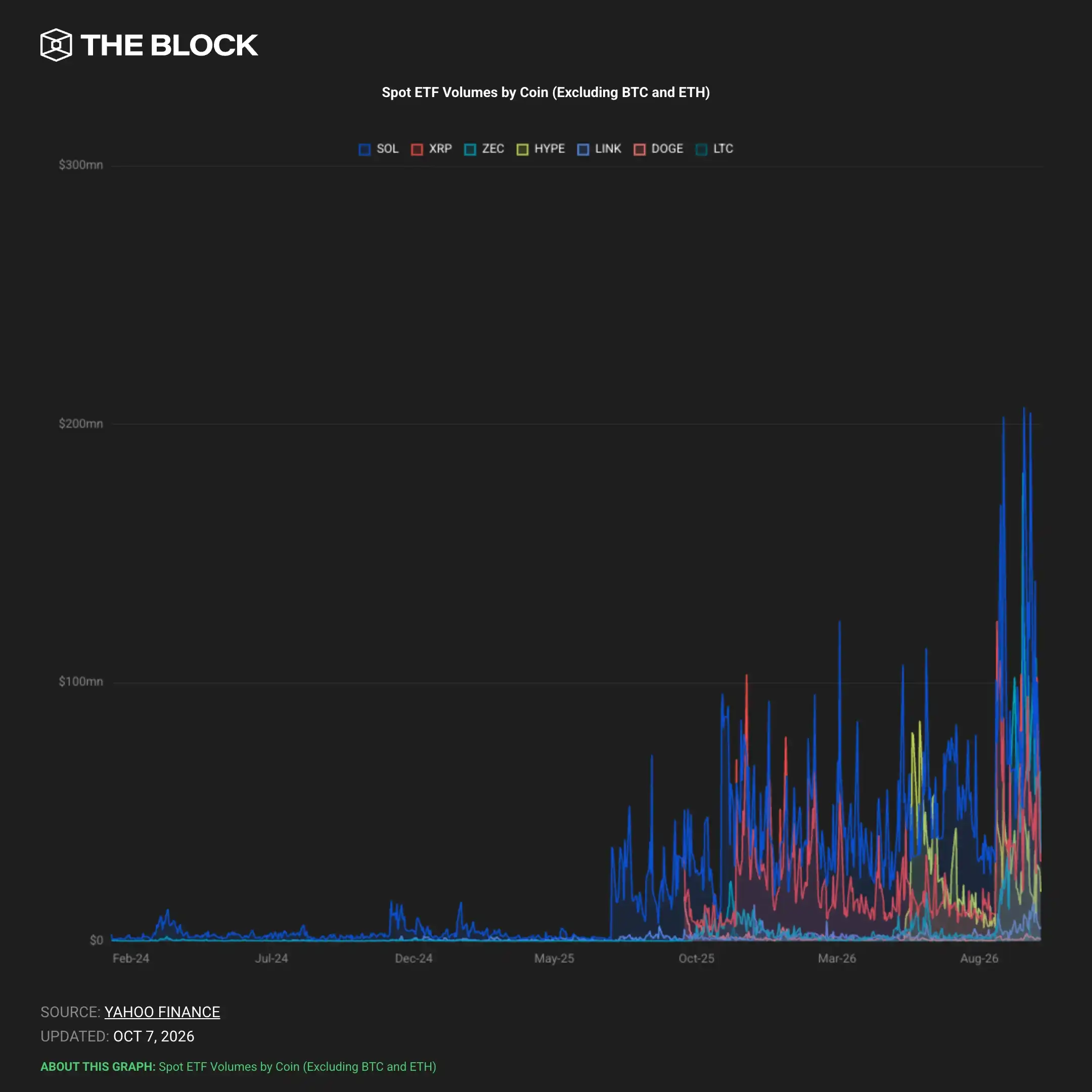
Chart: Trading volume for spot ETFs by coin (excluding BTC and ETH). Source: The Block/Yahoo Finance.
Lynch oversees the trading desk that sources or sells the underlying tokens for every subscription and redemption across Grayscale's ETF product line. She said her role now extends to business development and investor education.
"At Token2049, everyone is deeply embedded in the small world of crypto, but many of our conversations actually revolve around 'What is Bitcoin? What is Ethereum?'" she said. "You have to start from the very basics."
Lynch said that as the ETF market expands, Grayscale is also looking beyond traditional fund structures. Following the SEC's introduction of an innovation exemption, the firm submitted applications last week to tokenize two products established under the Investment Company Act of 1940: a Bitcoin covered call fund and an Ethereum covered call fund. Lynch described this innovation exemption as a "consolation prize" after the Clarity Act failed to pass.
"Of course, we are unhappy and disappointed that the Clarity Act did not pass, but once you get past the fact that 'it didn't pass,' in some ways it's actually clearer because it's no longer an open question," Lynch said.
Nevertheless, Lynch stated that the SEC's exemption still provides a path for the industry to advance tokenization. Last month, Grayscale, along with several other crypto companies, urged the SEC to accelerate ETF reviews and allow confidential submissions of registration drafts.