Bitcoin short-term holders hit 30-day profit streak as bull-market odds improve: CryptoQuant

cointelegraphPublished on 2026-09-15Last updated on 2026-09-15

Abstract

According to CryptoQuant analysis, Bitcoin short-term holders (STHs) have maintained a profit streak for 30 consecutive days as of mid-September 2026, marking the longest such period of the year. STHs, defined as wallets holding Bitcoin for less than six months, currently hold $168.2 billion in profit versus $102.6 billion in loss. Analysts view this sustained profitability as a key historical indicator for a potential bull-market reversal, similar to patterns seen at the end of the 2022 bear market. The broader Bitcoin investor base has also been in net profit since August 19. Data shows the cost basis for newer STHs (1-3 month holders) is $63,372, while for more mature STHs (3-6 month holders) it is $73,190, suggesting investor confidence is clustering above the $70,000 level as Bitcoin retains most of its gains from a 25% August rally.

Bitcoin (BTC) speculators have held onto profits for nearly a month in what new analysis sees as a key sign of market strength.


Key points:


  • Bitcoin short-term holders were in partial profit for the past month, marking the longest consecutive in-profit stint of 2026.
  • STH profitability — a historical hallmark of bullish BTC price reversals — currently stands at $168.2 billion in profit versus $102.6 billion in loss.
  • The broader Bitcoin investor base has stayed in net profit since Aug. 19.


Short-term holders boost optimism over BTC price comeback


Data from onchain analytics platform CryptoQuant shows that a subset of Bitcoin’s short-term holder (STH) cohort has been in profit since Aug. 16.


STH investors are wallets holding an unspent transaction output (UTXO) for less than six months. They correspond to newer buyers who are more sensitive to short-term price moves and volatility, adding or reducing exposure more readily than seasoned Bitcoin holders.


Since Aug. 16, the STH investor base has been split in terms of profits on their existing exposure. STH coins held in profit total $168.2 billion as of Tuesday, while $102.6 billion are held below acquisition price.
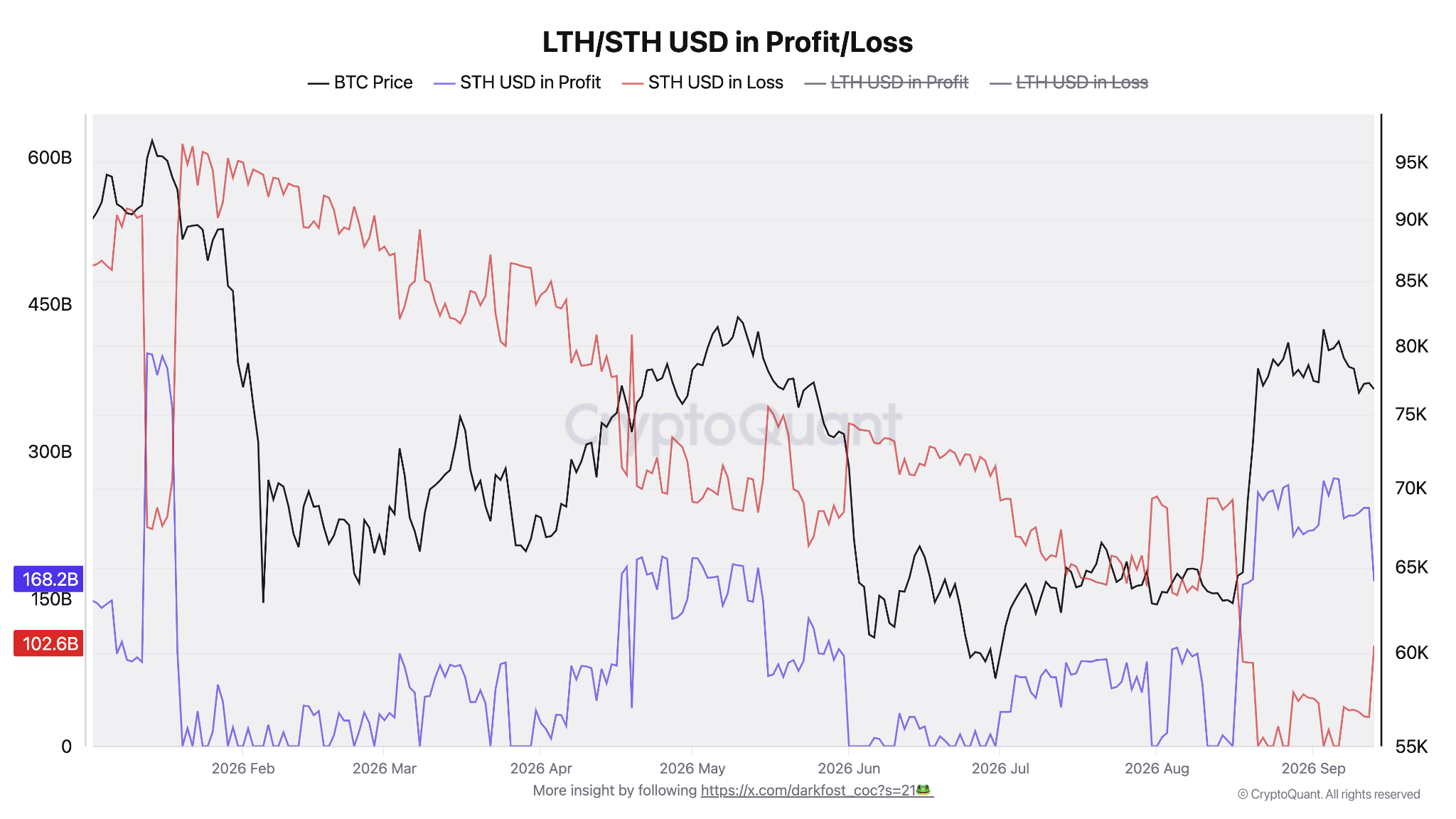

Bitcoin STH holdings in profit and loss. Source: CryptoQuant


To CryptoQuant, however, the ratio is less important than the fact that STHs have held onto at least some profit for 30 consecutive days.


“This is the first time STH have sat in profit territory for a sustained stretch since the market top. The last time was in January, but that episode didn’t last more than a week. In May, losses held by STH remained dominant,” it wrote in an accompanying blog post.


The phenomenon of lengthening uninterrupted periods of STH profitability is one that has characterized Bitcoin market recoveries throughout BTC price cycles. It was also observed at the end of Bitcoin’s 2022 bear market. CryptoQuant thus sees it as a prerequisite for the return of a long-term BTC price uptrend this cycle.


“The bear market trend only truly reverses once profits settle in for good STH and then push them to hold their positions and ride the upside,” it added.
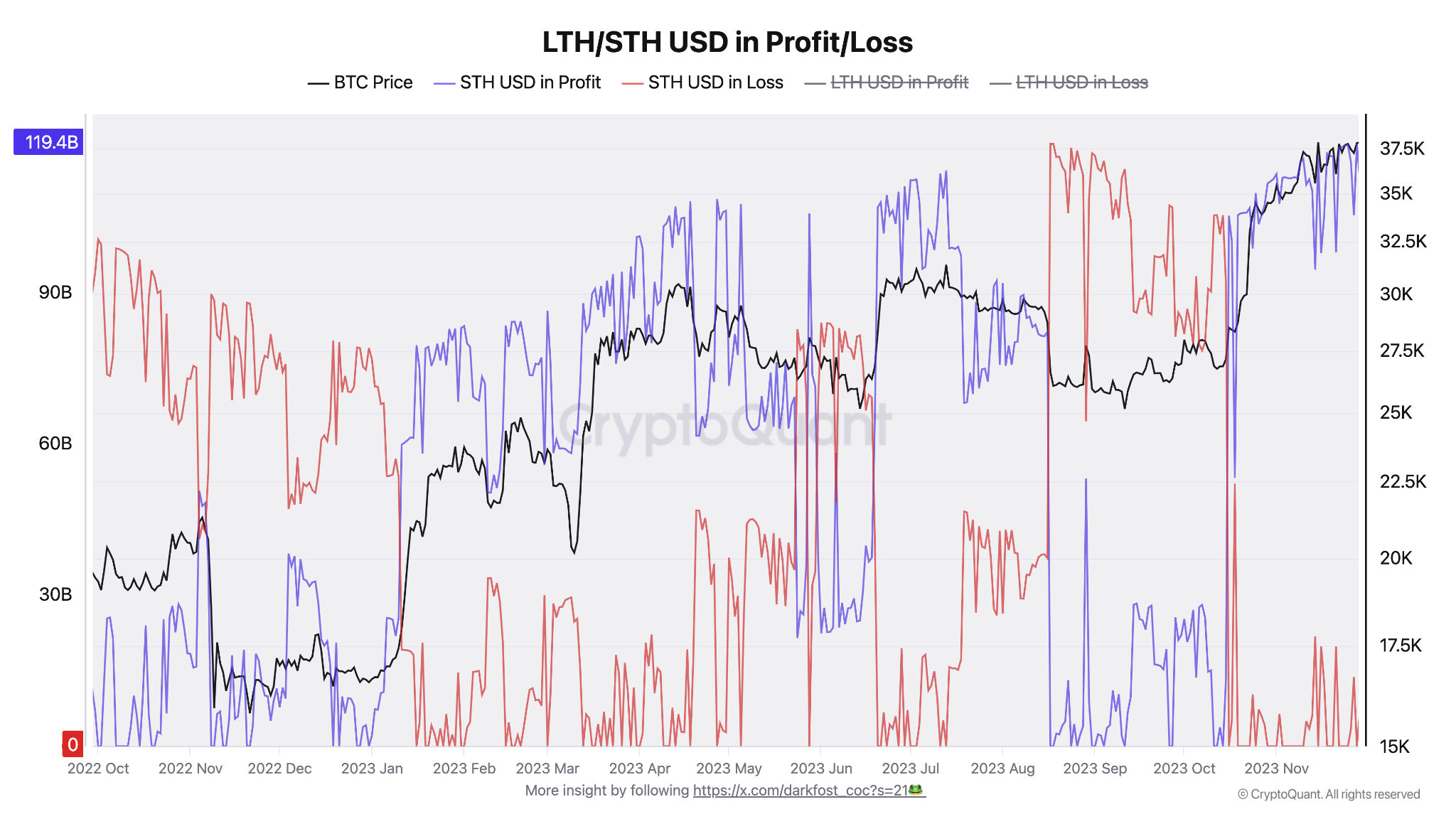

Bitcoin STH holdings in profit and loss through year-end 2023. Source: CryptoQuant


Newer investor cost bases cluster above $70,000


The data echoes a similar stint of aggregate profitability currently being witnessed across the Bitcoin investor base as BTC/USD retains the majority of its 25% August upside.


Related: CLARITY Act vote meets Fed rate hike: Five things to know in Bitcoin this week


As Cointelegraph reported, the spent output profit ratio (SOPR), which tracks net profits or losses across all investors, passed its breakeven level of 1 on Aug. 19 and has narrowly held above it since. Last week, onchain analytics suite Checkonchain argued that STH profitability in particular was “starting to look more like those early bull-market recoveries.”


STH profitability is currently being driven by entities holding between one and three months, CryptoQuant data shows, with that cohort having a cost basis (also known as realized price) at $63,372. The cost basis of the more mature end of the STH base — wallets holding for between three and six months — now sits at $73,190.
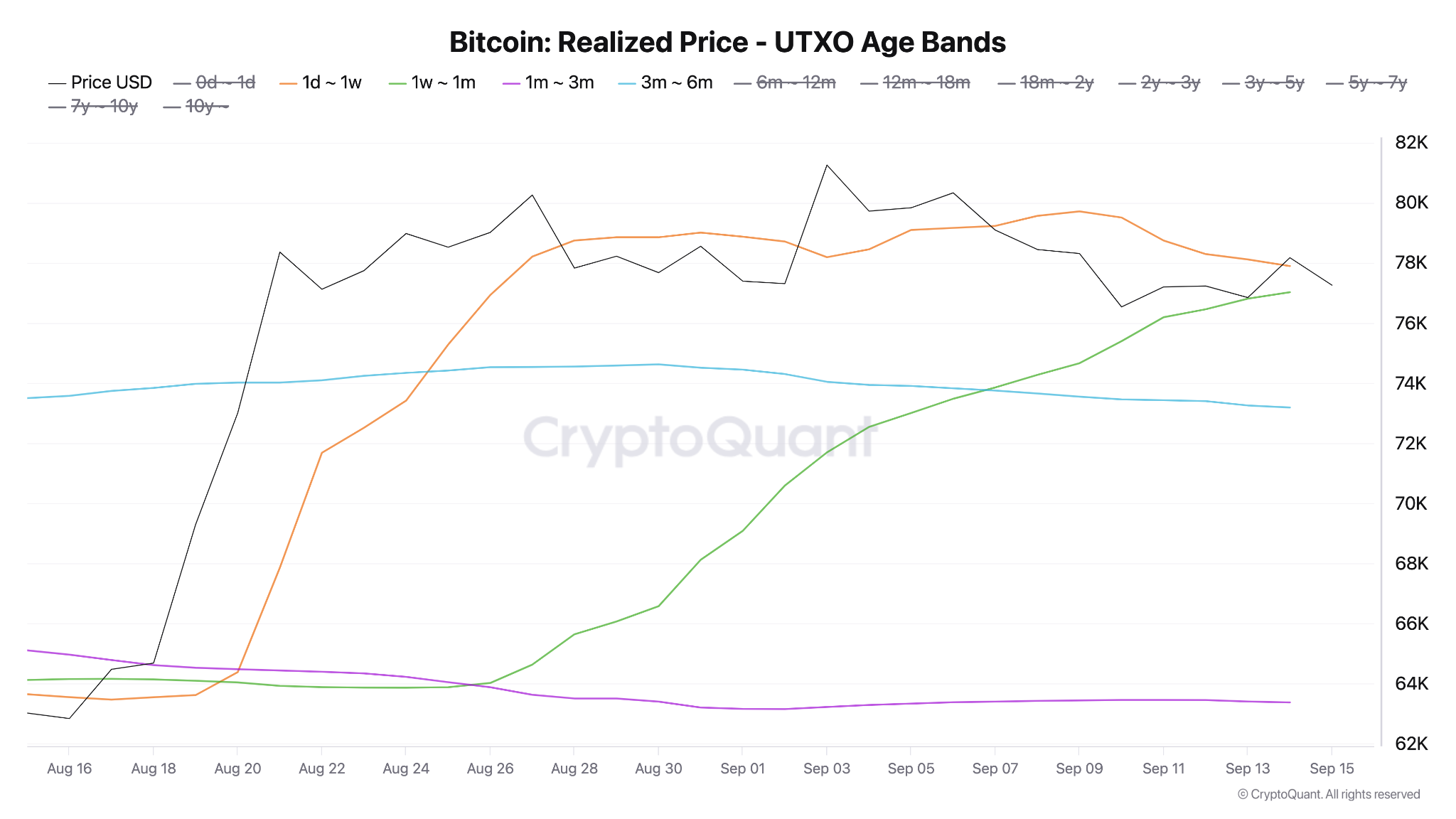

Bitcoin realized price by wallet age. Source: CryptoQuant


Related Questions

QWhat is a key indicator of market strength for Bitcoin according to the CryptoQuant analysis?

AA key indicator of market strength is that Bitcoin short-term holders (STH) have been in partial profit for 30 consecutive days, marking the longest such streak in 2026. Historically, sustained periods of STH profitability have signaled bullish price reversals.

QHow are 'short-term holders' (STH) defined in the context of this article?

AShort-term holders (STH) are defined as Bitcoin wallets holding an unspent transaction output (UTXO) for less than six months. They typically represent newer buyers who are more sensitive to short-term price moves and volatility.

QWhat is the current profit versus loss status for Bitcoin held by short-term holders as of the article's data?

AAs of the data referenced, Bitcoin held in profit by short-term holders totals $168.2 billion, while $102.6 billion is held at a loss (below acquisition price).

QWhy does CryptoQuant consider the lengthening period of STH profitability significant for the market cycle?

ACryptoQuant sees it as significant because lengthening uninterrupted periods of STH profitability have historically characterized Bitcoin market recoveries and the end of bear markets. It is considered a prerequisite for the return of a long-term BTC price uptrend, as it encourages these holders to maintain their positions and ride the market upside.

QWhat are the reported cost bases for the two key segments within the short-term holder cohort?

AAccording to CryptoQuant data, the cost basis (realized price) for STH wallets holding Bitcoin for one to three months is $63,372. For the more mature segment holding for three to six months, the cost basis is $73,190.

Related Reads

OpenAI launches AI payments in ChatGPT with Visa, Mastercard and Amex

OpenAI launched a feature letting AI agents make purchases for users directly within ChatGPT through existing payment networks, in partnership with American Express, Mastercard, and Visa. The wallet uses biometric verification like facial recognition or fingerprints to authorize transactions, and payment networks generate tokenized card credentials for each approved purchase, keeping users' actual card details from merchants and AI agents. The service is rolling out to ChatGPT Pro subscribers in the US with eligible US-issued cards, with plans to eventually support purchases within preset spending limits and other restrictions without requiring approval for each transaction. The launch reflects AI companies moving beyond product recommendations into executing transactions, potentially changing how consumers interact with online merchants. OpenAI is working with payment processors and fraud prevention firms to support AI purchases through existing checkout systems. It joins a growing field: Google introduced its Agent Payments Protocol in 2025, Visa and Mastercard have launched AI transaction initiatives, and crypto companies like Coinbase (x402 protocol), Circle (Agent Stack), and Crossmint are building payment infrastructure for AI agents. Global agentic commerce transaction value is expected to reach $1.5 trillion by 2030, up from an estimated $8 billion in 2026, according to Juniper Research.

cointelegraph1h ago

OpenAI launches AI payments in ChatGPT with Visa, Mastercard and Amex

cointelegraph1h ago

Kraken parent Payward gains market share as slower trading weighs on earnings

Kraken parent Payward nearly doubled its share of global crypto spot trading to 6.5% in September from 3.3% a year earlier, even as weaker trading activity weighed on earnings. The market-share gain reflects a larger portion of spot trading relative to competitors rather than increased activity; the company handled $353 billion in transactions in Q3, down 30% year over year. Adjusted EBITDA fell to $60 million from $178.6 million a year earlier, and total platform margin fell 12% to $487 million. Payward has spent two years expanding beyond its core exchange through acquisitions in derivatives, proprietary trading, tokenized assets and payments, including NinjaTrader, Breakout, Bitnomial and Reap. Derivatives contracts with per-contract fees rose 84% to 66 million, and margin from subscriptions and other paid services rose 59% to $125 million. Results improved from Q2, with total transaction volume up 22% and platform margin up 12% to $487 million from $436 million. Margin from customer-held assets, including staking, rose 26% to $128 million, accounting for roughly half the quarterly increase. Adjusted EBITDA climbed to $60 million from $23 million, though it remained down 66% year over year. Asset- and access-based services accounted for 52% of total platform margin, up from 46%. Payward confidentially filed for a US IPO in November 2025 but paused plans in March; the earliest potential listing window under consideration was Q2 2027.

cointelegraph2h ago

Kraken parent Payward gains market share as slower trading weighs on earnings

cointelegraph2h ago

Metaplanet swings to $170M loss as Bitcoin sale hits earnings

Metaplanet, the world's second-largest publicly traded corporate Bitcoin holder, reported a net loss of 27.16 billion yen (about $170 million) in the first nine months of 2026, compared with a profit of 13.53 billion yen ($84.6 million) a year earlier. The loss was driven by a 19.17 billion yen ($119.8 million) loss on the sale of 10,000 BTC and an 8.04 billion yen ($50.3 million) loss from a decline in the value of its Bitcoin holdings, which outweighed gains in its operating business. During the quarter, Metaplanet sold 10,000 BTC for 124.7 billion yen, temporarily held the proceeds in cash, stablecoins and other liquid assets, then spent 149.9 billion yen to buy 11,000 BTC at an average price 9.3% higher per coin. The company said the sale was intended to demonstrate to rating agencies and bond investors that it could convert Bitcoin into cash to meet financing obligations. Holdings ended September at 44,000 BTC, a net increase of 1,000 coins. Metaplanet borrowed against its Bitcoin during the quarter, raising its credit line debt to $649.5 million at the end of September from $414 million at the end of June. It funded purchases from the second quarter onward with borrowed funds, bond proceeds, exercised stock acquisition rights and revenue from its Bitcoin options business. Interest expense rose 56% quarter over quarter to 1.36 billion yen ($8.5 million), and short-term borrowings and bonds payable totaled 110.5 billion yen ($691 million). For the nine months through September, revenue rose 30.5% to 5.9 billion yen ($36.9 million) and operating profit increased 26.5% to 3.48 billion yen ($21.8 million). The company cut its full-year revenue forecast to 6.5 billion yen ($40.6 million) from 16 billion yen ($100 million). The results come as Bitcoin treasury companies face pressure from falling prices and index removals; MSCI confirmed Strategy, Metaplanet and Upexi will be removed from its equity indexes at the Nov. 30 market close. Bitcoin fell below $70,000 on Friday, trading around $68,600, down about 9% over the previous week.

cointelegraph5h ago

Metaplanet swings to $170M loss as Bitcoin sale hits earnings

cointelegraph5h ago

Trading

Spot
活动图片