Author:Rita
Bank of America's October Global Fund Manager Survey shows cash levels at 3.9%, still in sell-signal territory. 37% of investors say a 10-year Treasury yield of 6.0% would prompt a shift from stocks to bonds. The market is optimistic but crowded, with bond yields and AI capex posing the biggest risks.
The survey covered 185 fund managers overseeing $512 billion in assets. Investors are optimistic on the macro outlook, but growth expectations have turned negative, and inflation expectations have fallen to their lowest since January 2025. The most crowded trades are long global semiconductors (45%) and short US Treasuries (27%).
Disorderly rise in bond yields is seen as the biggest tail risk (31%), followed by an AI bubble (23%). AI hyperscaler capital expenditure is viewed as the most likely source of a credit event (39%). 57% say they will not cut AI capex in the next 6 months, but 30% expect to, up from 14%.
Cash at 3.9% Remains in Sell Territory
Cash levels are at 3.9%, unchanged from last month, above the August low of 3.5% but below the April 2025 high of 4.8%. BofA's cash rule indicates cash ≤4.0% is a sell signal. Equity allocation is net 44% overweight, down from 49% last month. Bond allocation is net 37% underweight, an improvement from last month's 48% underweight. Investors are waiting for higher yields to shift to bonds.
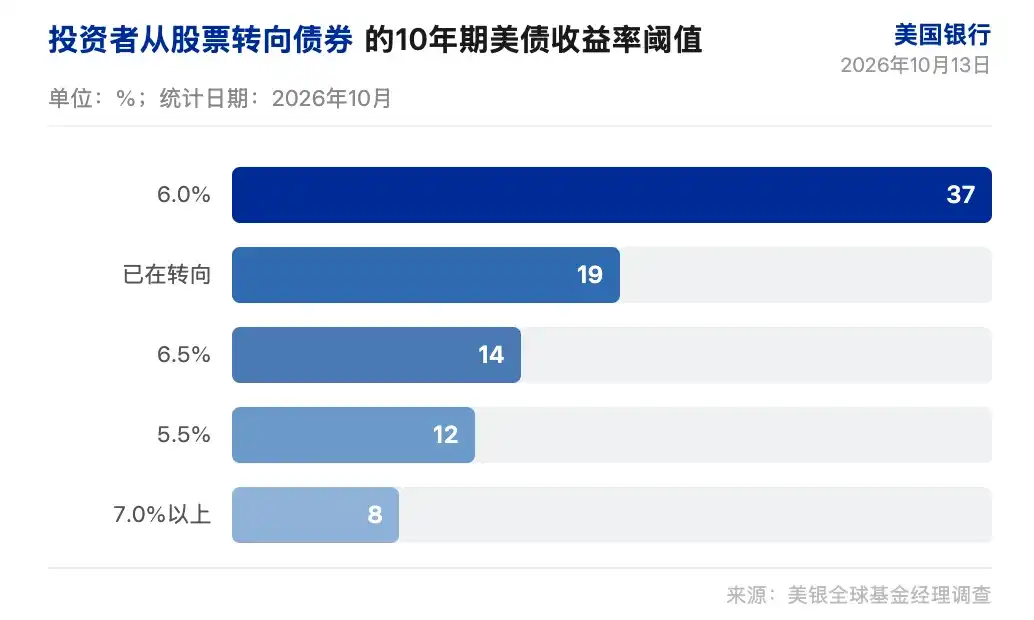
37% of investors say a 10-year Treasury yield of 6.0% would make them switch from stocks to bonds. 19% say they are already switching, 14% say 6.5%, 12% say 5.5%, and 8% say 7.0% or higher. The yield threshold is clustered around 6.0%.
Investor pessimism towards bonds has dropped to its lowest since May 2025. A net 1% expect long-term rates to rise, down from 15% last month. Bond underweight improved from 48% to 37%. BofA believes bond allocations may continue to recover.
Semiconductors Become Most Crowded Trade
45% of investors say long global semiconductors is the most crowded trade, down from the July peak of 82%. Short US Treasuries is at 27%, up from 18% last month. Tech is net 37% overweight, the highest since August 2020. Bank allocation fell 21 percentage points to net 13% overweight, the largest drop since March 2023. Consumer Discretionary is net 34% underweight, the largest underweight since July 2008.
Tech overweight is at its highest since August 2020. Bank allocation saw a significant decline, from net 34% overweight to net 13% overweight. Consumer Discretionary underweight is the largest since July 2008. Investors are making a clear choice between tech and banks.
Crowded trades are concentrated in semiconductors and shorting US Treasuries. BofA believes the risk of crowded trades is a sharper reversal. Crowding in semiconductors and short Treasuries remains high, but semiconductor crowding has retreated from its July peak.
Expectations for AI Capex Cuts Heat Up
57% say they will not cut AI capex in the next 6 months, while 30% say they will, up from 14%. 39% believe AI hyperscaler capex is the most likely source of a credit event. 45% believe there will be an AI bubble by 2027, while 42% believe there won't. Growth expectations: a net 4% expect the economy to weaken, compared to a net 8% expecting strength last month. Inflation expectations: a net 5% expect lower CPI.
Expectations for AI capex cuts have risen from 14% to 30%. Concerns about an AI bubble are rising, with 45% expecting one by 2027. Growth expectations have turned negative, with a net 4% expecting weakness. Inflation expectations have fallen to their lowest since January 2025, with a net 5% expecting lower CPI.
BofA believes AI capex and bond yields are two major risks. AI capex cuts could impact semiconductor and tech stocks. A disorderly rise in bond yields could trigger an asset allocation shift.
Bond Yields Seen as Biggest Tail Risk
31% see a disorderly rise in bond yields as the biggest tail risk, 23% choose AI bubble, 20% choose secondary inflation, and 11% choose hyperscaler credit events. 76% expect the Fed to hold rates on October 28th. 45% believe a Democratic sweep would lead to higher bond yields and lower stocks. In terms of allocation, investors increased bonds, Japanese and UK stocks, and utilities, while reducing banks, US stocks, and consumer discretionary.
Disorderly bond yield rise remains the top tail risk for another month. AI bubble and secondary inflation follow closely. 76% expect no hike in October. Under a Democratic sweep scenario, 45% expect higher yields and lower stocks.
The rotation has already begun. Investors added bonds, Japanese and UK stocks, and utilities, while cutting banks, US stocks, and consumer discretionary. US stock overweight fell from 25% to 11%. Japanese stocks shifted from net 1% underweight to net 9% overweight. UK stock underweight improved from 35% to 26%.
Rotation Has Already Begun
In October, investors increased bond allocation, with bond underweight improving from 48% to 37%. Japanese stocks shifted from net 1% underweight to net 9% overweight. UK stock underweight improved from 35% to 26%. US stock overweight fell from 25% to 11%. Tech overweight rose to 37%. Contrarian trades: long bonds, REITs, consumer discretionary/staples; short stocks, tech, banks, emerging markets.
Bond allocation improved, with Japanese and UK stocks receiving inflows. US stock overweight declined, while tech overweight rose. Contrarian trades point to bonds, REITs, and consumer sectors. BofA believes the rotation reflects investor concerns over bond yields and AI risks.
BofA recommends long bonds, REITs, consumer sectors, and short stocks, tech, banks, emerging markets. Cash at 3.9% is low, crowded trade risks are building, and the rotation has already begun.

Disclaimer
This article is a summary and interpretation by Chaoxiang Research of a third-party brokerage research report (Bank of America, October 13, 2026), combined with publicly available market information. The ratings, price targets, earnings forecasts, and related judgments cited are the views of that brokerage's analysts, representing only the stance of their institution, and do not represent the views of Chaoxiang Research, nor do they constitute any investment advice.
The market carries risks, and decisions should be made independently. This article should not be used as a basis for trading any securities.