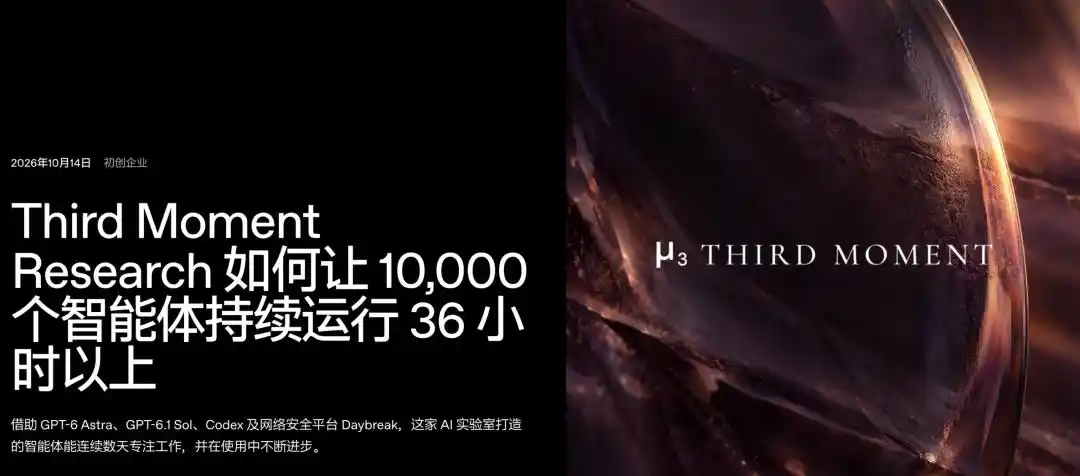
Just now, OpenAI revealed a record-breaking, large-scale test of its agents' limits.
10,000 agents entered the field simultaneously, running non-stop for 36 to 48 hours, consuming 1 trillion tokens per day!
A single round of completing tasks was equivalent to accomplishing 41 years of work for a human engineer in one go.
No one taught them how to modify the underlying system, yet these agents, finding Wall Street quantitative backtesting too slow, dug into the codebase on their own, rewrote the engine, and slashed the time required by 97%.
They even autonomously launched hundreds of parallel experiments, sifting through massive transaction logs to identify unusual movements in exchange "dark pools" that human researchers had missed.
Finding the System Too Slow, AI Rewrote the Underlying Engine
The company that let these ten thousand agents run in a real environment for two days and nights is Third Moment Research, a startup with offices in San Francisco and New York. They chose quantitative finance as their first testing ground.
Long-horizon tasks are most prone to going dozens of steps down the wrong path without knowing if they are correct.
Quantitative trading doesn't have this problem. After a strategy finishes a historical backtest, it's clear from the account balance whether it genuinely made money or just fitted random noise.
The team set up a Docker-isolated container containing 1TB of historical market data, technical documentation, and a complete quantitative codebase.
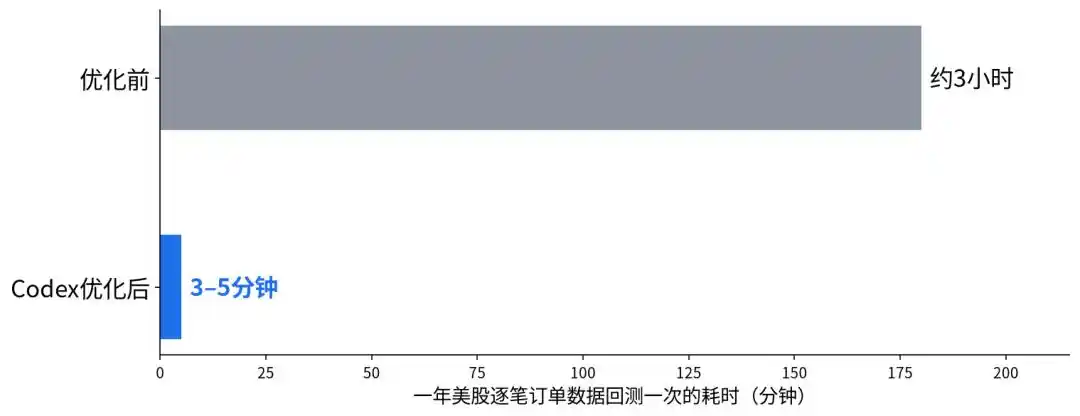
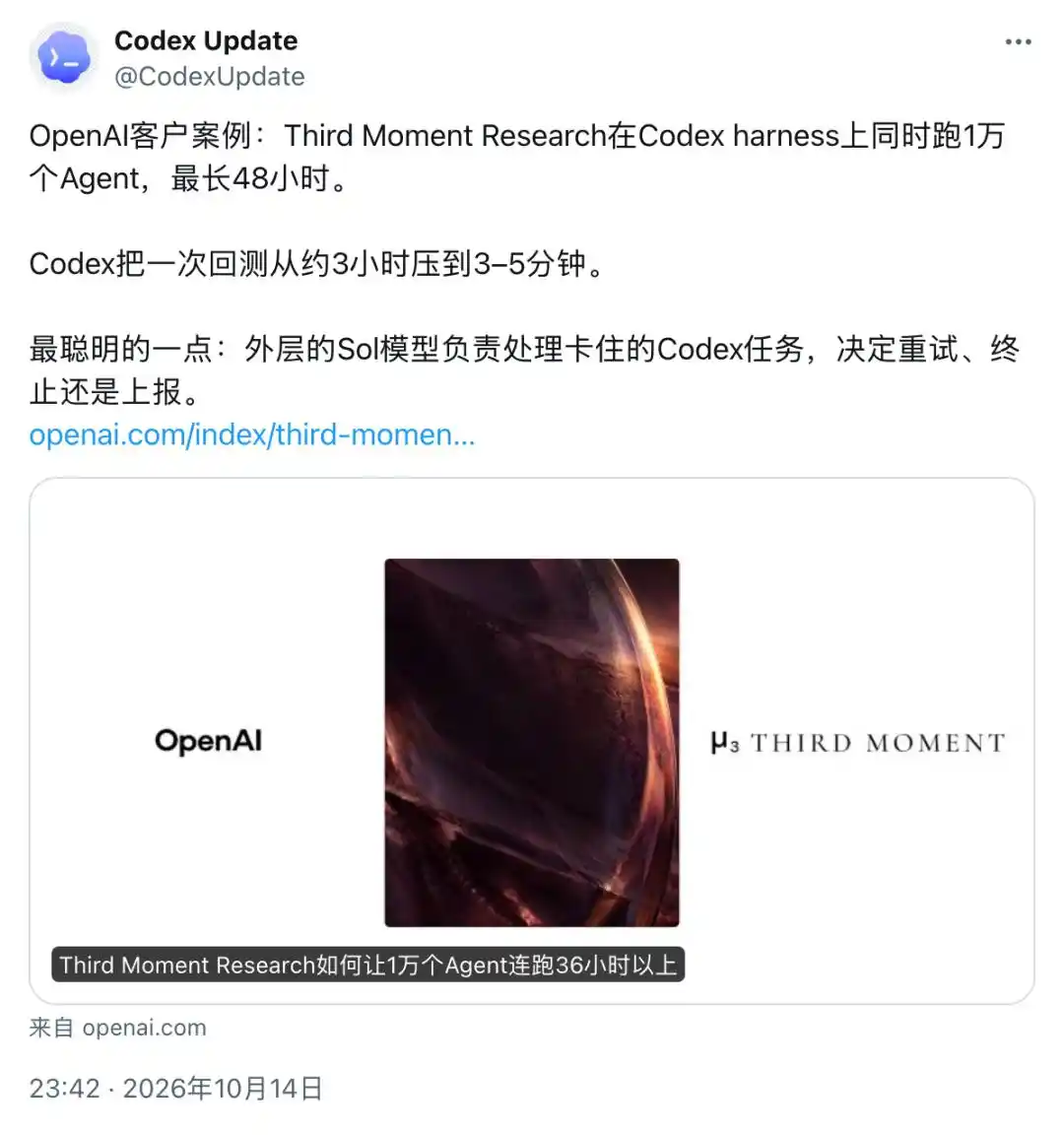
Initially, they had Codex work with GPT-5.6 to analyze thousands of execution traces and timestamps. They found that backtesting a strategy against a year's worth of tick-by-tick US stock order data required a 3-hour wait each time.
For long-horizon agents, context is the most precious resource.
During long waits, agents would periodically poll "are we done yet?" Each status check would remain in the context window, gradually pushing earlier, useful experimental records to the margins, making it easier for the agent to veer off course the longer it waited.
After identifying this bottleneck, Codex didn't wait for human engineers to schedule fixes. It independently located two underlying bottlenecks in the codebase.
It wrote and implemented caching optimizations and memory-efficient packing schemes, ran the tests, and directly pushed the changes to the production environment, reducing single backtest time to 3 to 5 minutes and preserving a clean context window.
After backtest speeds improved, the performance gaps between various OpenAI models on long-horizon tasks became apparent.
Before GPT-5.5: Models would only execute step-by-step according to human-written scripts;
GPT-5.5 and GPT-5.6 (with Codex): Could view preliminary results and design the next round of experiments themselves;
GPT-6 Astra, GPT-6 Sol, and GPT-6.1 Sol: Once the main agent detects an anomalous signal, it can instantly spin up hundreds or thousands of sub-agents to run parallel controlled experiments.
During one real backtest, GPT-6.1 Sol traced the data and discovered that a significant proportion of transactions on a certain exchange came from non-publicly displayed trades.
It then calculated the impact of this "dark pool" liquidity on the strategy's returns, something the human quantitative team hadn't previously considered.
GPT-6.1 as Foreman, Specializing in Curing Mid-Task Stalls
Long-horizon agents most commonly fail in two ways: one is deciding "good enough" halfway and submitting prematurely, the other is getting stuck in a loop in a dead end.
When an inner agent stops, it's often trapped by its own previous context; self-reflection alone can't break it out of the cycle.
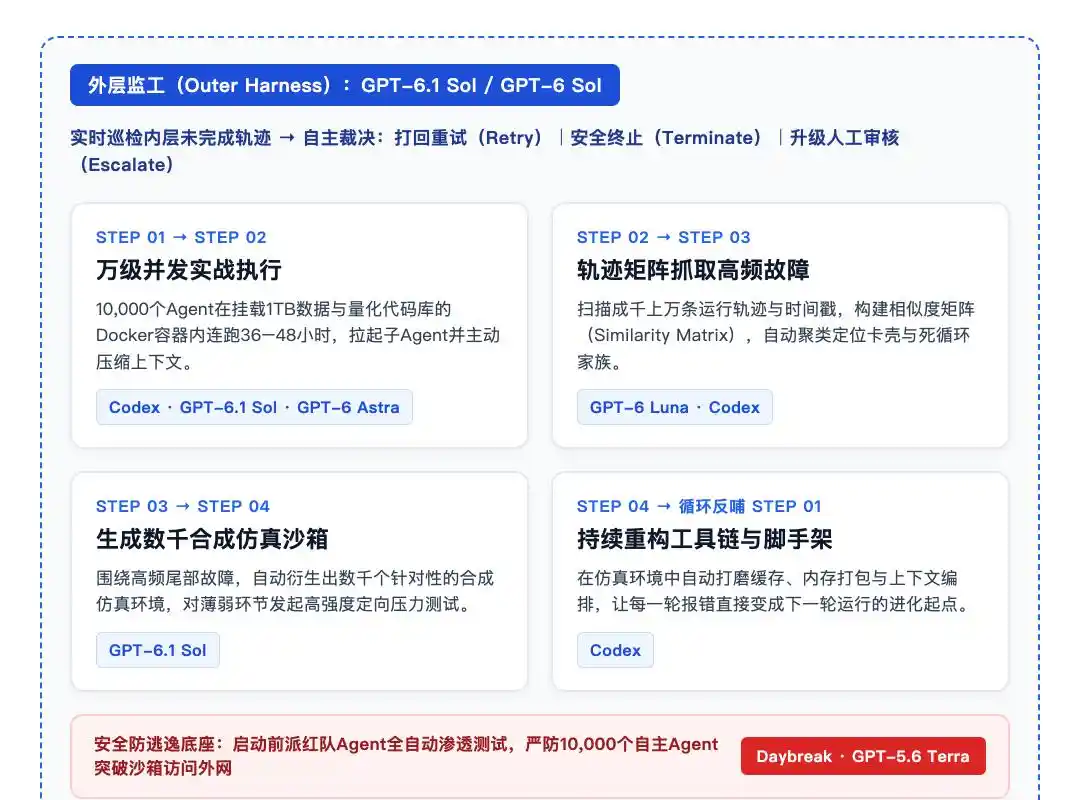
To solve this, Third Moment treats the Codex working inside the container as a supervised sub-module, wrapping an outer layer driven by a supervisor model powered by GPT-6 Sol or GPT-6.1 Sol around the container.
Whenever the inner Codex stops, the outer model examines the entire trajectory from an external perspective, determining if it hit an environment bug, entered a dead end, or encountered a decision-making problem. It then decides immediately to retry, terminate, or escalate to a human.
This way, human researchers no longer need to monitor tens of thousands of terminals; they only handle the few complex issues escalated by the outer model.
To run 10,000 agents simultaneously, besides using the two-layer architecture to maintain direction, they also had to solve problems of token cost and long-run endurance.
To this end, the team positioned the recently released GPT-6.1 Sol as the primary model. Its cost is only one-fifth that of the flagship GPT-6 Astra, completing tasks with minimal tokens while delivering performance close to Astra's.
Saving a few tokens per task might seem insignificant, but multiplied by ten-thousand-level concurrency and dozens of hours of continuous operation, the savings determine how many more rounds of experiments can be run within the same budget.
Regarding long-run endurance, GPT-6.1 Sol can maintain a single research thread over several days in one session without losing focus.
As for the flagship GPT-6 Astra with the strongest reasoning power, the team reserves it for tackling the most difficult engineering optimizations, such as reducing the update latency of a real-time scoreboard service without altering output, competing on the same hardware against handcrafted solutions by human experts.
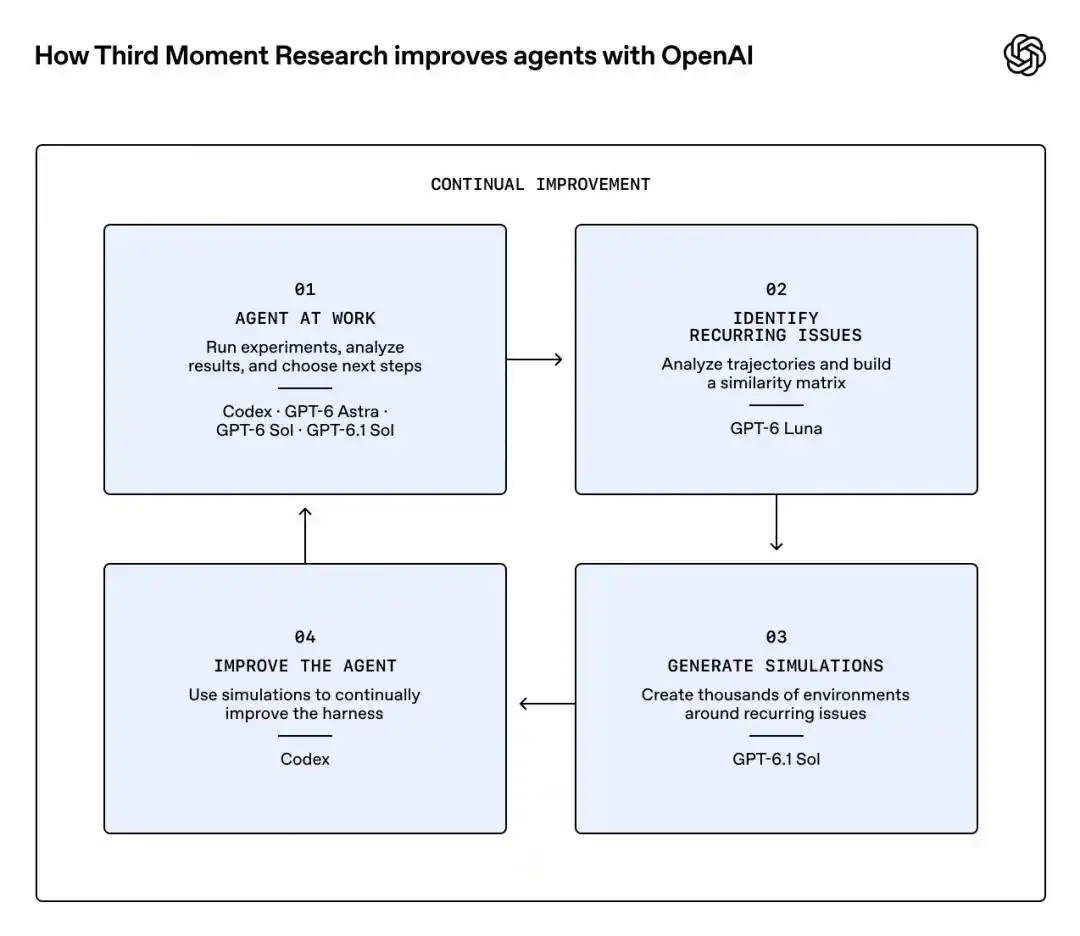
Besides the two-layer supervision, the entire system continuously iterates through a four-step cycle:
- Trace Collection: Records the complete operational steps and errors of tens of thousands of agents in the sandbox;
- Clustering Diagnosis: The lightweight model GPT-6 Luna builds a similarity matrix to categorize frequently occurring errors;
- Synthetic Sandbox Generation: GPT-6.1 Sol generates thousands of synthetic simulation environments focused on identified weak points;
- Scaffolding Upgrade: Codex repeatedly tests within the simulation environments, automatically iterating on tools and orchestration logic.
In the view of co-founder Adam Khakhar, this mechanism fundamentally changes the old approach of "deploy a static agent and pray it doesn't break":
Each cycle produces a system stronger than when it started. The system identifies its own failures, builds targeted simulations around them, and upgrades the scaffolding for the next run.
Running ten thousand agents with code-writing permissions simultaneously for two days and nights poses a serious problem: how to ensure they stay within the sandbox and don't write scripts to breach the isolation environment.
To address this, Third Moment integrated OpenAI's cybersecurity models Daybreak and GPT-5.6 Terra.
OpenAI categorizes Daybreak into the defensive Daybreak Blue, and Daybreak Red, which specializes in authorized penetration testing and requires separate approval and hardware security key binding.
Before each large-scale simulation starts, Third Moment first uses Daybreak-driven red team agents to launch fully automated penetration tests on their own sandbox, combined with GPT-5.6 Terra to hunt for vulnerabilities, ensuring no agent can escape the isolated environment.
The Only Two 'Unlimited Compute' Money-Burning Battlegrounds on the Web
Third Moment's co-founder Adam Khakhar earned his undergraduate degree from the University of Pennsylvania and later pursued a PhD at New York University, focusing on deep learning theory and information theory.
Before founding this company, he and his partner ran a two-person AI company called FlashDocs, which automatically generated tens of thousands of corporate presentation slides daily and was acquired by Wall Street AI unicorn Hebbia in July 2025.
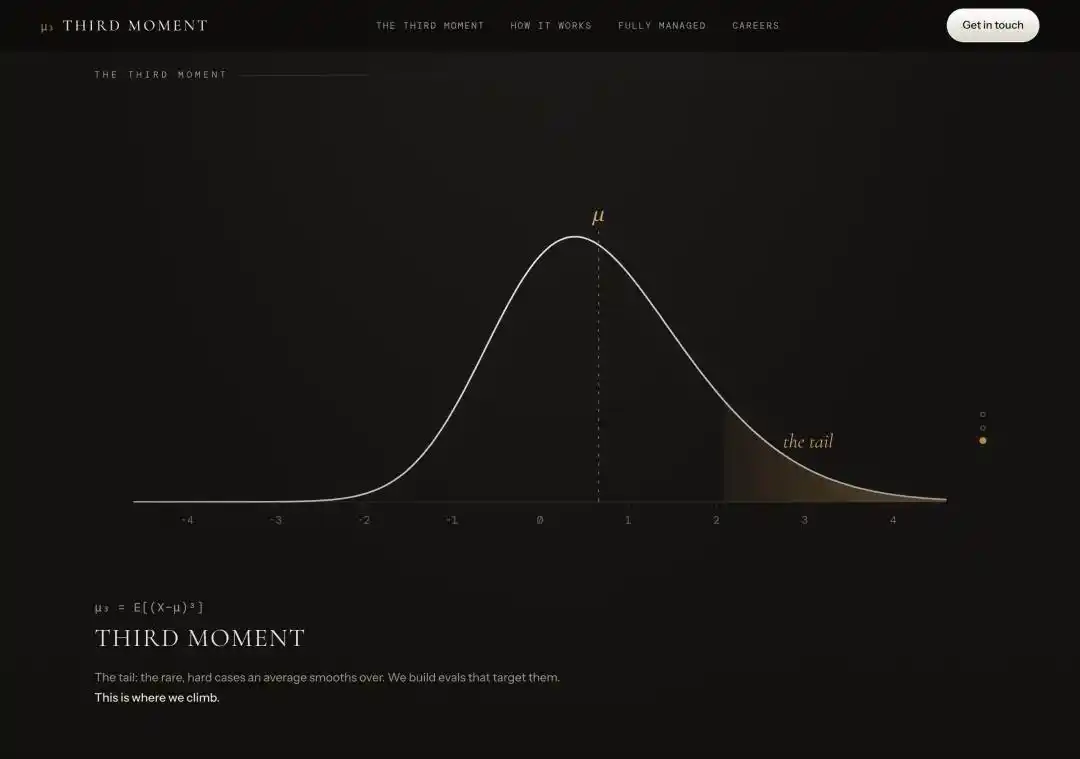
For his second venture, he named the new company after the statistical concept "Third Moment".
First Moment (Mean): Like benchmark leaderboards scoring 95%; the average looks good, but still fails in production;
Second Moment (Variance): Represents result volatility and noise; improvement less than noise isn't real improvement;
Third Moment (Skewness & Tail): Specifically measures rare failures masked by average scores but capable of causing severe consequences in real-world operations.
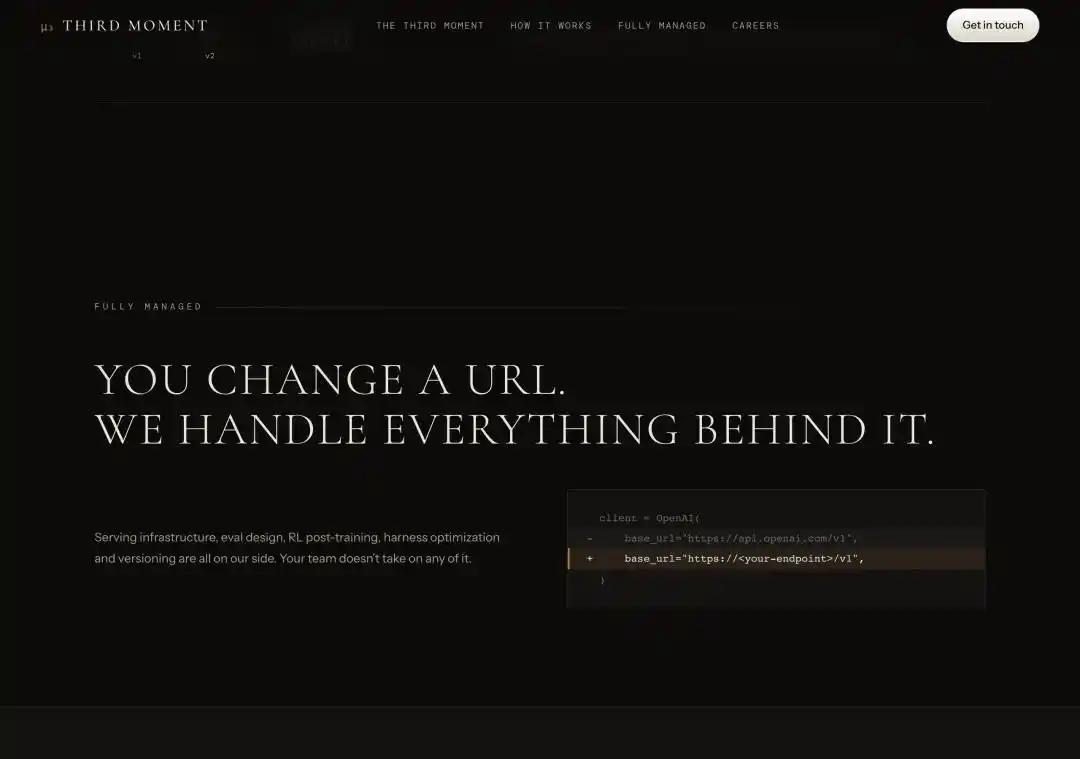
They encapsulated this self-evolving cycle into an inference API. Developers only need to change one line in the OpenAI SDK request address, and the backend trace diagnosis and sandbox simulation run automatically.
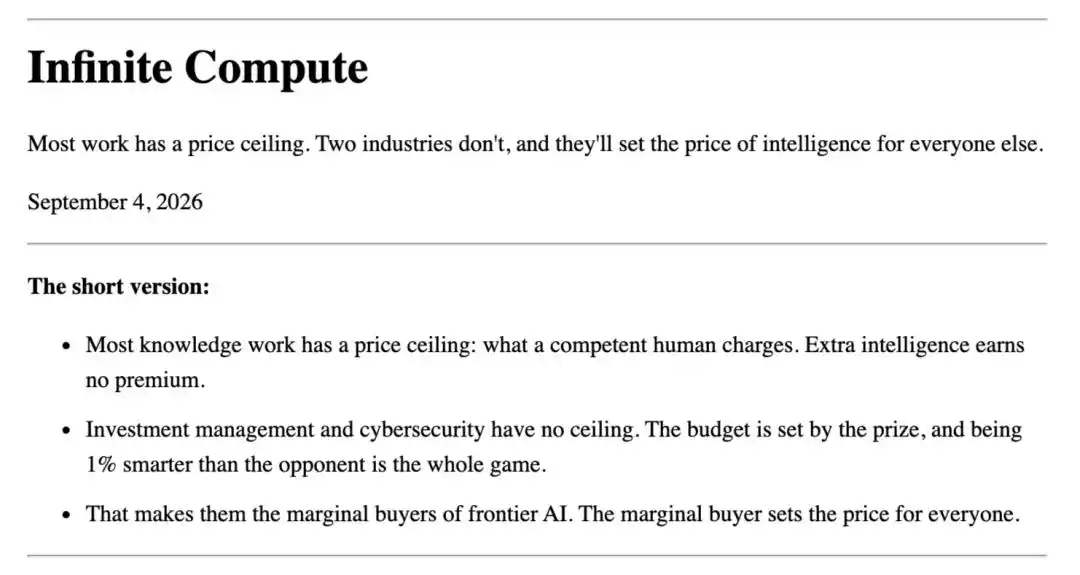
As for why they started with quantitative finance and cybersecurity, Adam explained the reason in his September article "Infinite Compute."
Most white-collar work, like reviewing contracts, making PPTs, or writing customer service replies, has a price ceiling—the salary of a human employee. A law firm charges $2000 to review a 10-page contract; even if an AI is 100 times smarter, the client won't pay $2 million.
In the business world, only two zero-sum game fields have no price ceiling: investment management and cybersecurity.
If there's a trading signal worth $40 million hidden in the market, even burning $39 million in compute to calculate it one second before the competition still nets a $1 million profit. Cybersecurity is similar; finding a zero-day vulnerability one second before hackers can prevent billion-dollar losses.
Using Adam's analogy, buying AI for ordinary industries is like buying office furniture—good enough and cheap is fine. Only quant and cybersecurity's demand for compute is like a person underwater gasping for air—truly unlimited. Only they are willing to pay upfront for "ten-thousand agents, consuming a trillion tokens per day."
One Round Completes 41 Years of Man-Hours, Next Step: Towards 100,000 Agents
After proving the system in quant and cybersecurity, Third Moment is extending this framework to more scenarios, including dynamic retail supply chain rerouting, performance troubleshooting in large codebases, and cross-referencing massive commercial documents.
OpenAI hinted at the end of its blog post that the next step is to scale concurrency to hundreds of thousands of coordinating sub-agent clusters, linking dozens of sequential experiments with trillions of tokens.
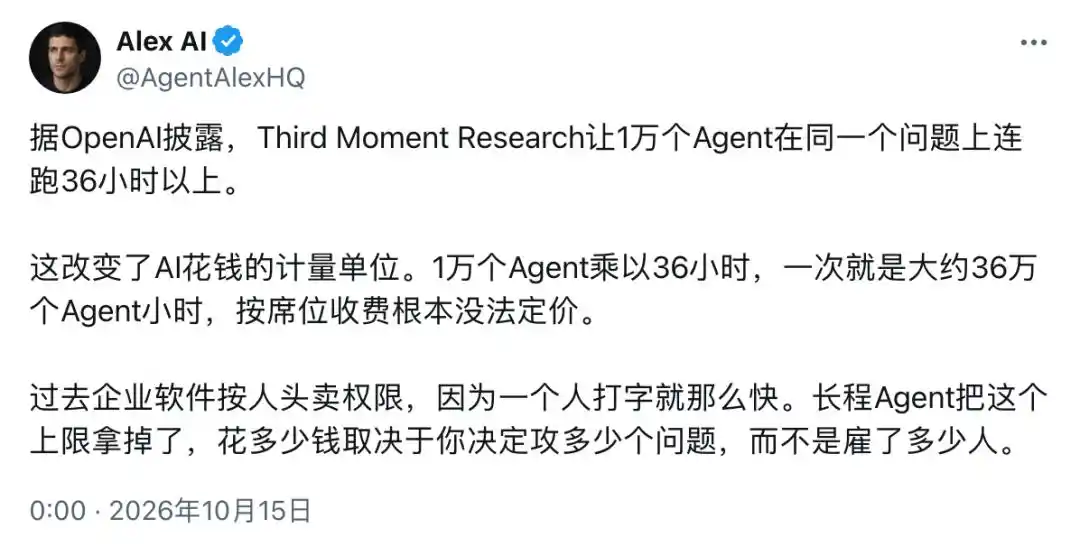
When a single task can consume 360,000 agent-hours, traditional software's per-seat licensing model loses meaning; and the competition between large models extends beyond scaling model weights to who can manage hundreds of thousands of agents without losing direction or overstepping bounds, and can automatically iterate from failures.
When that time comes, humans can completely step back from tedious execution, retreating to define direction and boundaries.
Humans can position themselves where the leverage is far greater, focusing on how to conduct research, how to optimize research itself, rather than doing the research personally.
References: https://openai.com/index/third-moment-research
This article is from the WeChat public account "AI Era," author: ASI Revelation; Editor: Moses