Google's $85 Billion Secondary Offering Breaks Historical Record, Buffett Invests $10 Billion in AI Infrastructure

marsbitPublished on 2026-06-09Last updated on 2026-06-09

Abstract

Alphabet (Google) has completed a record-breaking $847.5 billion equity offering, the largest in history. The funds are earmarked for AI infrastructure, with Alphabet's 2026 capital expenditure guidance raised to $180-190 billion. The complex financing structure included public offerings, convertible notes, and a $100 billion private placement to Warren Buffett's Berkshire Hathaway, seen as a major vote of confidence from value investors. Alphabet's move comes amid strong Q1 2026 results, with revenue hitting $110 billion and cloud backlog surpassing $460 billion. This offering signals the start of a massive AI funding supercycle. SpaceX is set for a $750 billion IPO, while AI giants Anthropic and OpenAI have also confidentially filed for public listings targeting trillion-dollar valuations. Analysts estimate total AI-related equity issuance in 2026 could reach $400 billion, dwarfing previous records. The flood of supply raises questions about market absorption, with historical data showing significant post-IPO pullbacks. Some advise investors seeking AI exposure to consider established players like Alphabet, which offers growth potential with comparatively lower risk than pure-play AI startups.

Author: Claude, Shenchao TechFlow

Shenchao TechFlow Insight: Alphabet priced $84.75 billion in equity financing on June 2nd, breaking Petrobras's 2010 record of $70 billion. The initial offering plan was $40 billion but expanded to $45 billion due to oversubscription; Berkshire Hathaway's $10 billion private placement anchored institutional confidence.

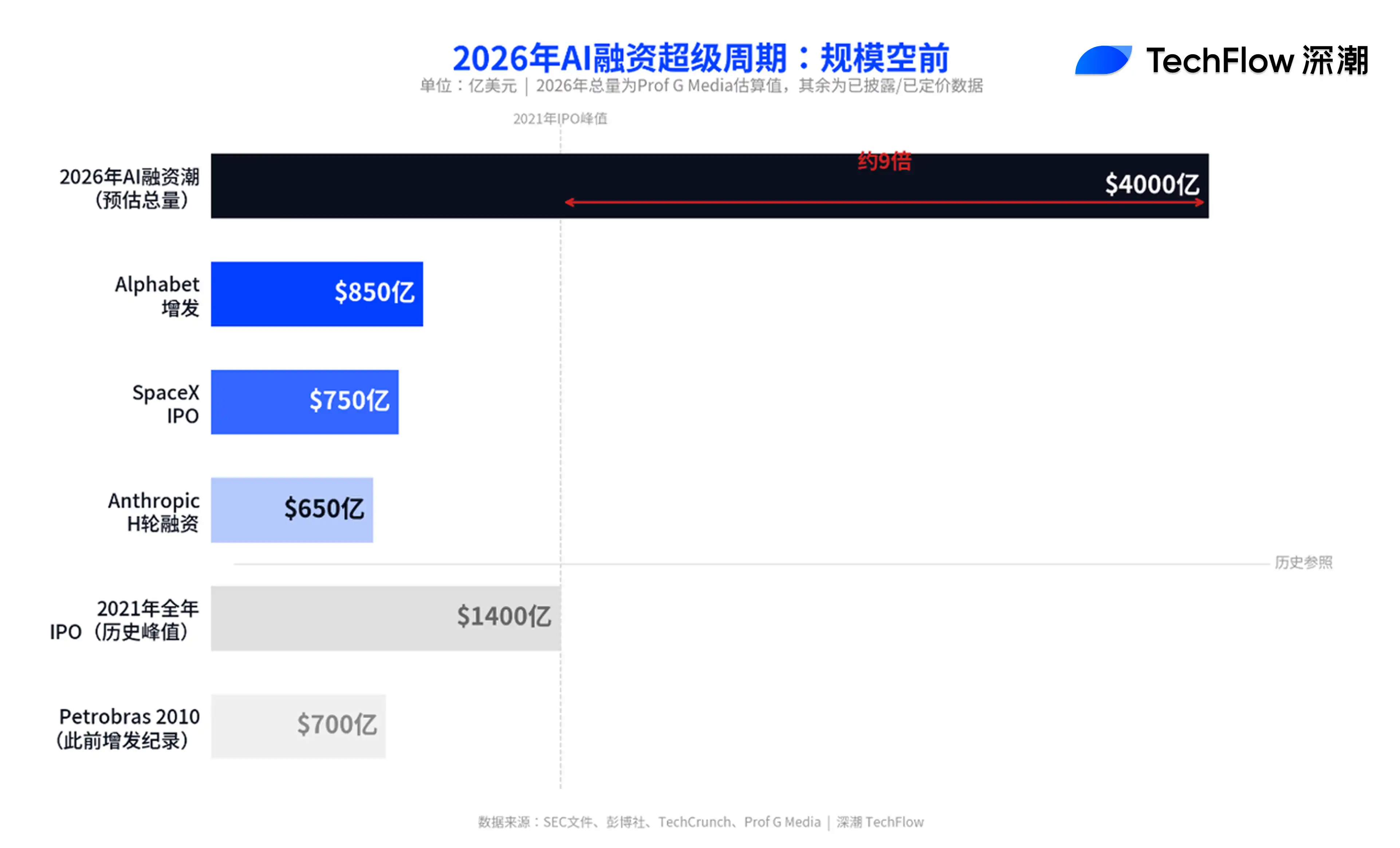
Meanwhile, SpaceX's $75 billion IPO is set to list on Nasdaq on June 12th, while Anthropic and OpenAI have both confidentially submitted S-1 filings. Total equity financing related to AI in 2026 could exceed $400 billion, nine times the size of last year's IPO market.

Alphabet has dropped a bombshell on the capital markets.

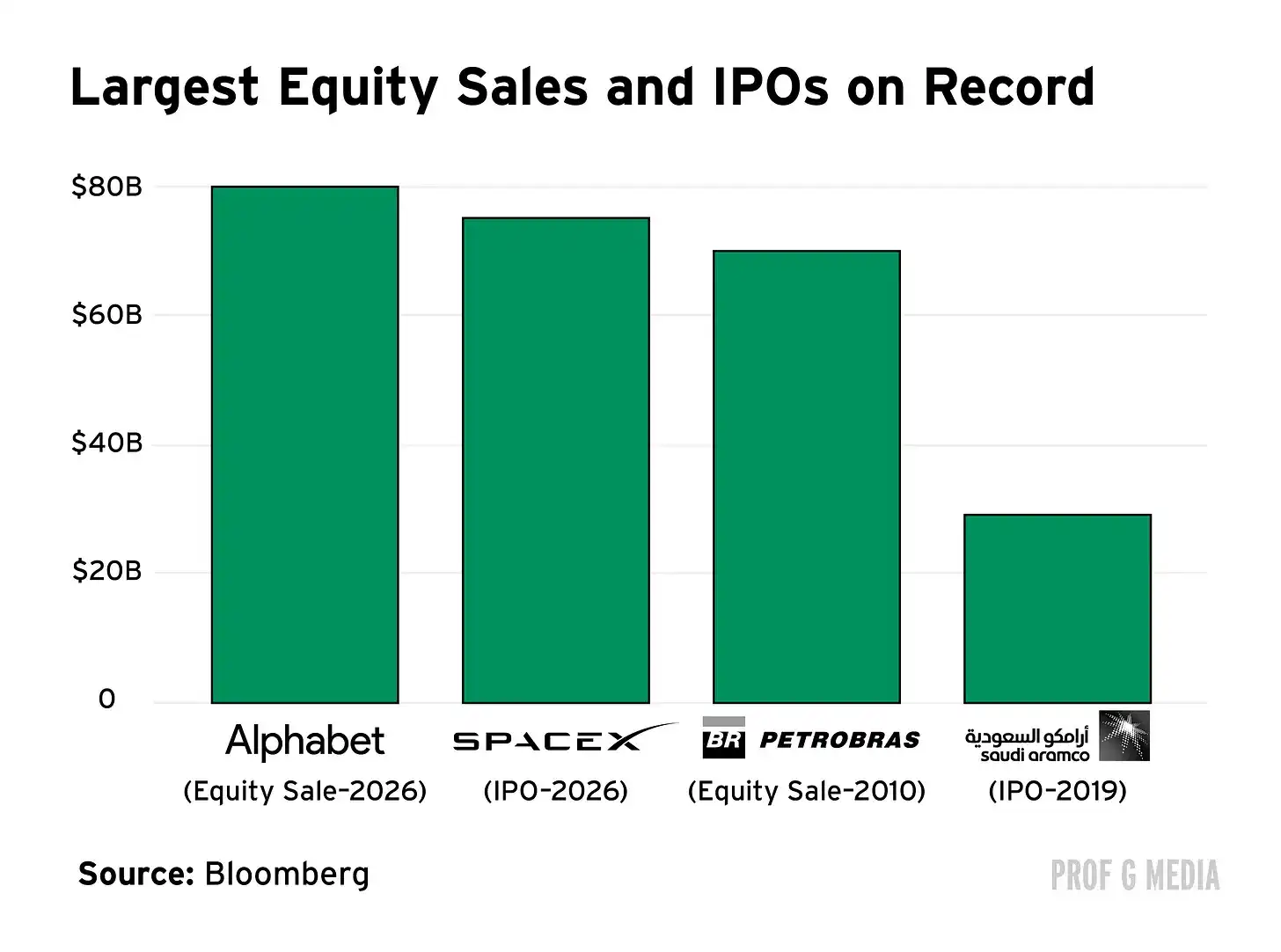
According to SEC filings and Bloomberg, Alphabet completed pricing for a total of $84.75 billion in equity financing on June 2nd, marking the largest single equity offering in history, surpassing the $70 billion record set by Petrobras in 2010 by over $14 billion. CEO Sundar Pichai posted on X platform that the initial offering was expanded from $40 billion to approximately $45 billion due to oversubscription. Following the announcement, Alphabet's stock price fell about 4%.
The destination of these funds is clear: AI infrastructure. Pichai defined it as "part of a multi-year investment strategy to seize the opportunities presented by AI." Alphabet's 2026 capital expenditure guidance has been raised to $180-$190 billion, nearly double the full-year 2025 figure of $91.4 billion.

How the $84.75 Billion Was Raised: A Four-Tier Structure Breakdown

This financing was not a simple secondary public offering but a composite structure pieced together from four components.

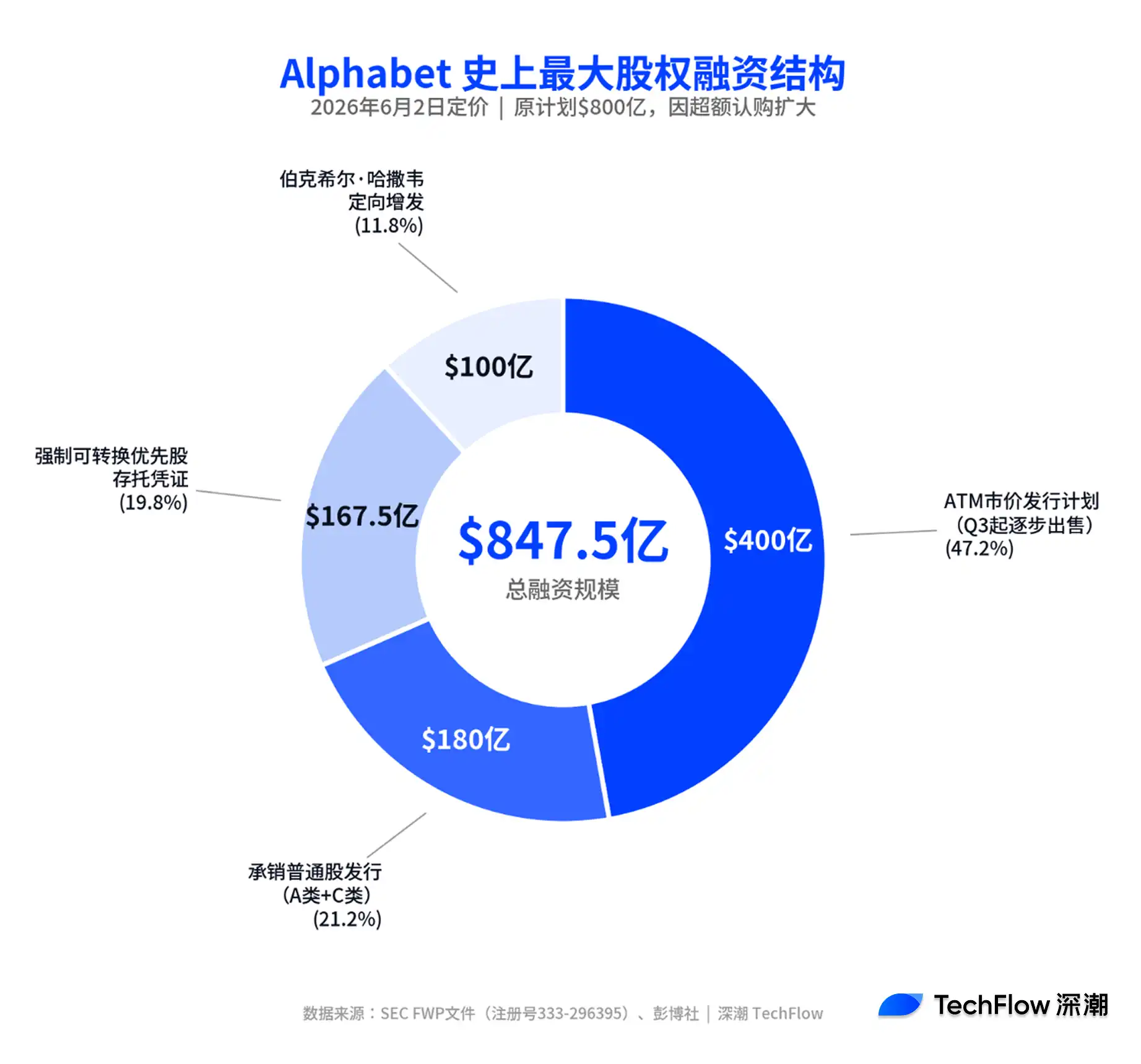
According to the FWP filing submitted to the SEC, the specific composition is: an underwritten offering of $18 billion in Class A common stock and Class C capital stock (expanded from the original plan of $15 billion); $16.75 billion in mandatory convertible preferred stock depositary receipts (expanded from the original plan of $15 billion), with a 6.25% fixed dividend rate; a $40 billion at-the-market offering program (ATM), which will gradually sell shares to the market starting in the third quarter; and a $10 billion private placement to Berkshire Hathaway.

The underwriting portion was priced at $355.20 per share for Class A shares and $351.80 per share for Class C shares. The common stock and depositary receipt offerings were settled on June 4th and June 5th, respectively.

Based on Alphabet's total market capitalization of approximately $4.2 trillion, this financing round represents less than 2% of its market value. According to Seeking Alpha analysis, considering the issuance structure and employee stock option tax obligations, the actual dilution effect may be lower than the nominal figure.
Buffett's $10 Billion Investment: Value Investors Cast a Vote of Confidence for AI Infrastructure

Berkshire Hathaway's $10 billion private placement was the most notable single transaction in this financing round.

According to SEC filings, Berkshire purchased equivalent amounts of Class A and Class C shares at approximately a 6.5% discount. This company, famous for value investing, has long been seen as conservative in the tech investment arena. But from heavily investing in Apple to now directly participating in AI infrastructure financing, Berkshire's move sends a signal: even the most cautious institutional capital now views AI infrastructure as an asset class worth betting on.

According to TechCrunch, Pichai specifically mentioned Berkshire's participation on X platform, emphasizing that its "long-term commitment to value investing" aligns with Alphabet's investment logic.

Google's Confidence: Q1 Revenue of $110 Billion, Cloud Backlog Exceeds $460 Billion

Alphabet's confidence in issuing an $85 billion financing check at this moment stems from solid data.

In the first quarter of 2026, Alphabet's total revenue reached $110 billion, a 22% year-over-year increase. Among this, Google Cloud revenue was $20 billion, a 63% increase, and contract backlog nearly doubled from the previous quarter to over $460 billion, with approximately 50% expected to be recognized as revenue within the next 24 months. Google Search and other business revenue grew 19% year-over-year to $60.4 billion, and Google paid subscription users reached 350 million. According to Prof G Media, Gemini's monthly active users are close to 900 million.

Pichai bluntly stated on the first-quarter earnings call: "We are constrained in the short term by compute supply." CFO Anat Ashkenazi added that capital expenditure in 2027 is expected to "increase significantly again." In other words, the $180-$190 billion annual capital expenditure is just the starting point.

Alphabet's President and Chief Investment Officer, Ruth Porat, played a key role in this financing round. Prof G Markets host Scott Galloway commented that Alphabet could have funded this investment entirely with cash from its own balance sheet, but Porat chose a smarter approach: financing with low-cost external capital while locking in investor allocations before Anthropic and OpenAI go public. "Every resource is finite, including investor appetite for AI infrastructure. Google just took $85 billion off the table," Galloway wrote.

The AI Financing Supercycle: SpaceX, Anthropic, OpenAI Queue Up for IPO

Alphabet's secondary offering is not an isolated event but the opening act of the 2026 AI capital markets supercycle.

SpaceX publicly filed its S-1 prospectus on May 20th, planning to issue 556.6 million shares at $135 per share, raising $75 billion, corresponding to a valuation of approximately $1.75 trillion. According to Bloomberg, the company is expected to price on June 11th and officially list on Nasdaq under the ticker "SPCX" on June 12th. The roadshow started on June 4th and has been oversubscribed. If completed, this will be the largest initial public offering in global IPO history.
Anthropic confidentially submitted a draft S-1 to the SEC on June 1st. Just prior, on May 28th, the company completed a $65 billion Series H funding round, with a post-money valuation of $965 billion, surpassing OpenAI's $852 billion to become the highest-valued AI company in Silicon Valley. According to multiple media reports, Anthropic's target IPO window is around October 2026, with exceeding a $1 trillion valuation on the first day seen as a baseline expectation.

OpenAI is also not far behind. According to CNBC's May 20th report, OpenAI is preparing to confidentially submit its IPO prospectus draft, with Goldman Sachs and Morgan Stanley acting as lead underwriters, targeting a valuation exceeding $1 trillion, with an IPO window between September and November 2026.

The Supply Shock of the $400 Billion Financing Wave: Can the Market Digest It?

Summing these numbers reveals a capital market financing scale in 2026 that is unprecedented.

According to Galloway's calculation, the largest year for IPO financing in history was 2021, with approximately $140 billion for the full year. The combined financing from just Google's secondary offering plus the IPOs of the three AI giants—SpaceX, Anthropic, and OpenAI—already far exceeds this record. If we add other AI-related listing projects like Cerebras and the entire 2026 financing pipeline, the total annual equity issuance could surpass $400 billion, approximately nine times the size of last year's IPO market.

Galloway presents a sobering historical statistic: the average maximum drawdown within one year of listing for the past 30 major IPOs was 55%. "The IPO moment is the peak of hype, the peak of demand. You are competing with every asset manager on the planet for the shares everyone wants," he wrote. "The smarter approach is often to wait for the hype to die down and find an entry point when fear is higher than greed."

For investors, Galloway offers a concise framework: Want AI exposure but unsure if Anthropic or OpenAI is worth their valuation? Buy Google. It's already one of the greatest businesses of all time, with a relatively reasonable valuation, offering upside with far less risk than pure-play AI companies. If AI ultimately disappoints, Alphabet won't disappear, but other companies might not be so lucky.

Related Questions

QWhat was the total size of Alphabet's record-breaking equity offering and how did it break the previous record?

AAlphabet completed an equity offering totaling $84.75 billion. This broke the previous record of $70 billion set by Petrobras (Brazil's state oil company) in 2010 by over $14 billion.

QWhat is the stated primary purpose of Alphabet's massive capital raise?

AThe stated primary purpose of the capital raise is for AI infrastructure investment. CEO Sundar Pichai defined it as 'part of a multi-year investment strategy to capture the opportunities presented by AI.'

QWho invested $10 billion in Alphabet's offering, and why is this significant?

ABerkshire Hathaway invested $10 billion in a private placement. This is significant as the company, known for its conservative value investing philosophy, is seen as giving a 'trust vote' to AI infrastructure as a legitimate asset class.

QWhich three major AI/tech companies are mentioned as preparing to go public in 2026, and what are their expected IPO valuations?

AThe three major companies are SpaceX (targeting a $1.75 trillion valuation), Anthropic (targeting a valuation exceeding $1 trillion), and OpenAI (also targeting a valuation exceeding $1 trillion).

QAccording to the article, what is a key risk or concern highlighted about the upcoming wave of large-scale AI-related public offerings?

AA key concern is the market's ability to absorb the massive supply of equity. Scott Galloway notes that the combined offering sizes could be 9x larger than last year's IPO market. He warns that IPOs often represent a peak in hype, and historically, major IPOs have seen an average maximum drawdown of 55% within their first year of trading.

Related Reads

From Shouting 150 Dollars to Liquidating HYPE in Just Three Days, How Much Credibility Does Arthur Hayes Have Left?

How much of Arthur Hayes's market credibility remains? Recently, the "godfather of crypto perpetual swaps" and BitMEX co-founder has faced public criticism, including accusations from on-chain investigator ZachXBT about creating exit liquidity for his followers. Starting last week, Hayes executed multiple sudden sell-offs. He had repeatedly publicly predicted the HYPE token would reach $150. After a $100,000 bet defending Hyperliquid on June 1st, he announced just three days later that he had completely sold his HYPE and NEAR holdings, successfully exiting near the peak. He also sold ZEC and WLD. His sale of WLD appeared to be a classic "pump and dump" maneuver. On June 3rd, he publicly set a $10 target for WLD, causing its price to surge over 35%. By June 6th, he announced he had sold his WLD, citing "anomalous" SpaceX pre-IPO price action, which triggered a sharp price drop. On June 9th, Hayes published a lengthy article explaining his actions, citing factors like rising energy costs and a potential AI bubble burst. Consequently, his family office, Maelstrom, now holds positions in US energy producers and only core crypto assets BTC and ETH, having sold AI-related stocks and non-core cryptocurrencies. This pattern is not new. In 2025, he similarly touted HYPE before selling it at what turned out to be a cycle peak, only to repurchase it at the next cycle's low. Similar scenarios played out with tokens like ETHFI and ENA. Long-term observers have developed a strategy: ignore Hayes's public statements but closely monitor his on-chain actions—be cautious following his buys, but decisively follow his sells. If he continues these tactics, especially as seen with the WLD case, his market credibility risks being permanently damaged. As Hayes himself admitted in his latest article, "I remain an unapologetic gambler."

marsbit18m ago

From Shouting 150 Dollars to Liquidating HYPE in Just Three Days, How Much Credibility Does Arthur Hayes Have Left?

marsbit18m ago

Fundraising is Like a Strange Dance: The 'Absurd Drama' of Silicon Valley Founders' Capital Raises

The article details a series of absurd and revealing anecdotes shared by Silicon Valley founders about their venture capital fundraising experiences, sparked by Greg Isenberg's story of pitching to a sleeping a16z partner. Founders describe surreal pitch meetings: one faced a barefoot, peanut-eating investor who offered triple the requested amount after 30 seconds; another performed a pitch in a VC's parked car; a founder discovered his audience understood no English beyond "yes." These stories highlight the often irrational and performative nature of fundraising. Beyond the absurdity, darker power imbalances are exposed. Stories include investors suggesting founders fire co-founders for their equity, blatant market misjudgments, disrespectful behavior from LPs, and discriminatory remarks. A debate also emerges around "Sequoia's" practice of splitting a round into two valuations. However, the thread isn't solely critical. Positive counter-narratives celebrate supportive VCs who offered crucial advice during crises, respected founders' timelines, and showed simple gestures of respect—like a partner personally fetching coffee before a major pitch. Ultimately, the collective sharing acts as a pressure release, illustrating that fundraising is a complex dance of power, trust, and sometimes sheer theater. It underscores that beyond capital, mutual respect and integrity remain the most enduring foundations of the founder-investor relationship.

marsbit32m ago

Fundraising is Like a Strange Dance: The 'Absurd Drama' of Silicon Valley Founders' Capital Raises

marsbit32m ago

Vitalik's Vision for the Next Evolution of On-Chain Finance: How to Reconstruct DeFi with an 'Options Mindset'?

Vitalik Buterin recently proposed a conceptual shift for DeFi: replacing traditional Collateralized Debt Positions (CDPs) and forced liquidations with an options-based mechanism. This aims to address key vulnerabilities in current DeFi lending. The traditional CDP model, foundational to protocols like MakerDAO and Aave, allows users to borrow against collateral but relies on real-time oracles and triggers sudden, mandatory liquidations during price volatility. This can cause cascading sell-offs, oracle manipulation risks, and significant MEV extraction, exacerbating market stress. Vitalik's alternative envisions splitting an asset like 1 ETH into two complementary components: one offering stable/index-like exposure and the other absorbing the opposite risk/reward. Instead of a hard liquidation threshold, a user's exposure to the target asset would gradually and smoothly deviate (following a near-quadratic curve) as the collateral price moves. The system would primarily depend on "slow oracles" for periodic settlement rather than instant price feeds. Key potential benefits include: the elimination of abrupt, forced liquidations; drastically reduced reliance on vulnerable real-time oracles; and inherent resistance to certain MEV exploits centered on liquidation auctions. The article posits that for Ethereum DeFi to maintain its relevance amid competition from faster, cheaper chains, it must compete on sophisticated financial engineering and robustness—not just transaction speed or yields. The core value proposition should shift towards offering users clearer, more manageable risk structures, greater autonomy, and resilience in extreme scenarios, moving DeFi from high-risk experimentation towards becoming reliable financial infrastructure.

marsbit1h ago

Vitalik's Vision for the Next Evolution of On-Chain Finance: How to Reconstruct DeFi with an 'Options Mindset'?

marsbit1h ago

Trading

Spot
Futures

Hot Articles

Discussions

Welcome to the HTX Community. Here, you can stay informed about the latest platform developments and gain access to professional market insights. Users' opinions on the price of AI (AI) are presented below.

活动图片