The Solana smart contract blockchain plans to increase the maximum transaction size from 1,232 bytes to 4,096 bytes on Wednesday, giving developers more than three times the space to place instructions in a single operation.
Operations that previously had to be split across multiple transactions can now be processed in a single transaction within Transaction v1. This includes large cryptographic proofs, payments requiring multiple signatures, and certain confidential transfers.
The new format is already operational on Solana's test and development networks. Existing transaction formats will continue to work, so wallets and applications won't have to upgrade to version 1 unless they need the extra space.
This could help Solana sharpen its advantage over rival Ethereum. While Solana has always been faster and cheaper, it previously lagged in one key area: its transactions were strictly capped at 1,232 bytes. Ethereum, in contrast, has no hard protocol limit on size, allowing developers to execute massive, data-heavy applications in a single operation by simply paying a higher transaction fee.
By raising this ceiling more than threefold to 4,096 bytes, Solana aims to eliminate this structural bottleneck.
The bigger change is for the software reading Solana. Services that pull blocks and transactions need to be updated to recognize version v1. Otherwise, requests may fail when encountering the new format.
Some software also needs to change where it looks for priority fee information. A priority fee is an optional extra payment users can make to speed up transaction processing. V1 stores this information in a different place, so legacy software may display a zero fee, even if one was paid.
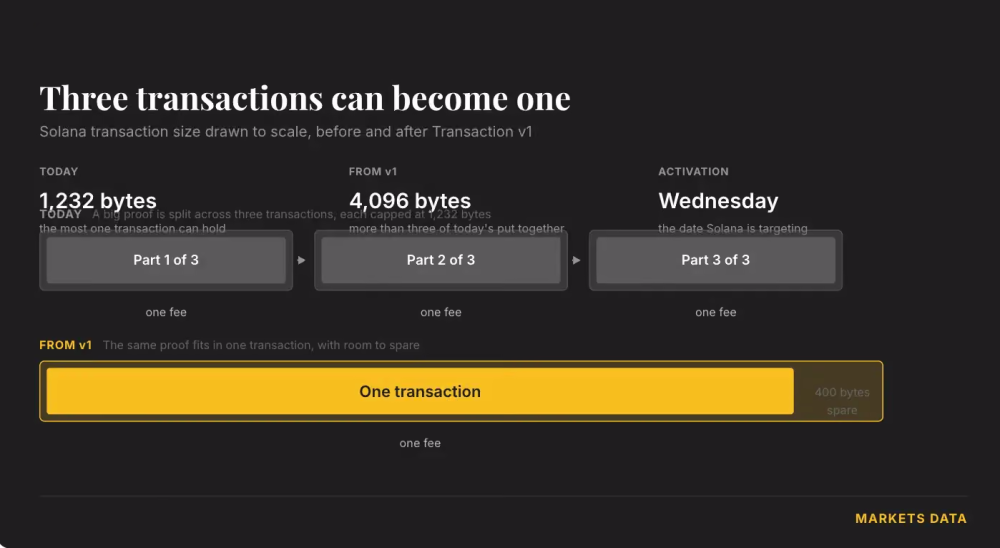
Three transactions can become one. Source: Shaurya Malwa.
Wallets, explorers, and trading apps often use these services to display what happened on the blockchain. This means incorrect data behind the scenes can turn into incorrect data on a user's screen.
Larger transactions also use more network bandwidth. Developers anticipate that users may have to offer higher priority fees when larger transactions compete for space, although the upgrade does not introduce a new per-byte fee.
The old 1,232-byte limit stems from Solana's original network design, where each transaction had to fit into an internet data packet roughly 1,280 bytes in size. In 2022, Solana changed how transaction traffic is transmitted, making the old ceiling less necessary.
The new limit is capped at 4,096 bytes because four kilobytes is the standard memory page size used by validator hardware. Increasing the size further could cause a single transaction to span multiple pages and make its processing more costly for the computers running Solana.
This change is outlined in two proposals, SIMD-0296 and SIMD-0385, co-authored by Jacob Creech and Andrew Fitzgerald, and is entirely separate from recent Solana governance votes that changed how quickly new SOL was created and removed from supply via fees earned from network activity.