AI Kills India's Most Profitable Business: 2 Trillion

marsbitPublished on 2026-06-09Last updated on 2026-06-09

Abstract

The article discusses the significant impact of AI on India's IT outsourcing industry, a sector that has been the backbone of the country's economic growth for three decades. On June 3, India's IT stock index plunged 5.8%, with major firms like TCS, Infosys, and Wipro seeing sharp declines. The panic stems from the realization that AI tools capable of coding, testing, documentation, and customer service directly threaten India's core business model of selling programmer hours. The industry, which generated approximately $282 billion in revenue in the 2025 fiscal year with nearly 80% from exports, faces an existential challenge. The traditional growth logic—more projects requiring more engineers—is being dismantled. Estimates suggest AI could reduce development teams from 100 people to just 2-3 for certain tasks, slashing project costs and company profit margins. Consequently, leading firms have begun reducing headcounts, a reversal of a decades-long trend, and entry-level job openings have plummeted. The risk is profound as IT services account for over 7% of India's GDP and support millions of jobs. With high youth unemployment, the AI-driven reduction in low-to-mid-level engineering roles poses a severe socio-economic threat. However, India also shows potential to adapt and lead in the AI era. Reports indicate it has the world's highest rates of AI tool adoption among employees and managers. Major IT firms are rapidly deploying enterprise AI solutions like Microsoft Copil...

On June 3rd, India's IT sector crashed.

TCS plummeted 9%, Infosys fell 4.3%, and Wipro dropped 3.7%. India's IT index fell 5.8% in a single day, setting a four-month record for the largest decline.

It wasn't a bad earnings report or a sudden policy change. The only two words that sent the market into a panic: AI.

Over the past year, the world's attention has been focused on the US and China — with OpenAI, Anthropic, and DeepSeek taking turns in the spotlight. But AI's first major blow has landed on India.

If AI can really write code, perform testing, create documentation, and handle customer service, what will happen to the country most dependent on 'selling programmers' to the world?

India is the answer.

Multiple industry insiders told Pencil News: this dramatic change suddenly accelerated in the second half of 2025, marked by the emergence of Agentic AI. AI can help complete 70% to 80% of the work for a SaaS software.

Kouting Intelligence, an AI programming company that has raised three rounds of funding, told Pencil News: "The impact of AI programming on the IT outsourcing economy is not an 'influence', but potentially a 'killer blow'.

01

30 Years of National Fortune, Hinged on a Line of Code

A single industry has sustained India for 30 years.

Many don't know that India's most profitable industry is not manufacturing, nor is it the internet. It's IT outsourcing.

According to data from the National Association of Software and Service Companies (NASSCOM), in the 2025 fiscal year, India's technology industry's total revenue reached approximately $282.6 billion (about ¥2 trillion), of which IT service revenue was about $137 billion, accounting for nearly half of the entire industry.

More importantly, exports. In FY 2025, India's technology industry's export revenue reached $224 billion, representing nearly 80% of total revenue.

What does this mean? Simply put, one of India's most lucrative businesses is working for American and European companies.

Kedi Chuhai CEO Luan Tianyi cut to the essence: "Software outsourcing is essentially 'selling people'. Charging by headcount and man-hours, very similar to the construction industry."

Over the past 30 years, India has almost rewritten its national fortune with this single industry. American companies need software development, European banks need system maintenance, Global 500 companies need digital transformation. What to do? Send the work to India, which then organizes thousands upon thousands of engineers to take the orders.

Thus, a classic model formed: more clients, more projects, more engineers, higher revenue.

Today, India's major leading IT service companies are representatives of this model.

In FY 2025, TCS's annual revenue exceeded $30 billion, with a workforce approaching 600,000; Infosys's annual revenue was about $19.3 billion, with over 320,000 employees; Wipro's annual revenue was about $10.5 billion, with over 230,000 employees.

Just these three companies alone have over 1.15 million employees.
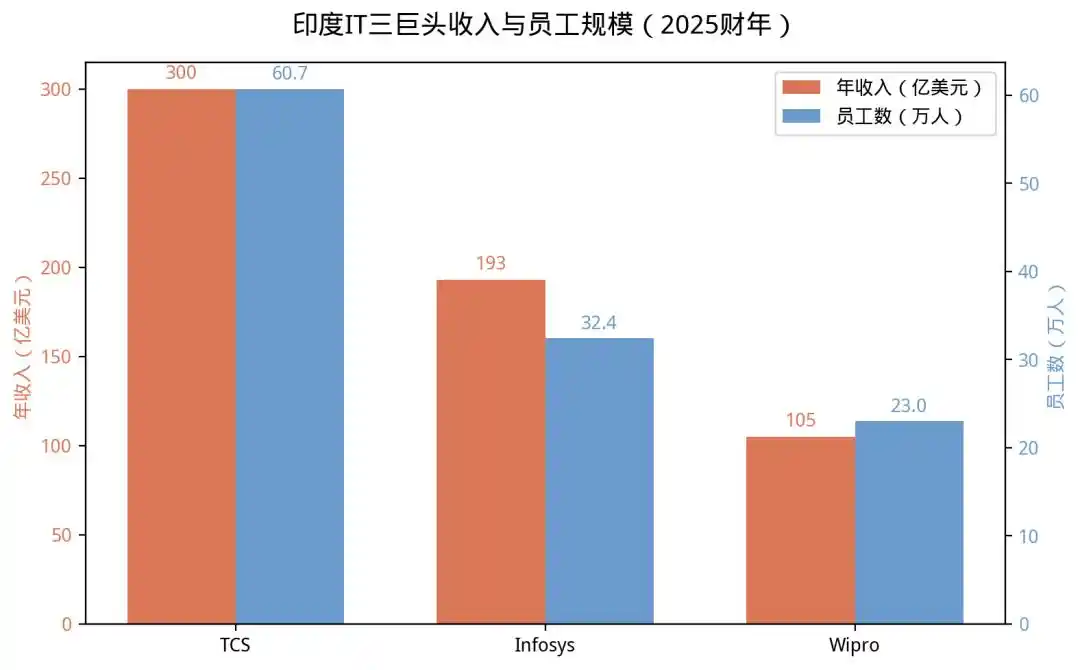
Revenue and Employee Scale of India's IT Big Three (FY 2025) Source: NASSCOM

More importantly, the growth logic of these companies has long been highly consistent: hire more engineers, take on more projects, earn more revenue. For decades, an important metric for capital markets evaluating Indian IT companies was not AI capability, but employee headcount.

According to Reuters data, the scale of India's IT industry has reached approximately $283 billion. Many international investors even call India: "The World's Back Office".

But this logic is changing. A key factor, related to AI: the IT outsourcing business is being dismantled by AI programming.

Su Wen said: "New technologies rarely kill directly in existing markets. A more common way is: in emerging markets, making you completely unqualified to participate. Like the person specialized in catching the ball under the basketball hoop, does that position still exist? No matter how good you are at catching, it's meaningless now."

02

Single-Day 5.8% Plunge: Capital is Voting with its Feet

Therefore, the capital market is starting to worry about one thing.

This past February, India's IT sector evaporated $22.5 billion (about ¥160 billion) in market value in one week. The market at the time thought it was an overreaction. But by June, panic reappeared.

On June 3, India's IT index plunged 5.8% in a single day, the biggest drop in 4 months; India's largest software exporter TCS plummeted 9%, Infosys fell 4.3%, Wipro dropped 3.7%.

TCS Headquarters Building Source: Forbes India

More notably, this is no longer an isolated incident. As of early June, India's IT index has fallen 22% cumulatively so far in 2026; while it fell 26% for the entirety of 2025. In other words, this star sector that once supported India's economic growth has been one of the worst-performing industries in the market for two consecutive years.
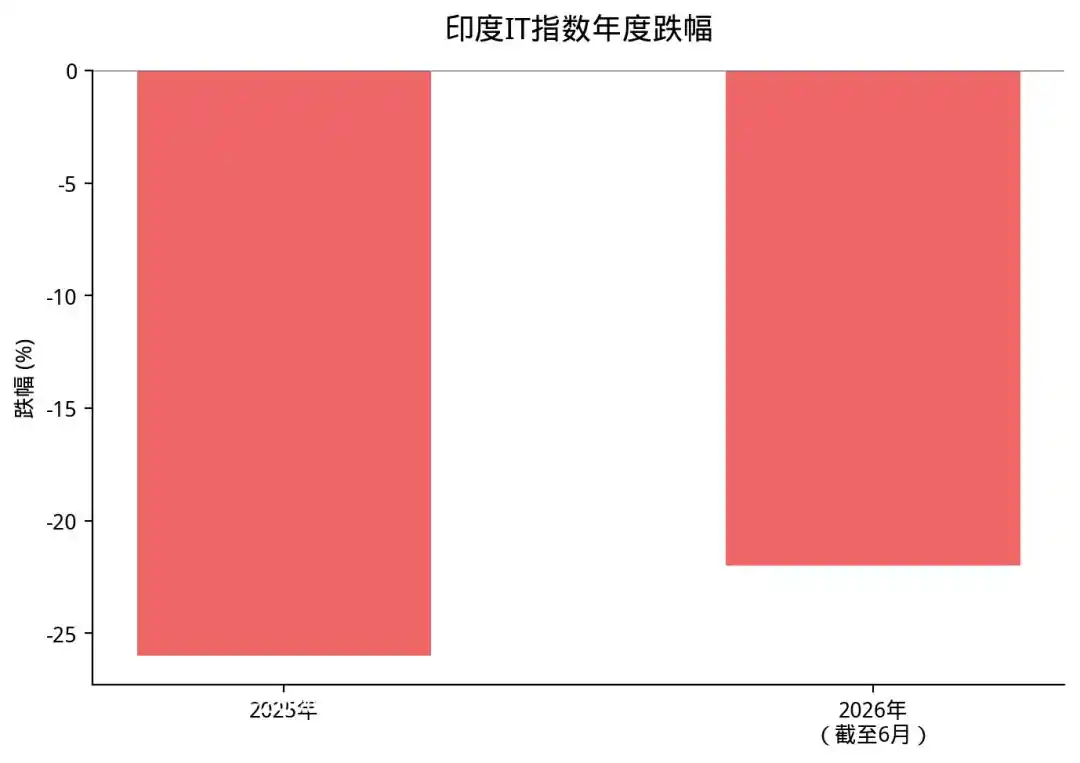
India's IT Index Plunges for Two Consecutive Years Source: Economic Times

The reason is simple. More and more investment institutions are realizing: what AI is replacing is precisely India's core business. Such as writing code, testing software, operations support, documentation, customer service support. These tasks used to require a large number of engineers, but now more and more companies are starting to try letting AI handle them.

What's more terrifying is that the capital market is not worried about "all programmers becoming unemployed." Rather, it's that: India's most profitable business model will become obsolete.

The past logic was: a client has a project, an Indian company sends 100 people, earns money for 100 people. The future may become: a client has a project, AI completes 80% of the work, only 20 people are needed.

Kouting Intelligence, an AI programming company that has raised three rounds of funding, provided Pencil News with a set of data: a development team that needed 100 people in the past can now be completed by 2-3 people; an e-commerce website that might have cost hundreds of thousands or even millions to develop can now have its cost compressed to $6-8.

Even more frightening is the average order value. "The average order value for software development companies may face a 70%-90% decline," Su Wen told Pencil News.

Brokerage research reports show that the overall net profit margin of the software outsourcing industry has dropped from nearly 10% to about 0.1% (not specifically referring to India). This means the profit margins of Indian IT companies are being squeezed out by AI.

The global perspective is even more staggering.

Mordor Intelligence data shows that the global IT outsourcing market size in 2025 was about $618 billion. Of this, about 40%-60% relies on labor-intensive delivery, roughly $250 billion to $450 billion — about ¥3 trillion — facing the risk of being directly replaced or having prices slashed by AI.
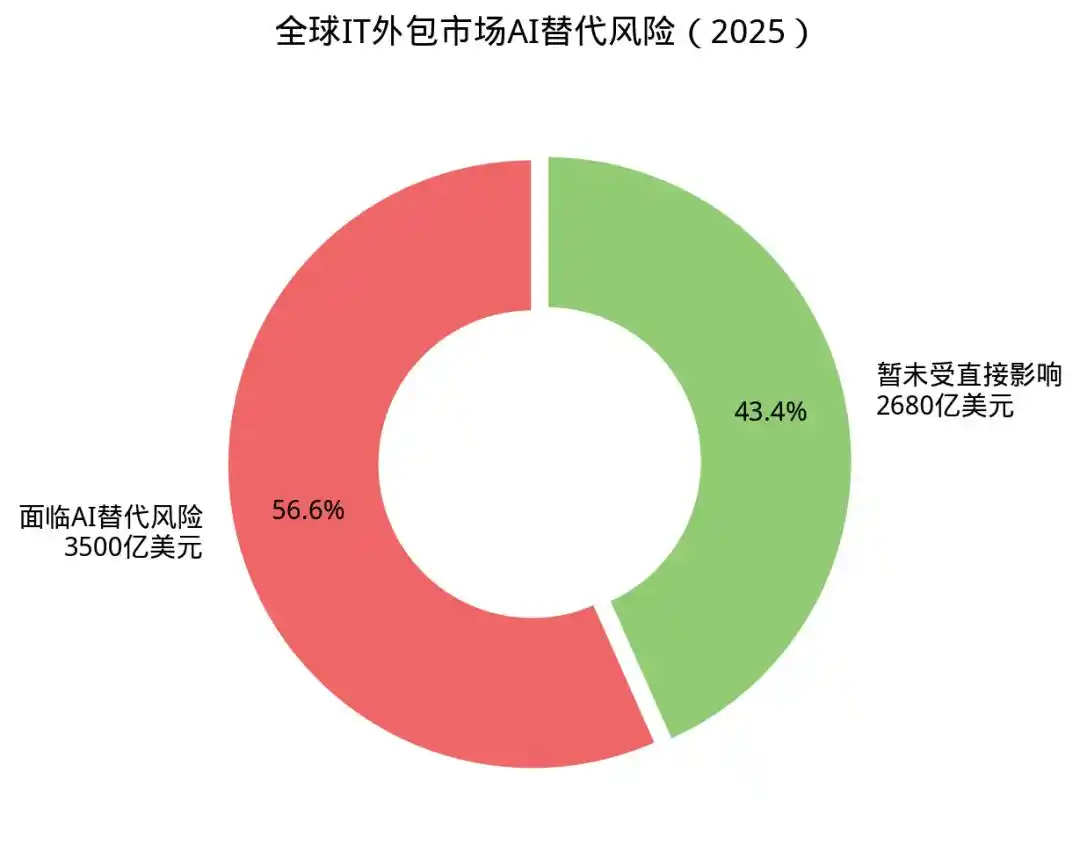
Global IT Outsourcing Market AI Substitution Risk (2025) Source: Mordor Intelligence

For a $280 billion industry, this is a nuclear-level alarm.

03

Leading Companies are Laying Off

More dangerous signals are emerging.

If it were just stock prices falling, it wouldn't be a big deal. What is truly noteworthy is hiring. More direct changes are already appearing in the headcounts of leading companies.

Su Wen's judgment is more radical: "A 20x reduction in engineering personnel is the bare minimum."

The judgment of veteran programmer Meisi, with over ten years of experience at large companies, is similar: "The future trend is a 10:1 compression. An engineering team of two to three thousand people might ultimately need only two to three hundred."

India's largest IT service company, TCS, had a total employee count of about 607,000 in FY 2025, a decrease of about 13,000 compared to the previous fiscal year. Infosys's total employee count was about 324,000, a year-on-year decrease of about 15,000.

This is a rare phenomenon in India's IT industry over many past years. For 30 years, the headcounts of these companies have almost only increased. Growth was the norm, contraction the exception. And today, this 30-year growth curve is turning downward.

ANSR Founder & CEO Lalit Ahuja stated plainly: "There is an air of caution in the market, companies are reducing their hiring numbers."

The entire Indian tech sector's hiring market is shrinking sharply. In June 2026, active tech job openings in India had fallen to 93,000, the lowest point in 28 months. Job openings for technical positions with less than 2 years of experience plummeted 44% year-on-year — nearly half of the entry-level positions vanished.

Su Wen explained the logic behind it: "Development with a complexity score of 4 or below can be completely replaced. A team that needed 100 people before now only needs 2-3."

In past growth cycles, increased projects often meant increased hiring; now, revenue growth and employee growth are gradually decoupling.

The biggest worry for Indian tech companies used to be: not enough people. Today, they are starting to wonder: are there too many people?

When leaders like TCS and Infosys simultaneously start "downsizing," the direction of an era has already changed.

04

India Hit in the Heart by AI

Why is India in more danger than others?

Because what AI has hit in India is not a peripheral industry, but a core industry.

Take a simple example. If AI impacts an e-commerce company, the effect is limited. If AI impacts the advertising industry, the effect is limited. But India is different; IT services are one of India's most important export industries. India's IT industry's total revenue has surpassed $315 billion, accounting for over 7% of India's GDP, employing over 6 million people. Behind these 6 million people are 6 million families, the livelihoods of tens of millions.

More importantly, this is not an isolated industry. IT outsourcing supports India's training industry, real estate industry (office buildings and residences in Bangalore, Hyderabad), service industry, and education industry. One IT job supports at least 3-5 related jobs. This means the impact of AI on the IT industry could ultimately affect the employment ecosystem of 20 to 30 million people in India.

And India itself faces an even harsher reality. Reuters data shows: India's urban youth unemployment rate remains high at 13.6%.

Huge numbers of young people are already looking for jobs. The unemployment rate for Indian university graduates has soared to 29.1%, with 40% of young graduates under 25 unable to find work. Over 1.5 million computer science graduates flood the job market every year, but only 42.6% meet the employable standards of companies.

Now AI is starting to squeeze employment further. Employment pressure + skill mismatch + AI substitution — these are not three separate problems, but a mutually reinforcing death spiral.

Su Wen put it bluntly: "The new market is already bypassing you. You're not losing to peers; this segment is being erased by technology."

An Everest Group analyst stated plainly: "AI will no longer require L1 and L2 level engineers." And these L1 and L2 engineers are precisely the foundation of India's IT industry, the first stop for the 1.5 million annual computer graduates, the entry point for millions of families to change their fortunes.

05

India's Opportunity: 80% of Employees Use AI, Ranked First Globally

Of course, India could also become the biggest winner.

The story isn't over. Because India has another set of data.

According to Boston Consulting Group's (BCG) latest "AI at Work 2026" report, India has become one of the most proactive countries globally in AI application, ranking first worldwide in employee and manager AI adoption rates.

Another survey by ADP, covering 34 countries, "People at Work 2026," shows: 80% of Indian employees use AI tools multiple times a week; 41% of Indian employees use AI daily; the global averages are only 50% and 20% respectively.

That means: globally, on average, about 1 in 5 people use AI daily; but in India, about 2 in 5 people use AI daily.
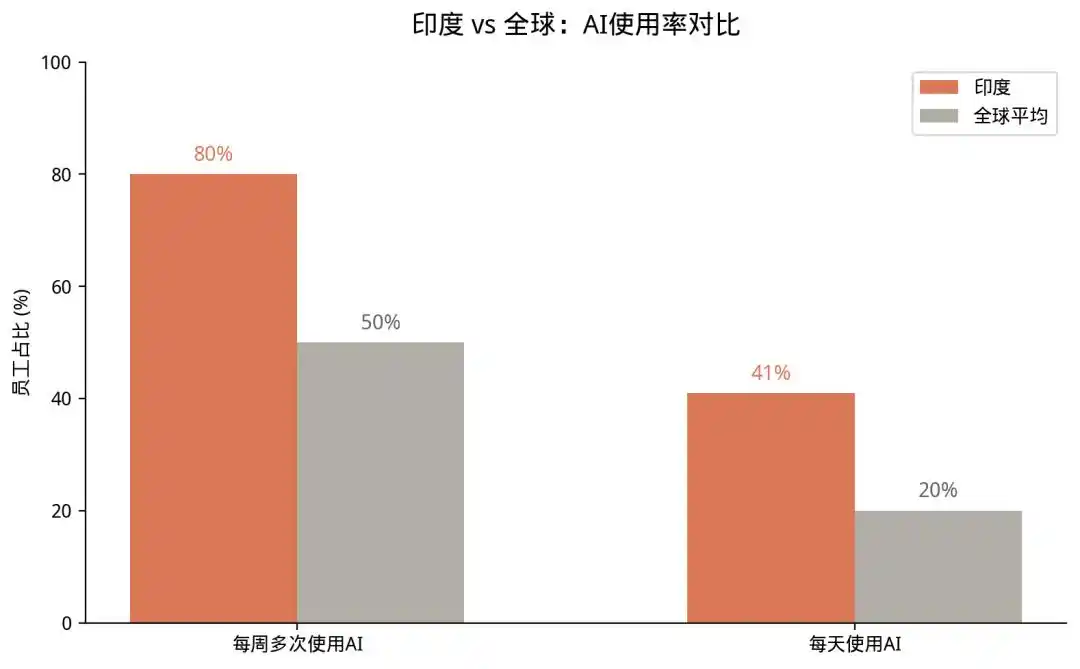
India vs Global AI Usage Comparison Source: BCG/ADP 2026

Not only are employees using it, but companies are also deploying it on a large scale. At the end of May, Microsoft disclosed a set of data: TCS, Infosys, and Wipro have each deployed over 100,000 Microsoft 365 Copilot licenses; the combined deployment scale of the three companies exceeds 300,000 seats, referred to by Microsoft as one of the world's largest enterprise-grade AI deployment cases.

In other words, two things are happening simultaneously in India: on one side, AI is impacting traditional outsourcing jobs; on the other side, AI is penetrating enterprises at an unprecedented rate.

This is also why Microsoft's India head recently stated publicly: India has become one of the fastest-growing AI markets globally.

06

The New Paradigm

What might the new paradigm for IT outsourcing in India be?

In fact, while the capital market is still worried about India's IT outsourcing model being dismantled by AI, India's largest tech companies have already started looking for new ways to make money: no longer selling engineers, but selling AI productivity.

The most typical is TCS. In Q1 2026, TCS disclosed that its annualized order book for AI-related business has reached $2.3 billion, up from $1.8 billion the previous quarter — a growth of about 28% in one quarter.

At the same time, TCS's new order wins for the quarter reached $12 billion, still maintaining a historical high. This indicates an interesting phenomenon: clients have not stopped spending money, only the way they spend it has changed.

In the past, clients bought 100 programmers. Today, clients buy AI solutions, Agent systems, and automation capabilities.

Many people think India's biggest future opportunity is to emulate the US and create something like Cursor. But a mainstream view is: India's real opportunity lies in becoming the world's largest AI implementation center.

In foundational models, the US already has a batch of monopolistic-level companies: OpenAI, Anthropic, Google, Meta, etc. But models are just the beginning; the real complexity lies in implementation.

As of 2026, India already has over 2,100 Global Capability Centers (GCCs), serving multinationals like Microsoft, JPMorgan Chase, Goldman Sachs, Walmart, Pfizer, generating about $100 billion in revenue and directly employing over 2.36 million people.

These Global Capability Centers essentially undertake: software development, system integration, enterprise digitization, data management, IT operations, etc. These tasks require massive engineering implementation capabilities, which is precisely the area where India has accumulated its deepest expertise over the past 30 years.

According to IDC predictions, by 2028, global enterprise AI spending will exceed $630 billion. And India's biggest opportunity may not be to compete in the model market, but to compete in the deployment market.

If for the past 30 years, India exported engineers to the world. Then for the next 10 years, India might export to the world: Agent deployment capabilities, AI operations capabilities, and AI productivity.

Perhaps, this is India's true new paradigm.

This article is from WeChat public account "Pencil News" (ID: pencilnews), author: Aiyu, editor: Wang Fang


Related Questions

QWhat was the main reason for the sudden drop in India's IT stock index on June 3rd?

AThe main reason was the growing panic over the impact of Artificial Intelligence (AI). The market is concerned that AI's ability to write code, perform testing, handle customer service, and other tasks will significantly disrupt India's core IT outsourcing business model, which relies heavily on selling programmer hours.

QAccording to the article, why is the Indian IT services industry particularly vulnerable to AI disruption?

AThe Indian IT services industry is particularly vulnerable because AI directly targets its core business model. This industry, which generates over $2 trillion in revenue and accounts for a large portion of India's exports and GDP, primarily makes money by providing human-intensive services like coding and software maintenance. AI threatens to drastically reduce the number of engineers needed for projects, thereby undermining the traditional 'sell people by the hour' revenue model.

QWhat data does the article present to show that traditional IT outsourcing jobs in India are already declining?

AThe article presents several data points: 1) Headcount reductions at major firms like TCS (down ~13,000 employees) and Infosys (down ~15,000 employees) in the 2025 fiscal year. 2) A sharp drop in active tech job openings in India to 93,000, a 28-month low, with entry-level job postings for workers with less than 2 years of experience plummeting by 44%. This indicates a reversal of the decades-long trend of constant hiring growth in the sector.

QDespite the challenges, what potential opportunity does AI present for India according to the article?

AThe article suggests that India's opportunity lies in becoming the world's largest AI implementation and deployment center. Instead of competing to build foundational AI models (like the US), India can leverage its decades of experience in IT services and its vast network of Global Capability Centers (GCCs) to specialize in deploying AI solutions, managing Agent systems, and providing AI-powered productivity services for global enterprises.

QWhat evidence does the article provide to show that India is aggressively adopting AI within its workforce?

AThe article cites surveys showing India leads globally in AI adoption rates among employees. According to the 'People at Work 2026' survey, 80% of Indian employees use AI tools multiple times a week, and 41% use them daily—far above the global averages of 50% and 20%, respectively. Furthermore, major Indian IT firms like TCS, Infosys, and Wipro have collectively deployed over 300,000 licenses for Microsoft 365 Copilot, representing one of the world's largest enterprise AI rollouts.

Related Reads

Humanity Loses $31 Million in Attack, Token Price Plummets 90% Due to a Single Private Key

On June 9th, the digital identity project Humanity Protocol suffered a major security breach resulting in over $31 million in losses. According to on-chain analyst Specter, hundreds of wallets holding the project's H token were drained. The attack was confirmed by founder Terence Kwok to be caused by the compromise of a foundation member's private key. As a precaution, users are advised to avoid interacting with Humanity's cross-chain bridge or liquidity pools. The incident caused the H token price to crash over 90%, from around $0.70 to a low of $0.052, wiping its market cap from $2 billion to approximately $35.7 million. The attacker allegedly minted 100 million new H tokens and is selling them for BNB. This breach adds to existing controversies surrounding Humanity Protocol. Founded in 2024, it aimed to verify human users via palm-print biometrics and zero-knowledge proofs. However, a leaked conversation in 2025 revealed that only about 1 million of its 9 million claimed Human IDs had completed biometric verification, suggesting 88% might be bots. Furthermore, the project has faced allegations of being a repackaged product from a Chinese access control vendor, raising privacy and authenticity concerns. Founder Terence Kwok's previous venture, Tink Labs, a hotel smartphone startup that raised $170 million, failed and entered bankruptcy in 2020 after burning through its funding. The current attack highlights the persistent critical issue of private key management in crypto. Unlike smart contract exploits, a private key compromise bypasses all on-chain security mechanisms. With no user compensation plan announced yet, this $31 million breach may be a final blow to the project's credibility, already weakened by previous controversies and a heavily depreciated token.

marsbit4m ago

Humanity Loses $31 Million in Attack, Token Price Plummets 90% Due to a Single Private Key

marsbit4m ago

MicroStrategy Will Not Die in This Downturn: Reflexivity, STRC Anchoring Back to Par, and the Self-Rescue Logic of "Sell Stock, Not Bitcoin"

This article analyzes the recent sharp decline in Bitcoin and MicroStrategy (MSTR), framing it as a targeted "reflexivity" attack. The trigger was MSTR using its cash reserves to buy back convertible notes, raising market concerns about a liquidity crisis. The playbook follows George Soros's principle: market expectations can shape reality. Fears that MSTR might be forced to sell BTC caused panic selling, lowering BTC's price and worsening MSTR's financial ratios, thus reinforcing the negative narrative. The author argues that MSTR's Structured Convertible (STRC), while falling in price, is a floating-rate security that will eventually return to par value (100). The price drop reflects the market demanding a higher yield due to perceived risk, but as a floating-rate instrument, its coupon can adjust, naturally pulling the price back to par over time. This is crucial for MSTR's continued ability to raise funds. The core thesis is that MSTR's best move to counter the attack is to **issue new equity (sell shares)**, not sell its Bitcoin holdings. While selling BTC would solve the immediate cash crunch, it would destroy the company's core investment thesis and premium. It would dilute the BTC per share, likely erase the market premium over its net asset value (mNAV > 1), and worsen its debt-to-asset ratio. Issuing shares while mNAV is high (e.g., 1.25x) allows MSTR to raise cash for reserves without harming shareholder value or the "perpetual accumulation" narrative. It improves the debt ratio and reassures STRC holders, breaking the negative reflexivity cycle. In conclusion, while MSTR could survive this episode even by selling BTC, doing so would fundamentally alter its investment proposition and weaken it for future cycles. The optimal, value-preserving strategy is to sell equity to rebuild reserves and maintain the long-term growth flywheel.

marsbit5m ago

MicroStrategy Will Not Die in This Downturn: Reflexivity, STRC Anchoring Back to Par, and the Self-Rescue Logic of "Sell Stock, Not Bitcoin"

marsbit5m ago

Humanity Loses $31 Million, a Private Key Causes Token Price to Plunge 90%

On June 9th, the digital identity project Humanity Protocol suffered a major security breach resulting in over $31 million stolen from hundreds of wallets holding its H token. The attack was caused by the compromise of a private key belonging to a foundation member, leading the team to advise users against interacting with its bridge or liquidity pools. Following the incident, the price of the H token plummeted by over 90%, from around $0.70 to a low of $0.052, wiping out a significant portion of its market capitalization. The attacker allegedly minted 100 million new H tokens and began selling them for BNB. Humanity Protocol, founded in 2024, aimed to verify human users through palm-print biometrics and zero-knowledge proofs on Polygon CDK. Despite raising $50 million across two funding rounds and achieving a unicorn valuation, the project faced prior controversies. Shortly after its June 2025 token launch, reports emerged that only about 1 million of its 9 million registered IDs had completed biometric verification, suggesting 88% might be bots. Furthermore, allegations surfaced that the project might be a rebranded "shell" of a Chinese access control company, raising concerns about data privacy and authenticity. The project's founder, Terence Kwok, has a controversial business history. His previous venture, Tink Labs, burned through $170 million in funding before collapsing in 2020. The breach highlights the persistent critical risk of private key management in crypto. With no user compensation plan detailed in the initial response, the incident deals a severe blow to trust in a project already struggling with credibility issues.

Foresight News26m ago

Humanity Loses $31 Million, a Private Key Causes Token Price to Plunge 90%

Foresight News26m ago

How to Conduct Deep Research Using Claude's Dynamic Workflows

The article "How to Use Claude's Dynamic Workflows for Deep Research" discusses overcoming the pitfalls of technical research, where both humans and AI can get overwhelmed by information, leading to vague conclusions. It introduces Claude Code's new "Dynamic Workflows" feature, which automatically designs and executes task-specific workflows before starting a task, unlike simpler "planning modes." This approach incorporates validation, result convergence, and adversarial verification from the outset. The core of Dynamic Workflows is six predefined scheduling patterns that address how to decompose tasks and synthesize results: 1. **Classify-and-Act (Routing):** An agent classifies the task and routes it to the most suitable specialist agent for execution. It's precise and efficient but struggles with ambiguous tasks. 2. **Fan-out & Merge:** The task is split into parallel, independent subtasks whose results are later merged. It's fast and isolates contexts but is more expensive and challenging to synthesize. 3. **Adversarial Verification:** Multiple "challenger" agents critique a worker agent's conclusion, requiring majority approval. This counters confirmation bias and self-assessment errors but relies on verifiable facts. 4. **Generate & Filter:** Multiple agents generate many candidate solutions, which are then filtered against a rubric to output only the best. It fosters diversity but depends heavily on the filter's quality. 5. **Tournament:** Multiple agents compete on the same task, with pairwise comparisons eliminating contestants over rounds to select the best. This offers stable relative judgment but is complex. 6. **Loop:** An agent iteratively attempts a task, learning from errors and adjusting until a stop condition is met. It handles tasks with unknown scope but risks infinite loops without proper design. The author compares their own custom deep-research system, which involved multi-agent analysis and deduplication but lacked goal-oriented convergence, to Claude's built-in workflow. The official workflow adds critical layers: initial problem decomposition, credibility assessment of sources, cross-agent voting to delete weak conclusions (not just averaging), and output tightly focused on the user's original goals and actionable recommendations. This structurally addresses common AI issues like goal drift, premature stopping, context pollution, and output bias. In summary, Dynamic Workflows represent a shift from smarter single conversations to a structured research process, compressing what used to require many dialogues into 3-4 interactions, albeit at higher token cost. The author notes remaining challenges for their specific domain (blockchain research): the need for fact-based verification over official documentation, depth in truly novel interdisciplinary thinking, the practical validation of proposed solutions, and tailoring information density to the audience.

marsbit37m ago

How to Conduct Deep Research Using Claude's Dynamic Workflows

marsbit37m ago

When LPs Teach Me Investment with Doubao: A Self-Narrative of a Private Equity GP Switching Careers

When LPs Use Doubao to Teach Investing: A Transition Story of a Private Equity GP AI is making life increasingly difficult for small private equity fund managers, as a former GP of an offshore dollar fund reveals. The fund, managing tens of millions in US stocks, outperformed the Nasdaq but struggled with fundraising. Its traditional Cayman SPC/BVI structure failed to attract major Asian LPs, who now prefer Hong Kong LPF or Singapore VCC frameworks. The rise of AI-powered quantitative strategies has further squeezed the space for funds like his, which relied on subjective, discretionary investing. AI tools have leveled the information playing field, empowering LPs—often high-net-worth individuals, entrepreneurs, or family offices—to analyze investments themselves using chatbots like Doubao. This has eroded trust in GPs' expertise, leading to more frequent challenges over investment decisions and even withdrawals, especially during market rallies when retail investors sometimes outperform funds. Friction arises not necessarily from AI's capabilities but from how LPs use it. Many rely on conversational AI for validation rather than rigorous analysis, sometimes receiving misleading or hallucinated advice. While AI democratizes research, effective investing still requires discerning real insight from plausible-sounding output. Ultimately, AI is unlikely to fully replace GPs. Asset management remains a trust-based service. However, the industry must adapt. The future may see "human私募" (private equity) learning from AI and focusing more on providing value beyond pure analysis—perhaps by mastering the emotional intelligence and trust-building that machines cannot replicate.

Odaily星球日报1h ago

When LPs Teach Me Investment with Doubao: A Self-Narrative of a Private Equity GP Switching Careers

Odaily星球日报1h ago

Trading

Spot
Futures

Hot Articles

What is SONIC

Sonic: Pioneering the Future of Gaming in Web3 Introduction to Sonic In the ever-evolving landscape of Web3, the gaming industry stands out as one of the most dynamic and promising sectors. At the forefront of this revolution is Sonic, a project designed to amplify the gaming ecosystem on the Solana blockchain. Leveraging cutting-edge technology, Sonic aims to deliver an unparalleled gaming experience by efficiently processing millions of requests per second, ensuring that players enjoy seamless gameplay while maintaining low transaction costs. This article delves into the intricate details of Sonic, exploring its creators, funding sources, operational mechanics, and the timeline of significant events that have shaped its journey. What is Sonic? Sonic is an innovative layer-2 network that operates atop the Solana blockchain, specifically tailored to enhance the existing Solana gaming ecosystem. It accomplishes this through a customised, VM-agnostic game engine paired with a HyperGrid interpreter, facilitating sovereign game economies that roll up back to the Solana platform. The primary goals of Sonic include: Enhanced Gaming Experiences: Sonic is committed to offering lightning-fast on-chain gameplay, allowing players and developers to engage with games at previously unattainable speeds. Atomic Interoperability: This feature enables transactions to be executed within Sonic without the need to redeploy Solana programmes and accounts. This makes the process more efficient and directly benefits from Solana Layer1 services and liquidity. Seamless Deployment: Sonic allows developers to write for Ethereum Virtual Machine (EVM) based systems and execute them on Solana’s SVM infrastructure. This interoperability is crucial for attracting a broader range of dApps and decentralised applications to the platform. Support for Developers: By offering native composable gaming primitives and extensible data types - dining within the Entity-Component-System (ECS) framework - game creators can craft intricate business logic with ease. Overall, Sonic's unique approach not only caters to players but also provides an accessible and low-cost environment for developers to innovate and thrive. Creator of Sonic The information regarding the creator of Sonic is somewhat ambiguous. However, it is known that Sonic's SVM is owned by the company Mirror World. The absence of detailed information about the individuals behind Sonic reflects a common trend in several Web3 projects, where collective efforts and partnerships often overshadow individual contributions. Investors of Sonic Sonic has garnered considerable attention and support from various investors within the crypto and gaming sectors. Notably, the project raised an impressive $12 million during its Series A funding round. The round was led by BITKRAFT Ventures, with other notable investors including Galaxy, Okx Ventures, Interactive, Big Brain Holdings, and Mirana. This financial backing signifies the confidence that investment foundations have in Sonic’s potential to revolutionise the Web3 gaming landscape, further validating its innovative approaches and technologies. How Does Sonic Work? Sonic utilises the HyperGrid framework, a sophisticated parallel processing mechanism that enhances its scalability and customisability. Here are the core features that set Sonic apart: Lightning Speed at Low Costs: Sonic offers one of the fastest on-chain gaming experiences compared to other Layer-1 solutions, powered by the scalability of Solana’s virtual machine (SVM). Atomic Interoperability: Sonic enables transaction execution without redeployment of Solana programmes and accounts, effectively streamlining the interaction between users and the blockchain. EVM Compatibility: Developers can effortlessly migrate decentralised applications from EVM chains to the Solana environment using Sonic’s HyperGrid interpreter, increasing the accessibility and integration of various dApps. Ecosystem Support for Developers: By exposing native composable gaming primitives, Sonic facilitates a sandbox-like environment where developers can experiment and implement business logic, greatly enhancing the overall development experience. Monetisation Infrastructure: Sonic natively supports growth and monetisation efforts, providing frameworks for traffic generation, payments, and settlements, thereby ensuring that gaming projects are not only viable but also sustainable financially. Timeline of Sonic The evolution of Sonic has been marked by several key milestones. Below is a brief timeline highlighting critical events in the project's history: 2022: The Sonic cryptocurrency was officially launched, marking the beginning of its journey in the Web3 gaming arena. 2024: June: Sonic SVM successfully raised $12 million in a Series A funding round. This investment allowed Sonic to further develop its platform and expand its offerings. August: The launch of the Sonic Odyssey testnet provided users with the first opportunity to engage with the platform, offering interactive activities such as collecting rings—a nod to gaming nostalgia. October: SonicX, an innovative crypto game integrated with Solana, made its debut on TikTok, capturing the attention of over 120,000 users within a short span. This integration illustrated Sonic’s commitment to reaching a broader, global audience and showcased the potential of blockchain gaming. Key Points Sonic SVM is a revolutionary layer-2 network on Solana explicitly designed to enhance the GameFi landscape, demonstrating great potential for future development. HyperGrid Framework empowers Sonic by introducing horizontal scaling capabilities, ensuring that the network can handle the demands of Web3 gaming. Integration with Social Platforms: The successful launch of SonicX on TikTok displays Sonic’s strategy to leverage social media platforms to engage users, exponentially increasing the exposure and reach of its projects. Investment Confidence: The substantial funding from BITKRAFT Ventures, among others, emphasizes the robust backing Sonic has, paving the way for its ambitious future. In conclusion, Sonic encapsulates the essence of Web3 gaming innovation, striking a balance between cutting-edge technology, developer-centric tools, and community engagement. As the project continues to evolve, it is poised to redefine the gaming landscape, making it a notable entity for gamers and developers alike. As Sonic moves forward, it will undoubtedly attract greater interest and participation, solidifying its place within the broader narrative of blockchain gaming.

1.6k Total ViewsPublished 2024.04.04Updated 2024.12.03

What is SONIC

What is $S$

Understanding SPERO: A Comprehensive Overview Introduction to SPERO As the landscape of innovation continues to evolve, the emergence of web3 technologies and cryptocurrency projects plays a pivotal role in shaping the digital future. One project that has garnered attention in this dynamic field is SPERO, denoted as SPERO,$$s$. This article aims to gather and present detailed information about SPERO, to help enthusiasts and investors understand its foundations, objectives, and innovations within the web3 and crypto domains. What is SPERO,$$s$? SPERO,$$s$ is a unique project within the crypto space that seeks to leverage the principles of decentralisation and blockchain technology to create an ecosystem that promotes engagement, utility, and financial inclusion. The project is tailored to facilitate peer-to-peer interactions in new ways, providing users with innovative financial solutions and services. At its core, SPERO,$$s$ aims to empower individuals by providing tools and platforms that enhance user experience in the cryptocurrency space. This includes enabling more flexible transaction methods, fostering community-driven initiatives, and creating pathways for financial opportunities through decentralised applications (dApps). The underlying vision of SPERO,$$s$ revolves around inclusiveness, aiming to bridge gaps within traditional finance while harnessing the benefits of blockchain technology. Who is the Creator of SPERO,$$s$? The identity of the creator of SPERO,$$s$ remains somewhat obscure, as there are limited publicly available resources providing detailed background information on its founder(s). This lack of transparency can stem from the project's commitment to decentralisation—an ethos that many web3 projects share, prioritising collective contributions over individual recognition. By centring discussions around the community and its collective goals, SPERO,$$s$ embodies the essence of empowerment without singling out specific individuals. As such, understanding the ethos and mission of SPERO remains more important than identifying a singular creator. Who are the Investors of SPERO,$$s$? SPERO,$$s$ is supported by a diverse array of investors ranging from venture capitalists to angel investors dedicated to fostering innovation in the crypto sector. The focus of these investors generally aligns with SPERO's mission—prioritising projects that promise societal technological advancement, financial inclusivity, and decentralised governance. These investor foundations are typically interested in projects that not only offer innovative products but also contribute positively to the blockchain community and its ecosystems. The backing from these investors reinforces SPERO,$$s$ as a noteworthy contender in the rapidly evolving domain of crypto projects. How Does SPERO,$$s$ Work? SPERO,$$s$ employs a multi-faceted framework that distinguishes it from conventional cryptocurrency projects. Here are some of the key features that underline its uniqueness and innovation: Decentralised Governance: SPERO,$$s$ integrates decentralised governance models, empowering users to participate actively in decision-making processes regarding the project’s future. This approach fosters a sense of ownership and accountability among community members. Token Utility: SPERO,$$s$ utilises its own cryptocurrency token, designed to serve various functions within the ecosystem. These tokens enable transactions, rewards, and the facilitation of services offered on the platform, enhancing overall engagement and utility. Layered Architecture: The technical architecture of SPERO,$$s$ supports modularity and scalability, allowing for seamless integration of additional features and applications as the project evolves. This adaptability is paramount for sustaining relevance in the ever-changing crypto landscape. Community Engagement: The project emphasises community-driven initiatives, employing mechanisms that incentivise collaboration and feedback. By nurturing a strong community, SPERO,$$s$ can better address user needs and adapt to market trends. Focus on Inclusion: By offering low transaction fees and user-friendly interfaces, SPERO,$$s$ aims to attract a diverse user base, including individuals who may not previously have engaged in the crypto space. This commitment to inclusion aligns with its overarching mission of empowerment through accessibility. Timeline of SPERO,$$s$ Understanding a project's history provides crucial insights into its development trajectory and milestones. Below is a suggested timeline mapping significant events in the evolution of SPERO,$$s$: Conceptualisation and Ideation Phase: The initial ideas forming the basis of SPERO,$$s$ were conceived, aligning closely with the principles of decentralisation and community focus within the blockchain industry. Launch of Project Whitepaper: Following the conceptual phase, a comprehensive whitepaper detailing the vision, goals, and technological infrastructure of SPERO,$$s$ was released to garner community interest and feedback. Community Building and Early Engagements: Active outreach efforts were made to build a community of early adopters and potential investors, facilitating discussions around the project’s goals and garnering support. Token Generation Event: SPERO,$$s$ conducted a token generation event (TGE) to distribute its native tokens to early supporters and establish initial liquidity within the ecosystem. Launch of Initial dApp: The first decentralised application (dApp) associated with SPERO,$$s$ went live, allowing users to engage with the platform's core functionalities. Ongoing Development and Partnerships: Continuous updates and enhancements to the project's offerings, including strategic partnerships with other players in the blockchain space, have shaped SPERO,$$s$ into a competitive and evolving player in the crypto market. Conclusion SPERO,$$s$ stands as a testament to the potential of web3 and cryptocurrency to revolutionise financial systems and empower individuals. With a commitment to decentralised governance, community engagement, and innovatively designed functionalities, it paves the way toward a more inclusive financial landscape. As with any investment in the rapidly evolving crypto space, potential investors and users are encouraged to research thoroughly and engage thoughtfully with the ongoing developments within SPERO,$$s$. The project showcases the innovative spirit of the crypto industry, inviting further exploration into its myriad possibilities. While the journey of SPERO,$$s$ is still unfolding, its foundational principles may indeed influence the future of how we interact with technology, finance, and each other in interconnected digital ecosystems.

54 Total ViewsPublished 2024.12.17Updated 2024.12.17

What is $S$

What is AGENT S

Agent S: The Future of Autonomous Interaction in Web3 Introduction In the ever-evolving landscape of Web3 and cryptocurrency, innovations are constantly redefining how individuals interact with digital platforms. One such pioneering project, Agent S, promises to revolutionise human-computer interaction through its open agentic framework. By paving the way for autonomous interactions, Agent S aims to simplify complex tasks, offering transformative applications in artificial intelligence (AI). This detailed exploration will delve into the project's intricacies, its unique features, and the implications for the cryptocurrency domain. What is Agent S? Agent S stands as a groundbreaking open agentic framework, specifically designed to tackle three fundamental challenges in the automation of computer tasks: Acquiring Domain-Specific Knowledge: The framework intelligently learns from various external knowledge sources and internal experiences. This dual approach empowers it to build a rich repository of domain-specific knowledge, enhancing its performance in task execution. Planning Over Long Task Horizons: Agent S employs experience-augmented hierarchical planning, a strategic approach that facilitates efficient breakdown and execution of intricate tasks. This feature significantly enhances its ability to manage multiple subtasks efficiently and effectively. Handling Dynamic, Non-Uniform Interfaces: The project introduces the Agent-Computer Interface (ACI), an innovative solution that enhances the interaction between agents and users. Utilizing Multimodal Large Language Models (MLLMs), Agent S can navigate and manipulate diverse graphical user interfaces seamlessly. Through these pioneering features, Agent S provides a robust framework that addresses the complexities involved in automating human interaction with machines, setting the stage for myriad applications in AI and beyond. Who is the Creator of Agent S? While the concept of Agent S is fundamentally innovative, specific information about its creator remains elusive. The creator is currently unknown, which highlights either the nascent stage of the project or the strategic choice to keep founding members under wraps. Regardless of anonymity, the focus remains on the framework's capabilities and potential. Who are the Investors of Agent S? As Agent S is relatively new in the cryptographic ecosystem, detailed information regarding its investors and financial backers is not explicitly documented. The lack of publicly available insights into the investment foundations or organisations supporting the project raises questions about its funding structure and development roadmap. Understanding the backing is crucial for gauging the project's sustainability and potential market impact. How Does Agent S Work? At the core of Agent S lies cutting-edge technology that enables it to function effectively in diverse settings. Its operational model is built around several key features: Human-like Computer Interaction: The framework offers advanced AI planning, striving to make interactions with computers more intuitive. By mimicking human behaviour in tasks execution, it promises to elevate user experiences. Narrative Memory: Employed to leverage high-level experiences, Agent S utilises narrative memory to keep track of task histories, thereby enhancing its decision-making processes. Episodic Memory: This feature provides users with step-by-step guidance, allowing the framework to offer contextual support as tasks unfold. Support for OpenACI: With the ability to run locally, Agent S allows users to maintain control over their interactions and workflows, aligning with the decentralised ethos of Web3. Easy Integration with External APIs: Its versatility and compatibility with various AI platforms ensure that Agent S can fit seamlessly into existing technological ecosystems, making it an appealing choice for developers and organisations. These functionalities collectively contribute to Agent S's unique position within the crypto space, as it automates complex, multi-step tasks with minimal human intervention. As the project evolves, its potential applications in Web3 could redefine how digital interactions unfold. Timeline of Agent S The development and milestones of Agent S can be encapsulated in a timeline that highlights its significant events: September 27, 2024: The concept of Agent S was launched in a comprehensive research paper titled “An Open Agentic Framework that Uses Computers Like a Human,” showcasing the groundwork for the project. October 10, 2024: The research paper was made publicly available on arXiv, offering an in-depth exploration of the framework and its performance evaluation based on the OSWorld benchmark. October 12, 2024: A video presentation was released, providing a visual insight into the capabilities and features of Agent S, further engaging potential users and investors. These markers in the timeline not only illustrate the progress of Agent S but also indicate its commitment to transparency and community engagement. Key Points About Agent S As the Agent S framework continues to evolve, several key attributes stand out, underscoring its innovative nature and potential: Innovative Framework: Designed to provide an intuitive use of computers akin to human interaction, Agent S brings a novel approach to task automation. Autonomous Interaction: The ability to interact autonomously with computers through GUI signifies a leap towards more intelligent and efficient computing solutions. Complex Task Automation: With its robust methodology, it can automate complex, multi-step tasks, making processes faster and less error-prone. Continuous Improvement: The learning mechanisms enable Agent S to improve from past experiences, continually enhancing its performance and efficacy. Versatility: Its adaptability across different operating environments like OSWorld and WindowsAgentArena ensures that it can serve a broad range of applications. As Agent S positions itself in the Web3 and crypto landscape, its potential to enhance interaction capabilities and automate processes signifies a significant advancement in AI technologies. Through its innovative framework, Agent S exemplifies the future of digital interactions, promising a more seamless and efficient experience for users across various industries. Conclusion Agent S represents a bold leap forward in the marriage of AI and Web3, with the capacity to redefine how we interact with technology. While still in its early stages, the possibilities for its application are vast and compelling. Through its comprehensive framework addressing critical challenges, Agent S aims to bring autonomous interactions to the forefront of the digital experience. As we move deeper into the realms of cryptocurrency and decentralisation, projects like Agent S will undoubtedly play a crucial role in shaping the future of technology and human-computer collaboration.

717 Total ViewsPublished 2025.01.14Updated 2025.01.14

What is AGENT S

Discussions

Welcome to the HTX Community. Here, you can stay informed about the latest platform developments and gain access to professional market insights. Users' opinions on the price of S (S) are presented below.

活动图片