Just now, Anthropic's two biggest backers have hit the brakes simultaneously.
On the eve of Anthropic's IPO bell-ringing.
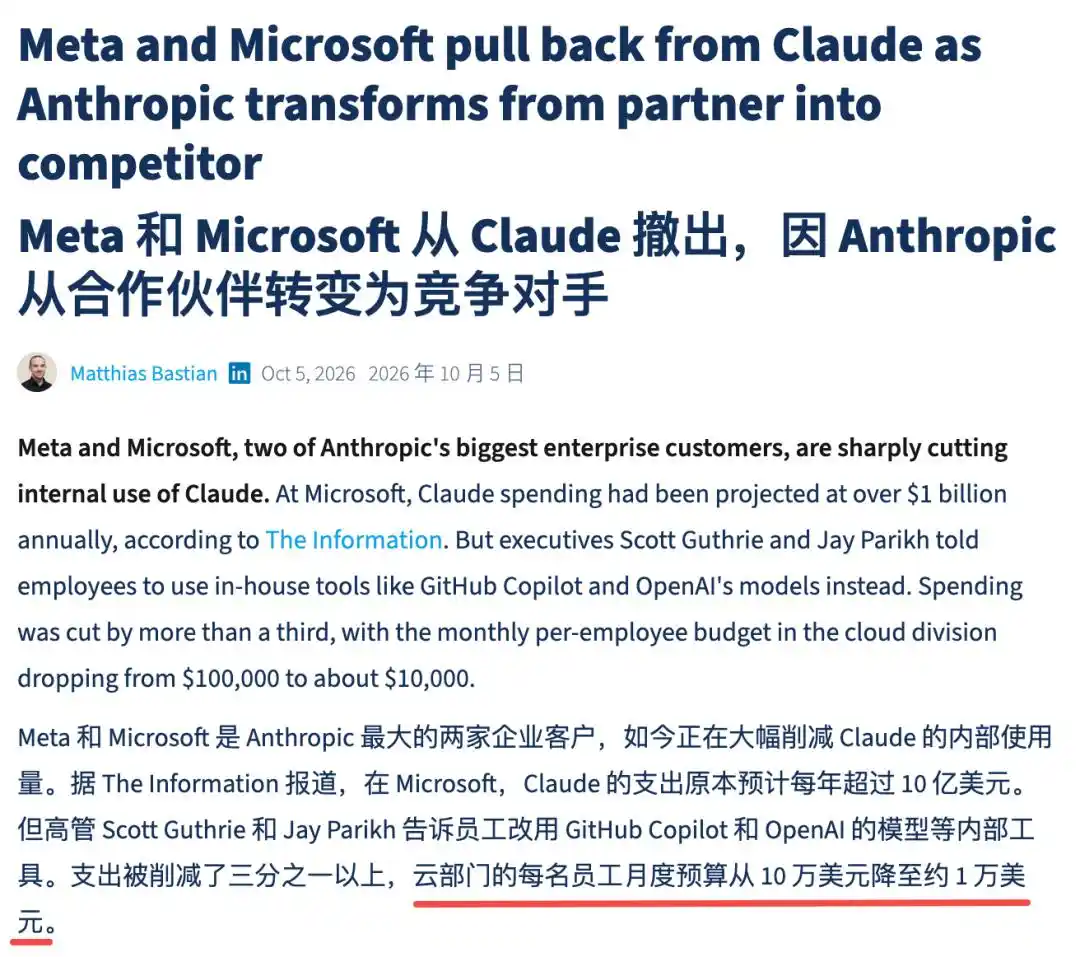
According to the latest report from The Information, Microsoft's internal budget for Claude, originally projected to exceed $10 billion this year, has been slashed by over one-third.
Meta's situation is even more drastic, with its internal Claude Code user base plummeting from about 60,000 employees to around 30,000—a halving.

Even more surreal is that with this halved user count, Meta still spent over $105 million on Claude Code in the past 28 days alone.
What is Claude's biggest problem?
It's not that it's not useful. Quite the opposite, it's too useful.
The Bill Explodes: The More Useful, The More Money Burns
Last December, Microsoft granted Claude Code access to thousands of engineers in its Experiences & Devices division.
No one promoted it, no one mobilized for it; it gained popularity on its own merits. In the first few months, token consumption doubled directly.
Each engineer's monthly token cost ranged between $500 and $2,000, burning millions of dollars for the entire team combined.
Microsoft's Cloud & AI chief Scott Guthrie and executive Jay Parikh couldn't sit still any longer, directly instructing: use less Claude, switch to GitHub Copilot and internal models.
According to The Decoder, the Cloud division's per-person monthly Claude allowance plummeted from $100,000 to about $10,000. A 90% slash in one stroke.
By May 2026, Microsoft canceled most Claude Code licenses, demanding a full migration before the fiscal year end on June 30.
Microsoft AI CEO Mustafa Suleyman said: Anthropic's solution is "extremely expensive," with the goal being to significantly reduce usage until complete cancellation.

Now look at Meta.
The recent 10% layoffs can only explain part of the employee user loss; the bigger reason is: Meta built its own replacement.
The internal coding tool MetaCode already has over 30,000 users, and Muse Code, which began external testing this August, also has over 6,000 internal users.
Meta's in-house Muse Spark model is advancing too quickly, largely displacing the demand for Claude.
Meta internally has a dashboard employees jokingly call 'Claudeonomics,' which burned 60 trillion tokens in 30 days. Equivalent to massive amounts of internal code and data daily passing through someone else's servers before returning.
What major company can tolerate this?
This is the inherent flaw of token-based billing.
In chat, you ask one question, it gives one answer; traffic is limited. But Agent mode is different; it reads code, runs tests, makes changes, and keeps working for hours, with the traffic meter constantly running. The more useful the tool, the more users, the more complex the tasks, the more terrifying the bill.
The more useful, the more expensive. The more expensive, the greater the urge to build your own.
The most painful aspect isn't just the money; it's the timing.
Anthropic secretly submitted an S-1 filing to the SEC in June this year; its public prospectus in September stated: two undisclosed customers collectively contributed about 25% of revenue.
The market widely speculates these two are Microsoft and Meta.
According to previously reported timelines, Anthropic was slated to begin its formal roadshow as early as mid-month, sprinting toward Nasdaq.
Just as a company prepares to convince investors that a quarter of its revenue might come from two customers, those very two customers coincidentally pull back at this critical juncture. If you were sitting in the roadshow audience, you'd have to think twice as well.
Furthermore, there's an even more intriguing contrast. While Microsoft is desperately saving money on Claude, Anthropic still has to spend massively on Microsoft Cloud.
The prospectus shows that Anthropic has approximately $31.4 billion in non-cancelable infrastructure purchase commitments with Microsoft.
The picture is somewhat awkward.
How Partners Turned into Rivals
The deeper logic lies in the shift in identity.
A year ago, everyone saw Anthropic as a shovel seller: the model was a tool anyone could buy and use.
But now it's different. Claude Code can write code, edit documents, run workflows itself; Claude Cowork increasingly resembles an Office alternative—and Office happens to be Microsoft's lifeline.
It's the same for Meta. They aim to turn Muse into an enterprise service; it makes no sense to fund a competitor while building a rival product.
According to reports, Meta also wants to restrict Anthropic's access to its training data.
The stronger the model, the closer it gets to the customer's core business. The closer to the core business, the less comfortable the customer is entrusting it to an outsider.
This trend isn't limited to these two companies.
In July, Alibaba completely stopped using Claude Code, pushing its in-house Qoder instead. In September, NVIDIA, Palantir, and Booz Allen also tightened usage, with NVIDIA preferring its own Nemotron when handling proprietary information.
The reasons vary. Some are cost, some data security, some prevention of distillation.
But the direction is consistent: when it comes to something as core as code, giants want to keep it in their own hands.
Anthropic is, of course, not naive; it's also responding.
The Fable 5.1 released in early September keeps base prices unchanged but slashes cached read costs by 75% in one go, making typical workloads about 25% cheaper overall, and highly Agent-intensive heavy tasks up to 45% cheaper.
Simultaneously, Anthropic adjusted its previously controversial data retention policy, allowing enterprises to keep data on their own infrastructure, trying to win back customers scared off by security concerns.
But the problem is, price cuts can only alleviate the矛盾, not solve the root cause. The giants aren't just complaining about cost; they're more concerned that this supplier is becoming their competitor.
AI Programming Enters the Accounting Era
Over the past two years, the AI industry competed on whose model was stronger, whose Agent could work independently longer.
Now, CFOs are starting to ask another question: how much does each line of code actually cost?
That's how Microsoft got here. Claude Code was so useful that usage doubled on its own, and the bill rose accordingly. Then they revoked most licenses.
No matter how much engineers love using it, it must pass the budget test.
The answer to this question is splitting the market into two layers. Models that are adequate, cheap, and controllable eat up the bulk of daily work; the strongest models are reserved only for the hardest small fraction.
For the entire AGI race, this is a brutal reminder—being the strongest isn't enough; it must also be affordable.
AI's capability curve and cost curve are now racing. No matter how fast capabilities advance, if costs don't come down, it can only reside in the hands of a few well-funded teams. Whoever makes intelligence cheap enough first will truly enter every engineer's daily routine.
Reference: https://www.theinformation.com/articles/meta-microsoft-work-wean-staff-anthropics-claude
This article is from the WeChat public account "Xin Zhi Yuan", author: ASI Revelations, editor: Solomon