Bitcoin Cierra el Cuarto Trimestre en Rojo, el Mercado Bajista Podría Extenderse 2-3 Meses

bitcoinistPublished on 2025-12-27Last updated on 2025-12-27

Abstract

Bitcoin cierra el cuarto trimestre de 2025 con una caída del 19,15%, reforzando las preocupaciones sobre la persistencia del mercado bajista. Desde su máximo de octubre en $126,200, la criptomoneda ha perdido un 30% de su valor. El analista GugaOnChain advierte que la presión a la baja podría extenderse hasta principios de 2026, respaldado por indicadores de capitulación: el SOPR está en 0,99 (ventas con pérdidas), el MVRV de corto plazo en 0,87 y el 35,66% del suministro de BTC está en pérdidas. El índice Fear & Greed marca 20, indicando "miedo extremo". Los flujos institucionales también muestran desconfianza, con salidas netas de ETFs en EE.UU. y un Coinbase Premium Gap negativo. Se anticipan correcciones adicionales en el primer trimestre de 2026 hasta que se estabilice la demanda. Al cierre, Bitcoin cotiza en $87,436.

Bitcoin está cerrando el cuarto trimestre de 2025 con debilidad, lo que refuerza las preocupaciones de que la fase de corrección del mercado está lejos de terminar. Después de alcanzar un máximo de alrededor de $126,200 a principios de octubre, la criptomoneda principal ha caído en una tendencia a la baja sostenida, perdiendo el 30% de su valor de mercado al cierre de esta edición.

Desde ese pico, Bitcoin ha luchado por recuperar de manera decisiva el nivel de $92,000, y los repetidos rechazos a precios más altos destacan una demanda menguante y una creciente cautela entre los inversores. Cabe destacar que el analista de criptomonedas GugaOnChain advierte que el cierre trimestral deficiente podría extender la presión a la baja hasta principios de 2026, ya que tanto los datos on-chain como los indicadores de sentimiento apuntan a una continuación de las condiciones bajistas.

Los Indicadores de Capitulación Señalan que el Estrés del Mercado Permanecerá en 2026

Según GugaOnChain en la publicación de QuickTake del viernes, el indicador de Rendimiento del Precio Trimestral de BTC (BTC: Quarterly Price Performance) reporta un rendimiento negativo del cuarto trimestre de -19.15%, lo que sirve como base de esta perspectiva bajista. Además, varios indicadores clave de capitulación también sugieren que el mercado no está preparado para ningún tipo de recuperación alcista.

Por ejemplo, el Ratio de Ganancias de Salidas Gastadas (Spent Output Profit Ratio - SOPR) se sitúa actualmente por debajo de 1 en 0.99, lo que indica que los inversores están vendiendo Bitcoin con pérdidas, una característica común de las fases de mercado bajista. De manera similar, el MVRV de Titulares a Corto Plazo (MVRV-STH) permanece por debajo de 1 en 0.87, señalando que los titulares a corto plazo están en una situación de pérdidas significativas y son más propensos a la capitulación en este momento.

Reforzando aún más esta narrativa, GugaOnChain señala el elevado porcentaje de la oferta de Bitcoin en pérdidas, que actualmente se sitúa en 35.66%, lo que empuja a más titulares de BTC a posiciones de pérdidas significativas, reduciendo así la confianza y aumentando el estrés del mercado. Además de estas métricas, el Índice de Miedo y Codicia (Fear & Greed Index) ha caído a la zona de "miedo extremo" en 20, lo que sugiere un pesimismo generalizado y aversión al riesgo entre los participantes.
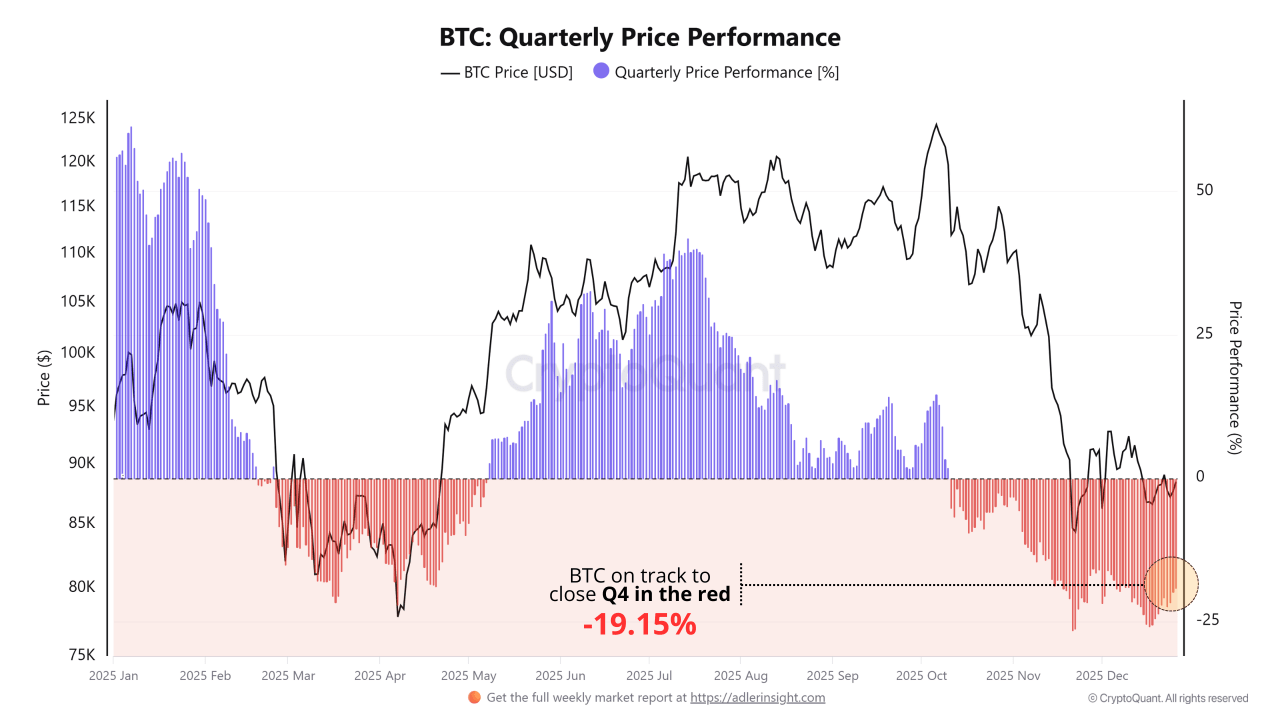
Fuente: CryptoQuant

Indicadores de Confirmación del Mercado Bajista

Más allá de las métricas de capitulación, GugaOnChain destaca indicadores de confirmación adicionales que sugieren que los riesgos a la baja seguirán siendo dominantes a corto plazo. Uno de estos indicadores, la Tasa de Crecimiento de la Capitalización de Mercado (Market Cap Growth Rate), medida por la brecha de la media móvil de 30 días frente a la de 365 días, es firmemente negativo en -11.65%, lo que apunta a una contracción del crecimiento del mercado en lugar de una expansión.

Los flujos institucionales también reflejan una confianza decreciente. Los ETF spot de Bitcoin en EE.UU. registraron salidas netas de $825.7 millones entre el 18 y el 24 de diciembre de 2025, lo que destaca el apetito institucional reducido mientras persisten las luchas de precios del Q4. Mientras tanto, la Brecha de Prima de Coinbase (Coinbase Premium Gap) se ha mantenido negativa en –66.11, lo que señala una demanda más débil de los inversores con sede en EE.UU. en comparación con los mercados extranjeros.

Al evaluar juntas estas varias métricas, GugaOnChain concluye que es probable que el mercado de criptomonedas permanezca en una fase bajista durante los próximos dos o tres meses. Por lo tanto, los inversores deberían anticipar más correcciones en el primer trimestre de 2026 hasta que las señales de capitulación disminuyan y la demanda se estabilice.

Al cierre de esta edición, Bitcoin cotiza a $87,436, lo que refleja una ligera pérdida del mercado del 0.42% en el último día.

BTC cotizando a $87,660 en el gráfico diario | Fuente: Gráfico BTCUSDT en Tradingview.com

Trending Cryptos

Related Questions

Q¿Cómo cerró Bitcoin el cuarto trimestre de 2025 según el artículo?

ABitcoin cerró el cuarto trimestre de 2025 con un rendimiento negativo del -19,15%, reforzando la preocupación de que la fase de corrección del mercado está lejos de terminar.

Q¿Qué indicador muestra que los inversores están vendiendo Bitcoin con pérdidas y cuál es su valor actual?

AEl Spent Output Profit Ratio (SOPR) es el indicador que muestra que los inversores están vendiendo Bitcoin con pérdidas, y actualmente se sitúa en 0,99 (por debajo de 1).

QSegún GugaOnChain, ¿cuánto tiempo podría persistir el mercado bajista en el criptomercado?

ASegún GugaOnChain, el criptomercado podría permanecer en una fase bajista durante los próximos dos o tres meses, extendiendo la presión a la baja hasta principios de 2026.

Q¿Qué reflejan los flujos institucionales de los ETF spot de Bitcoin en EE.UU. entre el 18 y el 24 de diciembre de 2025?

ALos ETF spot de Bitcoin en EE.UU. registraron salidas netas de 825,7 millones de dólares entre el 18 y el 24 de diciembre de 2025, lo que refleja una disminución del apetito institucional.

Q¿A qué precio cotizaba Bitcoin al cierre de la publicación y cuál fue su variación en el último día?

AAl cierre de la publicación, Bitcoin cotizaba a 87.436 dólares, reflejando una ligera pérdida del 0,42% en el último día.

Related Reads

Jensen Huang's Daughter: From Chef to an $8 Million Annual Salary

Madison Huang, daughter of NVIDIA founder Jensen Huang, recently made a rare public appearance in Beijing during the 2026 World Robot Conference. As the Senior Director of Product and Technology Marketing for NVIDIA's Physical AI Platform, with an annual salary of approximately $1.2 million, her visit focused on evaluating leading Chinese robotics companies like UBTech, Unitree, and others. This highlights NVIDIA's strategic interest in the burgeoning Chinese robotics ecosystem, a key battleground for the development of Physical AI—technology that enables machines to understand and interact with the physical world. Huang's career path is unconventional. Initially pursuing her passion, she studied culinary arts, worked as a chef, and later held a marketing role at LVMH. She joined NVIDIA as an intern in 2020 after completing an MBA, quickly rising through the ranks. Her brother, Spencer Huang, followed a similar path, closing a cocktail bar he co-founded to also join NVIDIA, where he now works on robotics software. Jensen Huang has publicly addressed nepotism concerns, humorously noting that some "second-generation" employees outperform their parents. The conference itself underscored China's vibrant robotics sector, marked by Unitree's recent blockbuster IPO and a pipeline of companies preparing to go public. While hardware development and manufacturing are advancing rapidly, industry leaders like Wang Xingxing of Unitree point to the next critical challenge: developing the "brain" or AI that allows robots to perform diverse, unseen tasks based on simple instructions. With massive manufacturing scale and diverse real-world testing scenarios, China is positioned as a central player in the global race to define the future of robotics.

marsbit8m ago

Jensen Huang's Daughter: From Chef to an $8 Million Annual Salary

marsbit8m ago

He Gave Wang Xingxing the First 2 Million, Now Serves as Chairman for the Next 'Unitree'

On August 19, 2024, Unitree Robotics, China's "first humanoid robotics stock," went public. Its founder, Wang Xingxing, started a decade ago with his self-developed XDog. In 2016, at a critical funding juncture, he received his first angel investment of 2 million RMB from Yin Fangming. This bet has since yielded a return of over 140 times. Yin Fangming is more than just a key investor. He was a co-founder of the AI robotics company ROOBO, whose own venture ultimately struggled. This firsthand experience with the hardware challenges in robotics gave him unique insight when backing Unitree, a company renowned for its hardware R&D and cost control. While his own company faltered, Yin continued investing shrewdly. He partially cashed out some Unitree shares early, reinvesting the proceeds into sectors like energy (e.g., solid-state battery firm TaiLan) and commercial aerospace (e.g., small launch vehicle developer XianDeng Aerospace). However, his most significant move after Unitree is his deep involvement with Galaxy General, a leading embodied AI unicorn. In July 2024, Yin stepped from behind the scenes to officially become its Chairman, indicating a role far beyond a typical investor. This comes as Galaxy General is viewed as preparing for future capital moves. Yin's career has consistently been ahead of the curve—from mobile internet to AI and robotics. Known for his foresight and low profile, he declined an interview for this story, offering only a statement encouraging support for visionary entrepreneurs like Wang Xingxing.

marsbit23m ago

He Gave Wang Xingxing the First 2 Million, Now Serves as Chairman for the Next 'Unitree'

marsbit23m ago

Coldcard Theft Reflection: Source Code Visibility Does Not Equal Security

The article examines the open-source vs. closed-source debate in crypto, prompted by a theft of over $100M in Bitcoin from Coldcard hardware wallets. It clarifies key terminology: true "Free and Open Source Software" (FOSS) grants four essential freedoms (use, study, share, modify), while "source available" code, like Coldcard's firmware, may have usage restrictions. The piece argues that visible source code alone does not guarantee security; actual safety depends on the economic incentives for thorough, ongoing review by skilled individuals. Using Bitcoin Core as a model, the article describes a successful, transparent open-source development culture built on public review and consensus. It contrasts this with the Coldcard case, where a critical bug in a lightly-reviewed, source-available library went undetected for years, highlighting a "tragedy of the commons" scenario where assumed but absent scrutiny creates vulnerability. The economics of licensing are crucial: restrictive licenses can limit the pool of motivated commercial reviewers. Finally, the article explores AI's impact. It cites the Bitcoin Red Team's use of AI to rapidly audit codebases and find vulnerabilities at scale, demonstrating a powerful new tool for security. However, AI also floods projects with low-quality code, straining maintainers. The piece concludes that in high-stakes crypto, only well-audited projects—whether open or closed-source—can withstand evolving threats, with AI both challenging and aiding security practices.

marsbit33m ago

Coldcard Theft Reflection: Source Code Visibility Does Not Equal Security

marsbit33m ago

Trading

Spot

Hot Articles

What is $BITCOIN

DIGITAL GOLD ($BITCOIN): A Comprehensive Analysis Introduction to DIGITAL GOLD ($BITCOIN) DIGITAL GOLD ($BITCOIN) is a blockchain-based project operating on the Solana network, which aims to combine the characteristics of traditional precious metals with the innovation of decentralized technologies. While it shares a name with Bitcoin, often referred to as “digital gold” due to its perception as a store of value, DIGITAL GOLD is a separate token designed to create a unique ecosystem within the Web3 landscape. Its goal is to position itself as a viable alternative digital asset, although specifics regarding its applications and functionalities are still developing. What is DIGITAL GOLD ($BITCOIN)? DIGITAL GOLD ($BITCOIN) is a cryptocurrency token explicitly designed for use on the Solana blockchain. In contrast to Bitcoin, which provides a widely recognized value storage role, this token appears to focus on broader applications and characteristics. Notable aspects include: Blockchain Infrastructure: The token is built on the Solana blockchain, known for its capacity to handle high-speed and low-cost transactions. Supply Dynamics: DIGITAL GOLD has a maximum supply capped at 100 quadrillion tokens (100P $BITCOIN), although details regarding its circulating supply are currently undisclosed. Utility: While precise functionalities are not explicitly outlined, there are indications that the token could be utilized for various applications, potentially involving decentralized applications (dApps) or asset tokenization strategies. Who is the Creator of DIGITAL GOLD ($BITCOIN)? At present, the identity of the creators and development team behind DIGITAL GOLD ($BITCOIN) remains unknown. This situation is typical among many innovative projects within the blockchain space, particularly those aligning with decentralized finance and meme coin phenomena. While such anonymity may foster a community-driven culture, it intensifies concerns about governance and accountability. Who are the Investors of DIGITAL GOLD ($BITCOIN)? The available information indicates that DIGITAL GOLD ($BITCOIN) does not have any known institutional backers or prominent venture capital investments. The project seems to operate on a peer-to-peer model focused on community support and adoption rather than traditional funding routes. Its activity and liquidity are primarily situated on decentralized exchanges (DEXs), such as PumpSwap, rather than established centralized trading platforms, further highlighting its grassroots approach. How DIGITAL GOLD ($BITCOIN) Works The operational mechanics of DIGITAL GOLD ($BITCOIN) can be elaborated on based on its blockchain design and network attributes: Consensus Mechanism: By leveraging Solana’s unique proof-of-history (PoH) combined with a proof-of-stake (PoS) model, the project ensures efficient transaction validation contributing to the network's high performance. Tokenomics: While specific deflationary mechanisms have not been extensively detailed, the vast maximum token supply implies that it may cater to microtransactions or niche use cases that are still to be defined. Interoperability: There exists the potential for integration with Solana’s broader ecosystem, including various decentralized finance (DeFi) platforms. However, the details regarding specific integrations remain unspecified. Timeline of Key Events Here is a timeline that highlights significant milestones concerning DIGITAL GOLD ($BITCOIN): 2023: The initial deployment of the token occurs on the Solana blockchain, marked by its contract address. 2024: DIGITAL GOLD gains visibility as it becomes available for trading on decentralized exchanges like PumpSwap, allowing users to trade it against SOL. 2025: The project witnesses sporadic trading activity and potential interest in community-led engagements, although no noteworthy partnerships or technical advancements have been documented as of yet. Critical Analysis Strengths Scalability: The underlying Solana infrastructure supports high transaction volumes, which could enhance the utility of $BITCOIN in various transaction scenarios. Accessibility: The potential low trading price per token could attract retail investors, facilitating wider participation due to fractional ownership opportunities. Risks Lack of Transparency: The absence of publicly known backers, developers, or an audit process may yield skepticism regarding the project's sustainability and trustworthiness. Market Volatility: The trading activity is heavily reliant on speculative behavior, which can result in significant price volatility and uncertainty for investors. Conclusion DIGITAL GOLD ($BITCOIN) emerges as an intriguing yet ambiguous project within the rapidly evolving Solana ecosystem. While it attempts to leverage the “digital gold” narrative, its departure from Bitcoin's established role as a store of value underscores the need for a clearer differentiation of its intended utility and governance structure. Future acceptance and adoption will likely depend on addressing the current opacity and defining its operational and economic strategies more explicitly. Note: This report encompasses synthesised information available as of October 2023, and developments may have transpired beyond the research period.

2.1k Total ViewsPublished 2025.05.13Updated 2025.05.13

What is $BITCOIN

Discussions

Welcome to the HTX Community. Here, you can stay informed about the latest platform developments and gain access to professional market insights. Users' opinions on the price of BTC (BTC) are presented below.

活动图片