Bitcoin Vs. XRP: Will BRICS Influence The US Crypto Reserve?

bitcoinistPublished on 2025-01-27Last updated on 2025-01-27

Abstract

An online confrontation broke out between the Bitcoin and XRP communities over the weekend, fueled by former President Donald Trump’s...

An online confrontation broke out between the Bitcoin and XRP communities over the weekend, fueled by former President Donald Trump’s last weeks’ announcement of a “Digital Asset Stockpile” under his administration’s newly unveiled crypto executive order. Although many observers expected a declaration of a “Bitcoin Strategic Reserve,” the broader term set off debates about whether assets beyond Bitcoin—particularly XRP—would be included in the United States’ national digital asset holdings.

Jason P. Lowery, a US Space Force officer and astronautical engineer known for his well-regarded MIT thesis linking Bitcoin’s Proof-of-Work consensus mechanism to a form of national security infrastructure, has positioned himself to the question if it is likely the the Trump administration will add other crypto assets to its “digital asset stockpile” besides Bitcoin.

Why Bitcoin And Not XRP

In a post on X on Sunday, Lowery expressed skepticism about whether governments like those in the BRICS bloc (Brazil, Russia, India, China, and South Africa) would ever adopt a cryptocurrency that is perceived to be under US jurisdiction. While he did not specifically name XRP, Lowery’s references to “meme coin” or “one controlled by an American CEO” can be interpreted as a veiled nod to XRP or any cryptocurrency managed by a US-based entity.

In his own words: “Do you really think BRICS is interested in adding a meme coin to their reserves, or one controlled by an American CEO? Do you believe they’d choose a USD stablecoin issued by an American company trying to position itself as a neo-Federal Reserve Bank?”

He added, “Or are they far more likely to adopt the coin that has been relentlessly vilified and condemned by the US for over 15 years precisely because it operates beyond US control? The coin that guarantees sovereign access to block space, ensuring transactions cannot be censored or denied, provided they continue to possess the physical power and infrastructure they’ve already invested in.”

Lowery’s remarks underscore his overarching thesis that Bitcoin has strategic properties appealing to nations outside the US sphere of influence, particularly because of its decentralized, censorship-resistant architecture. In his view, this places Bitcoin in a unique position on the global geopolitical chessboard.

Lowery’s critical question revolves less around technological merit and more around geopolitical choice. He contends that, when it comes to forming the next “global reserve asset,” the ultimate deciding factor will be what other nations want to hold—particularly potential competitors and adversaries such as China or Russia. He explained:

“The next global reserve asset, by definition, will be the one chosen by other nations—particularly our global competitors. And BRICS will almost certainly favor the asset that offers the greatest independence from US influence—the one that is demonstrably censorship-resistant, provably decentralized, and sovereign. The one that wasn’t premined. The one that isn’t being shilled by cringey, wannabe American influencers.”

His caution to the US crypto community is explicit: favoring an asset domestically is not enough if adversaries find no strategic reason to adopt it. Lowery emphasized the importance of assessing whether foreign governments would realistically add significant amounts of a given digital asset to their state reserves. Otherwise, he suggests, advocating for any other coin—especially one tied closely to US authorities or corporate entities—may be a futile exercise that could inadvertently “undermine the future security and prosperity of this nation.”

While the Trump administration has yet to clarify whether any crypto beyond Bitcoin will be included in the US “Digital Asset Stockpile,” Ripple advocates remain hopeful. They contend that regulatory clarity around XRP and ongoing partnerships with financial institutions may eventually secure it a position as a recognized strategic asset.

Still, according to Lowery, global trends—and notably BRICS’ actions—might override any domestic optimism. If countries in the BRICS bloc and beyond decide that Bitcoin’s decentralization and resistance to censorship confer a distinct geostrategic advantage, they could choose to adopt it en masse. From Lowery’s perspective, this potential international preference for Bitcoin would force the US to bolster its own holdings or risk strategic disadvantage:

“If you cannot confidently say that nations like China or Russia will add massive amounts of your favored crypto asset to their strategic reserves, then you are being insincere—and you’re undermining the future security and prosperity of this nation.”

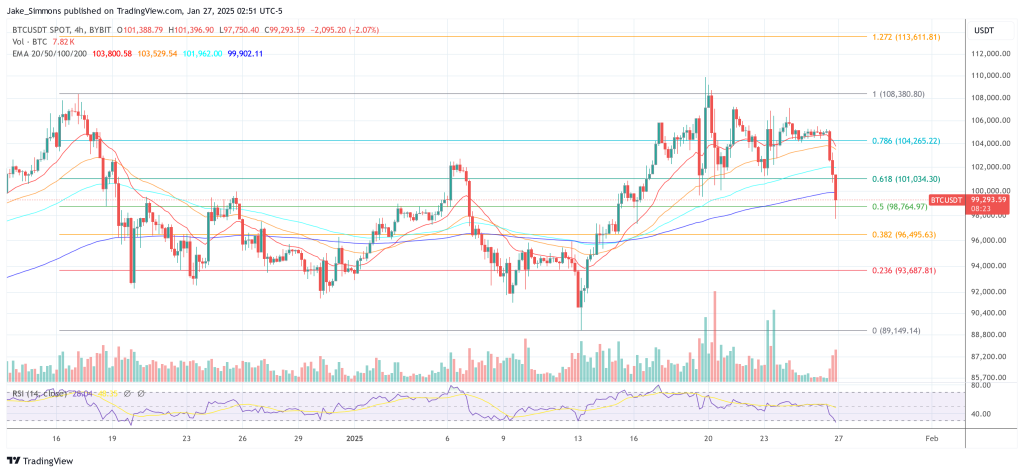
At press time, BTC traded at $99,293.
Bitcoin price
Bitcoin price, 4-hour chart | Source: BTCUSDT on TradingView.com
Featured image created with DALL.E, chart from TradingView.com
Jake Simmons

Jake Simmons

Jake Simmons has been a Bitcoin enthusiast since 2016. Ever since he heard about Bitcoin, he has been studying the topic every day and trying to share his knowledge with others. His goal is to contribute to Bitcoin's financial revolution, which will replace the fiat money system. Besides BTC and crypto, Jake studied Business Informatics at a university. After graduation in 2017, he has been working in the blockchain and crypto sector. You can follow Jake on Twitter at @realJakeSimmons.

Related Reads

a16z: 7 Charts to Understand How Tokenization Is Changing the Nature of Assets

a16z: 7 Charts on How Tokenization is Transforming the Nature of Assets Tokenized Assets, often referred to as "real-world assets" (RWA), are altering the form, flow, and structure of the financial system. The market recently surpassed $30 billion (excluding stablecoins), driven largely by tokenized U.S. Treasuries. These offer investors digital, yield-bearing assets with efficient settlement. Growth varies significantly by asset class. Asset-backed credit leads in speed, followed by niche financial assets, while venture capital and active strategies took longer to scale. U.S. Treasuries and commodities dominate, holding about two-thirds of the current market share. Within commodities, gold tokenization dominates entirely due to its standardization and historical appeal in crypto. The ecosystem is spread across multiple blockchains. Ethereum holds over half the market, with others like BNB Chain, Solana, and Stellar holding significant shares. However, a key insight is that most tokenized assets currently lack "composability." While the total market is large, only a small fraction (e.g., 5% of tokenized bonds) is used within DeFi protocols. Many tokens are simply digital records of off-chain assets, not natively programmable financial building blocks. In contrast, smaller categories like reinsurance tokens see very high on-chain usage. Looking ahead, forecasts for the tokenized asset market by 2030 range from $2 trillion to over $30 trillion, representing immense potential growth from today's ~$340 billion base. Yet, relative to global markets (e.g., $140T+ in bonds), tokenization's penetration remains minuscule (<0.02%). The current phase focuses on digitizing straightforward assets for efficiency. The next major challenge is bringing more complex financial instruments on-chain and integrating tokenized assets into truly composable, internet-native financial infrastructure.

marsbit10m ago

a16z: 7 Charts to Understand How Tokenization Is Changing the Nature of Assets

marsbit10m ago

Under the squeeze between giants Tether and Circle, how can foreign exchange stablecoins break through?

In the face of dominance by Tether (USDT) and Circle (USDC), new entrants in the stablecoin space face significant challenges competing directly, especially in the foreign exchange (FX) market. A more viable and efficient path forward is the adoption of synthetic foreign exchange (Forex) built atop existing USD stablecoin rails. The rise of stablecoin neo-banks represents the next major growth area for mass crypto adoption, with FX becoming a core component. However, replicating the vast liquidity, distribution channels, and network effects of USDT/USDC is extremely difficult for new FX stablecoin issuers. The total market cap of all FX stablecoins is a fraction (roughly 1/700th) of USD stablecoins, leading to issues like poor liquidity, peg instability, limited acceptance, and complex compliance hurdles. Instead of issuing spot FX stablecoins, the article advocates for a model inspired by traditional finance's non-deliverable forwards (NDFs). Users would continue to hold underlying USDT/USDC, while their account balances are displayed and economically settled in their preferred local currency through MtM (Mark-to-Market) NDF structures. This approach leverages the deep liquidity and infrastructure of USD stablecoins while providing synthetic forex exposure. Key advantages include strong peg stability via oracles, retained access to USD stablecoin yields and liquidity, high capital efficiency, and easy scalability to new currencies. Primary use cases for this on-chain NDF forex include: 1. Neo-banks, custodians, and wallets offering multi-currency accounts to attract international users and increase deposits. 2. Forex carry trade strategies, potentially offering more stable and scalable yields compared to crypto-native products like Ethena. 3. Global corporate payments, allowing businesses to receive payments in local currencies while hedging forex risk on-chain, similar to services offered by Stripe in traditional finance. This synthetic forex model presents a pragmatic solution to overcome the network effects of incumbents and unlock the next wave of stablecoin utility for global consumers and businesses.

marsbit4h ago

Under the squeeze between giants Tether and Circle, how can foreign exchange stablecoins break through?

marsbit4h ago

Trading

Spot
Futures

Hot Articles

What is $BITCOIN

DIGITAL GOLD ($BITCOIN): A Comprehensive Analysis Introduction to DIGITAL GOLD ($BITCOIN) DIGITAL GOLD ($BITCOIN) is a blockchain-based project operating on the Solana network, which aims to combine the characteristics of traditional precious metals with the innovation of decentralized technologies. While it shares a name with Bitcoin, often referred to as “digital gold” due to its perception as a store of value, DIGITAL GOLD is a separate token designed to create a unique ecosystem within the Web3 landscape. Its goal is to position itself as a viable alternative digital asset, although specifics regarding its applications and functionalities are still developing. What is DIGITAL GOLD ($BITCOIN)? DIGITAL GOLD ($BITCOIN) is a cryptocurrency token explicitly designed for use on the Solana blockchain. In contrast to Bitcoin, which provides a widely recognized value storage role, this token appears to focus on broader applications and characteristics. Notable aspects include: Blockchain Infrastructure: The token is built on the Solana blockchain, known for its capacity to handle high-speed and low-cost transactions. Supply Dynamics: DIGITAL GOLD has a maximum supply capped at 100 quadrillion tokens (100P $BITCOIN), although details regarding its circulating supply are currently undisclosed. Utility: While precise functionalities are not explicitly outlined, there are indications that the token could be utilized for various applications, potentially involving decentralized applications (dApps) or asset tokenization strategies. Who is the Creator of DIGITAL GOLD ($BITCOIN)? At present, the identity of the creators and development team behind DIGITAL GOLD ($BITCOIN) remains unknown. This situation is typical among many innovative projects within the blockchain space, particularly those aligning with decentralized finance and meme coin phenomena. While such anonymity may foster a community-driven culture, it intensifies concerns about governance and accountability. Who are the Investors of DIGITAL GOLD ($BITCOIN)? The available information indicates that DIGITAL GOLD ($BITCOIN) does not have any known institutional backers or prominent venture capital investments. The project seems to operate on a peer-to-peer model focused on community support and adoption rather than traditional funding routes. Its activity and liquidity are primarily situated on decentralized exchanges (DEXs), such as PumpSwap, rather than established centralized trading platforms, further highlighting its grassroots approach. How DIGITAL GOLD ($BITCOIN) Works The operational mechanics of DIGITAL GOLD ($BITCOIN) can be elaborated on based on its blockchain design and network attributes: Consensus Mechanism: By leveraging Solana’s unique proof-of-history (PoH) combined with a proof-of-stake (PoS) model, the project ensures efficient transaction validation contributing to the network's high performance. Tokenomics: While specific deflationary mechanisms have not been extensively detailed, the vast maximum token supply implies that it may cater to microtransactions or niche use cases that are still to be defined. Interoperability: There exists the potential for integration with Solana’s broader ecosystem, including various decentralized finance (DeFi) platforms. However, the details regarding specific integrations remain unspecified. Timeline of Key Events Here is a timeline that highlights significant milestones concerning DIGITAL GOLD ($BITCOIN): 2023: The initial deployment of the token occurs on the Solana blockchain, marked by its contract address. 2024: DIGITAL GOLD gains visibility as it becomes available for trading on decentralized exchanges like PumpSwap, allowing users to trade it against SOL. 2025: The project witnesses sporadic trading activity and potential interest in community-led engagements, although no noteworthy partnerships or technical advancements have been documented as of yet. Critical Analysis Strengths Scalability: The underlying Solana infrastructure supports high transaction volumes, which could enhance the utility of $BITCOIN in various transaction scenarios. Accessibility: The potential low trading price per token could attract retail investors, facilitating wider participation due to fractional ownership opportunities. Risks Lack of Transparency: The absence of publicly known backers, developers, or an audit process may yield skepticism regarding the project's sustainability and trustworthiness. Market Volatility: The trading activity is heavily reliant on speculative behavior, which can result in significant price volatility and uncertainty for investors. Conclusion DIGITAL GOLD ($BITCOIN) emerges as an intriguing yet ambiguous project within the rapidly evolving Solana ecosystem. While it attempts to leverage the “digital gold” narrative, its departure from Bitcoin's established role as a store of value underscores the need for a clearer differentiation of its intended utility and governance structure. Future acceptance and adoption will likely depend on addressing the current opacity and defining its operational and economic strategies more explicitly. Note: This report encompasses synthesised information available as of October 2023, and developments may have transpired beyond the research period.

363 Total ViewsPublished 2025.05.13Updated 2025.05.13

What is $BITCOIN

Discussions

Welcome to the HTX Community. Here, you can stay informed about the latest platform developments and gain access to professional market insights. Users' opinions on the price of BTC (BTC) are presented below.

活动图片