Solv在KBW发布标准化一体式比特币质押平台

Odaily星球日报Published on 2024-09-10Last updated on 2024-09-10

Abstract

让比特币质押变得更加便捷,推动DeFi生态扩展。

Solv在KBW发布标准化一体式比特币质押平台

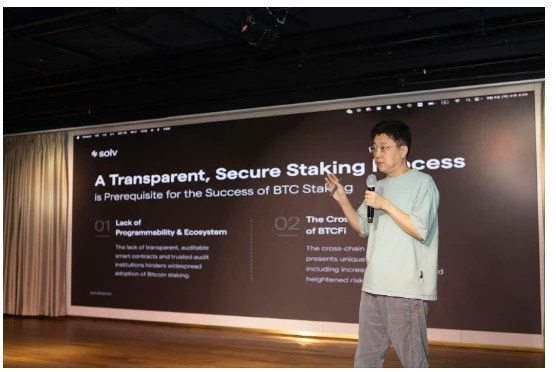
2024 年 KBW 活动期间,比特币质押成为热议话题之一。Solv 协议与 Eigenlayer、GoPlus Security、Altlayer 和 Dodo Chain 联合举办了主题活动,探讨 BTC、AVS 和安全性。在活动中,Solv 的创始人兼 CTO Will Wang 公布 “ Solv 一体化比特币质押方案”,其目标是构建一个安全、高效、易用的平台,让比特币质押变得更加便捷,推动 DeFi 生态扩展。

作为市场上最大的比特币质押平台,Solv 拥有超过 20, 000 个 BTC 的质押量和超过 20 万用户。超过 70% 的 SolvBTC (Solv 推出的比特币资产)已投入各类质押场景,成为当前比特币领域中 TVL 最高、资金利用效率最高的协议。

“比特币质押:DeFi 的下一个增长引擎”

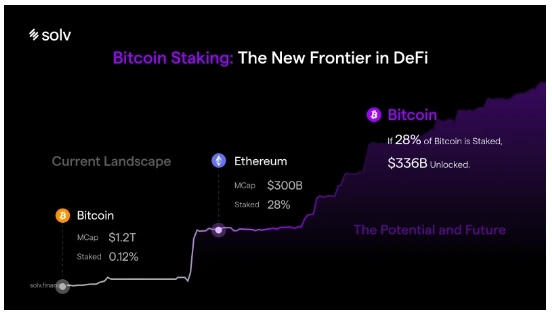
Solv 协议主张通过比特币质押解锁 1.2 万亿美元的比特币资产潜力。Will 在演讲中指出,当前比特币质押的采用率远低于以太坊,而以太坊的质押率已达到 28% 。若比特币能达到类似的质押率,将释放约 3300 亿美元的价值,推动 DeFi 的进一步发展。

Solv在KBW发布标准化一体式比特币质押平台

然而,几个关键挑战阻碍了比特币质押的广泛普及:

  • 可编程性不足:缺乏透明、可审计的智能合约,限制了质押的广泛应用。

  • 基础设施碎片化:质押活动分散在多个链上,增加了用户参与的复杂性和风险。

“比特币质押需要新一代的基础设施”

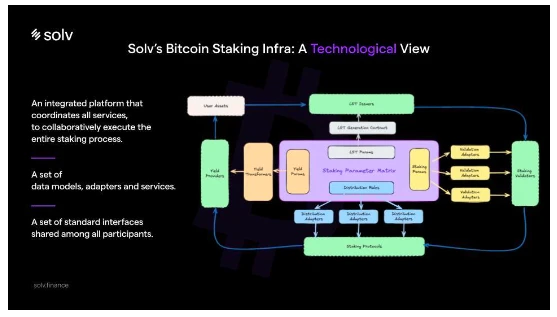
Solv 提出一体化质押平台,重新定义了整个质押流程和生态系统。

Solv在KBW发布标准化一体式比特币质押平台

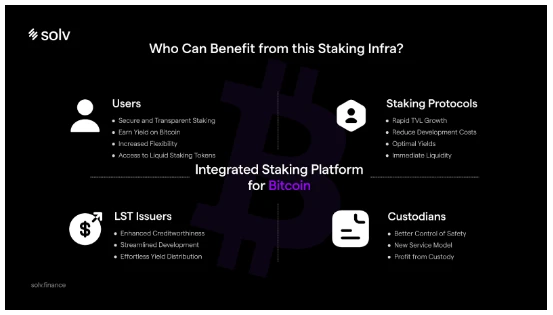
在该架构中,将质押流程分解为四个关键角色,并通过一体化的平台架构将他们紧密联系在一起:

  • LST 发行者 (LST Issuers):  创建与质押比特币挂钩的流动性收益代币(LST)。Solv 是当前市场上最大的 Bitcoin LST Issuer。

  • 质押协议 (Staking Protocols):  管理用户存入的比特币,提供安全收益。例如 Babylon、CoreDao、Botanix、Ethena、GMX 等协议。

  • 质押验证者 (Staking Validators):  例如 Ceffu、Cobo、Fireblocks、Solv Guard 等,负责验证交易,确保质押交易的有效性,并及时更新验证状态。

  • 收益分配者 (Yield Distributors): 及时、准确地分配用户的质押奖励。例如 Babylon、Solv、Pendle、Gauntlet、Antalpha 等。

通过整合这四个角色,Solv 构建了一个完整的比特币质押生态系统,为用户提供更便捷、更安全、更具吸引力的质押体验。

“四大核心优势:安全、便捷、开放和标准化”

Will 在演讲中总结了 Solv 一体化平台的四大优势:

  • 安全保障:  通过整合活跃验证服务 (AVS) 来确保质押交易的安全性。 AVS 会监控质押交易的各个环节,例如目标地址、脚本哈希、质押期限等,确保交易的有效性和安全性,避免出现错误或恶意行为。

  • 流程优化: 简化了质押流程,用户只需将比特币存入平台,即可享受安全、高效的质押服务,并获得收益。

  • 开放与合作:  这是一个开放、包容和高效的生态系统。例如,Solv 与 Ceffu 合作,在 Babylon 网络上成功实现了质押验证服务。

  • 行业标准化:作为一套规范 BTC 质押流程和参数体系的标准化质押流程,能让 BTC 质押行业快速发展。

Solv在KBW发布标准化一体式比特币质押平台

Solv 打造的多元化 LST 资产

在演讲最后,Will 还介绍了 Solv 基于一体化平台打造了的多种独特的 LST 资产.除了 Solv 与 Babylon、Ethena 联合推出的 SolvBTC.BBN(Babylon LST) 和 SolvBTC.ENA  之外,Will 还透露 Solv 即将推出 SolvBTC.Core 和 SolvBTC.CASH。分别是基于 PoS 共识网络的生息资产和基于期权套利的机构级固收资产。

当前,Solv 已与 20 余条行业领先的公链和 DeFi 协议建立了战略合作,巩固了其在比特币领域的生态优势。此次推出的一体化质押平台是行业首个标准化质押流程,标志着比特币质押行业的重大飞跃。这一创新将极大推动 BTC 质押的快速发展,奠定 Solv 在比特币质押领域的领军地位。

Related Reads

The Veil of Mythos Becomes Anthropic's Lever to Move Trillions

The article discusses Anthropic's reported upcoming $30 billion funding round, which would value the company at over $900 billion. It analyzes how the company has leveraged strategic narratives around its unreleased "Mythos" model, rather than just its publicly available products, to drive this massive valuation. Key points include Google's surprising $40 billion investment in a competitor, suggesting it is buying strategic positioning. Anthropic's "Glasswing" cybersecurity project and the unreleased Mythos model are portrayed not through direct proof, but through carefully crafted narratives of being "too powerful for public release," creating an aura of exclusive, high-level capability. This is bolstered by reports of the White House and NSA seeking access to Claude/Mythos despite previous security concerns, implying indispensable technology. Furthermore, Anthropic's reported rapid revenue growth—from a $1 billion annual run-rate in late 2024 to over $30 billion by April 2026, largely driven by enterprise API and Claude Code—provides a financial story for investors. The article concludes that Anthropic's core business model is effectively converting unverifiable technical potential, government interest, and future revenue projections into a compelling narrative that secures immense capital, using the actions of wealthy investors and powerful institutions as the ultimate validation of its worth.

marsbit33m ago

The Veil of Mythos Becomes Anthropic's Lever to Move Trillions

marsbit33m ago

Google CEO Admits Lagging Behind in Coding

Google CEO Sundar Pichai acknowledged in a recent interview that Google's Gemini AI models are currently "lagging behind" in coding capabilities, particularly for complex, long-horizon tasks requiring advanced developer expertise. He noted the field is advancing at an "unprecedented" pace, where 30-60 days now brings changes equivalent to five years in the past. Pichai expressed that achieving Artificial General Intelligence (AGI) now seems closer than previously imagined due to rapid progress. While highlighting strengths in text, multimodal, and reasoning tasks, Pichai admitted competitors like Anthropic and OpenAI have focused more intently on coding. He emphasized Google's commitment to catching up, citing internal tools like Antigravity 2.0 and the newly released Gemini 3.5 Flash, which aims to address previous shortcomings. Regarding Google Search's AI-driven overhaul, Pichai stated changes will be gradual to align with user needs, not disrupt the core search experience or its advertising model. He addressed public AI anxiety as understandable, given the technology's potential to reshape jobs and society, but remained optimistic about AI augmenting human capabilities and creating new opportunities. Pichai stressed the need for broad societal dialogue and responsible development as AI approaches more advanced, potentially recursive self-improvement stages. He affirmed Google's long-term commitment to leading in AI while navigating its profound implications responsibly.

marsbit2h ago

Google CEO Admits Lagging Behind in Coding

marsbit2h ago

The Paradox of Automation: The Stronger the AI, the Busier Humans Become

The Paradox of Automation: The more powerful AI becomes, the more work humans have to do. This article, based on observations from AI-heavy company Every, argues that while AI agents automate tasks like coding, writing, and customer service, they don't eliminate human jobs. Instead, they transform work and create *more* demand for human expertise. AI commoditizes "yesterday's human capabilities" by cheaply generating code, text, and images from past data. This leads to an abundance of similar, generic outputs. Consequently, what becomes scarce and valuable is human judgment in the present moment: knowing *what* is worth doing, *why*, and *how* to do it well. The article identifies two collaboration models: "Agent employees" for delegated tasks and "human-AI collaboration" within tools like Claude Code for complex work. In both cases, humans are essential to set direction, judge quality, and maintain systems. As AI makes execution cheap, human roles shift from executors to designers, reviewers, and meaning-makers. The author addresses "benchmark anxiety" by explaining that AI excels within specific, human-defined problem "frames." As AI masters one frame (e.g., code rewriting), new, more complex frames emerge (e.g., deciding *when* to rewrite). This creates an ongoing cycle where AI chases the frames, but humans remain the "framers." Even with advanced AGI, this dynamic may persist as long as AI lacks true human-like agency and self-directed purpose. The core paradox holds: automation amplifies the need for the very human judgment it seems to replace.

marsbit3h ago

The Paradox of Automation: The Stronger the AI, the Busier Humans Become

marsbit3h ago

a16z: 7 Charts to Understand How Tokenization is Changing the Nature of Assets

"a16z: 7 Charts on How Tokenization is Changing the Nature of Assets" Tokenized Assets (or Real-World Assets - RWA) are transforming asset forms, liquidity, and financial system construction. The market recently surpassed $30 billion, stabilizing around $34 billion (excluding stablecoins), representing a tenfold increase in less than two years, driven by clearer regulations, mature institutional infrastructure, and increased financial institution adoption. The primary driver of recent growth is tokenized U.S. Treasury bonds. These offer investors efficient, flexible digital access to yield-bearing assets and improve institutional operations like settlement and collateral management. Other asset classes show varied growth: asset-backed credit leads, followed by niche financial assets (e.g., reinsurance, mining notes), while venture capital took longer to scale. Market segmentation shows high concentration. In commodities, tokenized gold dominates (~$5 billion), as its standardized, storable nature fits tokenization well. Bonds are the largest category ($15.2B), but only ~5% are used in DeFi protocols. Conversely, smaller niches like reinsurance tokens see high (~84%) on-chain utilization, highlighting a core industry divide: most current tokenized assets are merely digitized records for easier holding/transfer, lacking the "composability" (free combination/interaction) that is key to blockchain-native finance. The ecosystem is distributed across multiple blockchains, with Ethereum hosting over half the value ($15.7B), followed by BNB Chain, Solana, and others. Future market size predictions vary widely (e.g., $2-$30 trillion by 2030+), but all indicate massive potential from the current small base. Tokenized assets currently represent minuscule fractions of their global counterparts (e.g., 0.01% of global bonds). The current phase focuses on digitizing straightforward assets. The next challenge is to bring more complex financial components on-chain and deeply integrate tokenized assets into composable, internet-native financial infrastructure.

链捕手4h ago

a16z: 7 Charts to Understand How Tokenization is Changing the Nature of Assets

链捕手4h ago

Trading

Spot
Futures

Hot Articles

What is $BITCOIN

DIGITAL GOLD ($BITCOIN): A Comprehensive Analysis Introduction to DIGITAL GOLD ($BITCOIN) DIGITAL GOLD ($BITCOIN) is a blockchain-based project operating on the Solana network, which aims to combine the characteristics of traditional precious metals with the innovation of decentralized technologies. While it shares a name with Bitcoin, often referred to as “digital gold” due to its perception as a store of value, DIGITAL GOLD is a separate token designed to create a unique ecosystem within the Web3 landscape. Its goal is to position itself as a viable alternative digital asset, although specifics regarding its applications and functionalities are still developing. What is DIGITAL GOLD ($BITCOIN)? DIGITAL GOLD ($BITCOIN) is a cryptocurrency token explicitly designed for use on the Solana blockchain. In contrast to Bitcoin, which provides a widely recognized value storage role, this token appears to focus on broader applications and characteristics. Notable aspects include: Blockchain Infrastructure: The token is built on the Solana blockchain, known for its capacity to handle high-speed and low-cost transactions. Supply Dynamics: DIGITAL GOLD has a maximum supply capped at 100 quadrillion tokens (100P $BITCOIN), although details regarding its circulating supply are currently undisclosed. Utility: While precise functionalities are not explicitly outlined, there are indications that the token could be utilized for various applications, potentially involving decentralized applications (dApps) or asset tokenization strategies. Who is the Creator of DIGITAL GOLD ($BITCOIN)? At present, the identity of the creators and development team behind DIGITAL GOLD ($BITCOIN) remains unknown. This situation is typical among many innovative projects within the blockchain space, particularly those aligning with decentralized finance and meme coin phenomena. While such anonymity may foster a community-driven culture, it intensifies concerns about governance and accountability. Who are the Investors of DIGITAL GOLD ($BITCOIN)? The available information indicates that DIGITAL GOLD ($BITCOIN) does not have any known institutional backers or prominent venture capital investments. The project seems to operate on a peer-to-peer model focused on community support and adoption rather than traditional funding routes. Its activity and liquidity are primarily situated on decentralized exchanges (DEXs), such as PumpSwap, rather than established centralized trading platforms, further highlighting its grassroots approach. How DIGITAL GOLD ($BITCOIN) Works The operational mechanics of DIGITAL GOLD ($BITCOIN) can be elaborated on based on its blockchain design and network attributes: Consensus Mechanism: By leveraging Solana’s unique proof-of-history (PoH) combined with a proof-of-stake (PoS) model, the project ensures efficient transaction validation contributing to the network's high performance. Tokenomics: While specific deflationary mechanisms have not been extensively detailed, the vast maximum token supply implies that it may cater to microtransactions or niche use cases that are still to be defined. Interoperability: There exists the potential for integration with Solana’s broader ecosystem, including various decentralized finance (DeFi) platforms. However, the details regarding specific integrations remain unspecified. Timeline of Key Events Here is a timeline that highlights significant milestones concerning DIGITAL GOLD ($BITCOIN): 2023: The initial deployment of the token occurs on the Solana blockchain, marked by its contract address. 2024: DIGITAL GOLD gains visibility as it becomes available for trading on decentralized exchanges like PumpSwap, allowing users to trade it against SOL. 2025: The project witnesses sporadic trading activity and potential interest in community-led engagements, although no noteworthy partnerships or technical advancements have been documented as of yet. Critical Analysis Strengths Scalability: The underlying Solana infrastructure supports high transaction volumes, which could enhance the utility of $BITCOIN in various transaction scenarios. Accessibility: The potential low trading price per token could attract retail investors, facilitating wider participation due to fractional ownership opportunities. Risks Lack of Transparency: The absence of publicly known backers, developers, or an audit process may yield skepticism regarding the project's sustainability and trustworthiness. Market Volatility: The trading activity is heavily reliant on speculative behavior, which can result in significant price volatility and uncertainty for investors. Conclusion DIGITAL GOLD ($BITCOIN) emerges as an intriguing yet ambiguous project within the rapidly evolving Solana ecosystem. While it attempts to leverage the “digital gold” narrative, its departure from Bitcoin's established role as a store of value underscores the need for a clearer differentiation of its intended utility and governance structure. Future acceptance and adoption will likely depend on addressing the current opacity and defining its operational and economic strategies more explicitly. Note: This report encompasses synthesised information available as of October 2023, and developments may have transpired beyond the research period.

363 Total ViewsPublished 2025.05.13Updated 2025.05.13
What is $BITCOIN

Discussions

Welcome to the HTX Community. Here, you can stay informed about the latest platform developments and gain access to professional market insights. Users' opinions on the price of BTC (BTC) are presented below.

活动图片