What Kind of People Is Anthropic Actually Hiring? Insights from 1,680 Resumes Provide the Answer

marsbitPublished on 2026-06-15Last updated on 2026-06-15

Abstract

Contrary to the common perception of Anthropic as a PhD-heavy AI research lab, an analysis of 1,680 engineer profiles reveals its core talent is experienced "builders." The engineering team, largely assembled in the past 18 months (median tenure 10 months), hires senior engineers with a median of 12.2 years of prior experience. They primarily come from major engineering-focused companies like Google, Meta, Amazon, Microsoft, Stripe, Databricks, Snowflake, and Palantir, not primarily from other AI labs. Their backgrounds are infrastructure-heavy (40%), focusing on backend, distributed systems, databases, and security, with skills like Python, Java, C++, and AWS being common. Only 13.7% hold PhDs. The dominant job title is "Member of Technical Staff." For early-career hires (<6 years experience), entry is not based on standard work history but on prestigious signals: top internships (e.g., at FAANG or quant trading firms), competition rankings, research publications, or AI safety fellowship experience. The key insight for applicants is to present as infrastructure builders, highlighting experience with large-scale systems, not as pure researchers, reflecting Anthropic's identity as a highly engineered infrastructure company.

Editor's Note: Anthropic is often imagined by outsiders as an AI lab composed of PhDs, researchers, and frontier model experts. However, this analysis of 1,680 engineer profiles offers a more realistic answer: the core of Anthropic is not just "research," but "building."


By analyzing 5,306 LinkedIn profiles listing Anthropic as the current employer and further filtering down to 1,680 engineer profiles, this article reaches a counter-intuitive conclusion: the most core talent profile at Anthropic is not the "researcher" imagined by the outside world, but a group of experienced "builders" (people who can truly set up, run, and scale large-scale systems).

Data shows that Anthropic's engineering team was largely formed rapidly in the past 18 months: over half of current engineers joined less than a year ago. However, the new hires are generally very senior, with a median of 12.2 years of work experience before joining. A significant number came from companies renowned for engineering prowess and infrastructure, such as Google, Meta, Amazon, Microsoft, Stripe, Databricks, Snowflake, and Palantir.

This also explains the real focus of Anthropic's engineering organization: compared to the model research that outsiders focus on, it operates more like a highly engineered infrastructure company. Its engineers' backgrounds are concentrated in areas like infrastructure, backend, distributed systems, databases, and security. Only 13.7% hold PhDs; the majority are senior engineers with bachelor's or master's degrees.

Opportunities for early-career talent are not nonexistent, but the bar is equally high: top tech company internships, competition achievements, publications, or experience in AI safety/alignment projects often serve as screening signals in place of years of experience.

The author's final advice is straightforward: if you want to join Anthropic, don't write your resume as if applying to a research lab. Instead, highlight the large-scale systems you have actually built, scaled, and maintained. At its foundation, the competition in frontier AI is increasingly becoming a competition of engineering capability and infrastructure capability.

The original text is below:

Builders, Not Researchers

I scraped all LinkedIn profiles listing Anthropic as the current employer, totaling 5,306 people. I then filtered for the 1,680 individuals in genuine engineering roles and further examined the 7,986 records in their past job descriptions to analyze what they were doing before joining Anthropic.

Here are the results.

The Organization Was Scaled Up Almost Overnight
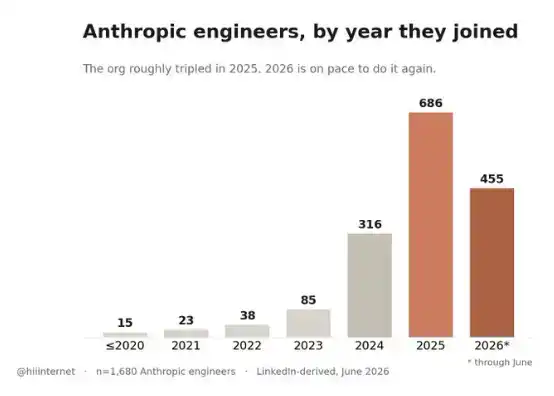
Only 15 engineers who joined Anthropic before 2021 are still employed there today. In 2025, this organization's engineering team nearly tripled in size, adding 686 engineers that year; the hiring pace for 2026 is projected to be similar, with 455 added by June.

Currently, half of the engineering team has been at Anthropic for less than a year. 53% joined within the past 12 months. Median tenure: 10 months.

This is a large-scale organization that was essentially built up in about 18 months.

They Almost Exclusively Hire Senior Engineers
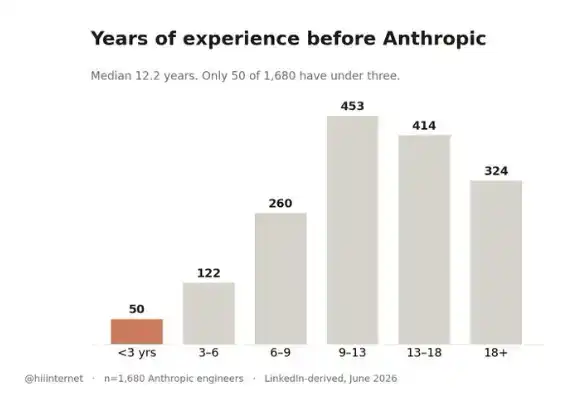
The median years of work experience before joining Anthropic is 12.2 years. The middle 50% have between 8.8 and 16.5 years of experience. Among these 1,680 people, only 50 have less than 3 years of experience. 44% have 13 or more years of experience. New graduate hiring is virtually nonexistent.

In other words, the typical new hire at Anthropic is an engineer with 12 years of experience who has only been at Anthropic for 10 months.

Clear Bias Towards Infrastructure Over Traditional Research
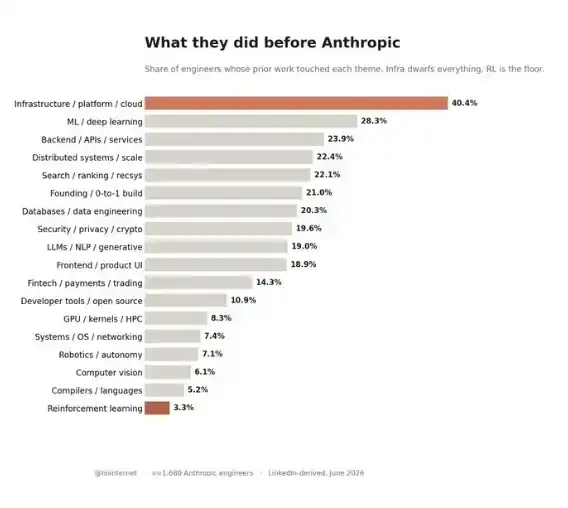
Infrastructure background appears in 40% of the engineers' profiles. Backend, distributed systems, databases, and security each appear in about 20% of profiles. Reinforcement learning, the "RL" in RLHF, appears in only 3.3%.

The typical Anthropic engineer spent the past decade building large-scale production systems at either a hyperscale cloud provider or an infrastructure-heavy startup.

Their self-listed skills tell the same story: Python (585 people), Java (566), C++ (443), JavaScript (376), SQL (302), Linux (230), Distributed Systems (189), AWS (154). The more "sexy"-sounding model training work certainly exists, but it's a low percentage.

The Largest Talent Source Is Not a Lab, It's Google
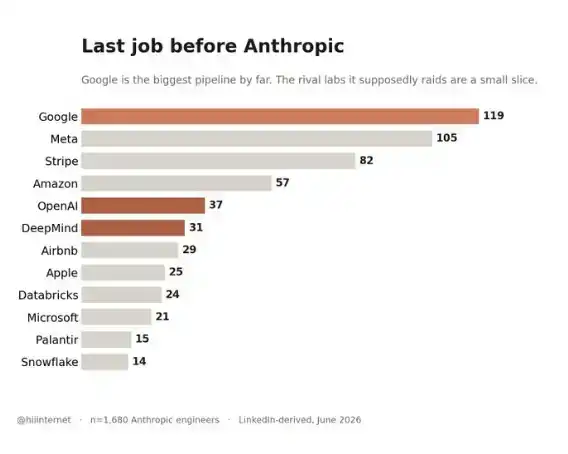
Everyone thinks Anthropic mainly hires from OpenAI and DeepMind. But its largest talent pipeline, by far, is Google. Those competitor labs are just two small bars in the middle of the chart.

Anthropic clearly prefers companies known for engineering rigor: Stripe, Databricks, Snowflake, Palantir, Airbnb.

Looking at where these engineers have worked historically, the ranking is: Google (405 people), Meta (273), Amazon (197), Microsoft (171), Stripe (124), Apple (87), Stanford (68), DeepMind (62), Airbnb (51), OpenAI (48). Half of the current engineering team, 50%, have at least one FAANG company in their career history.

Of course, they also hire from other AI labs. OpenAI is a top-five direct source, and DeepMind is a top-six direct source. About 94 engineers moved directly from other frontier AI labs to Anthropic.

The Myth of the PhD
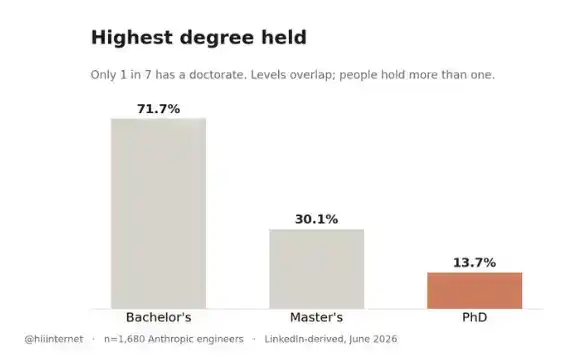
Only 13.7% hold a doctoral degree. That's roughly one in seven people.

The typical Anthropic recruitment target is not a research scientist, but a senior engineer with a bachelor's or master's degree. The image of a "lab full of PhDs" is largely incorrect at the engineering team level.

The distribution of academic majors also perfectly fits the profile of a "building organization": Computer Science (819 people), followed by Mathematics (78), Physics (70), Computer Engineering (69). Philosophy also makes the top 20, with 13 people, likely related to safety.

Stanford Is Clearly the Leading Source by University
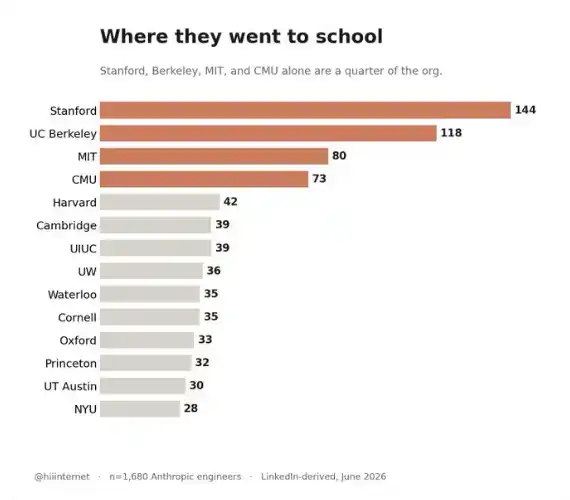
Looking at universities, the historical cumulative ranking is: Stanford (144 people), Berkeley (118), MIT (80), CMU (73), Harvard (42), Cambridge (39), UW (36), Waterloo and Cornell (35 each), Oxford (33), Princeton (32). The top four schools combined account for a quarter of the entire engineering team.

80% of people share the same job title.

"Member of Technical Staff."

A former Instagram CTO, a few former Adept founders, and Stanford faculty at Anthropic all share the title "MoTS." This flattening of job titles is clearly intentional. Seniority and specific function are, by design, hidden.

Where is the One Entry Point for Early-Career People into Anthropic?
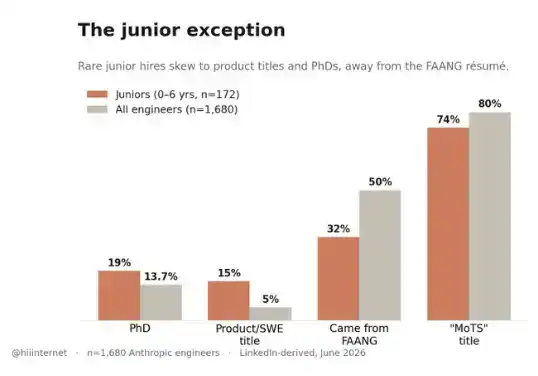
There are 172 engineers with less than 6 years of experience, and 50 of them have less than 3 years. But they are not typical new graduates. They roughly fall into two categories, with almost no ordinary mid-level engineers in between.

Compared to the entire engineering team, they show distinctly different characteristics: a higher PhD rate of 19% vs. 13.7% overall; product/SWE titles are three times more common, at 15% vs. 5% overall; they are also far less likely to have FAANG experience, only 32% vs. 50% overall.

In place of years of experience, they possess a different form of prestige capital:

The Internship Pipeline. 50% of them list internships at these companies: Meta (16 people), Google (10), DeepMind (6), Microsoft (5), Amazon (5), plus Jane Street, Two Sigma, HRT, Optiver, Nvidia.

From Quant Trading to AI Labs. 9% had stints at top trading firms, including Jane Street, Two Sigma, Five Rings, HRT, Optiver, Citadel. This is a group of young math/coding competition talent entering AI labs via the high-frequency trading industry.

Alignment Fellowships. 6% had exposure to MATS, SERI, Redwood, or ARC. This is an entry point that is almost exclusively for early-career talent and virtually absent among the senior cohort.

A very clear profile emerges: MIT, IOI Silver Medalist, Codeforces rating 2900+, entered reinforcement learning and safety directly after four years of work. Their screening criteria aren't years of experience, but competition rankings and publications.

These young engineers are also more international than their senior counterparts. School sources for low-seniority engineers include: Berkeley (15), Stanford (14), Cambridge (10), MIT (7), Tsinghua (7), Oxford (6), plus Imperial, NUS, Shanghai Jiao Tong University, ETH Zürich.

So, How Should You Interpret This?

If you want to join Anthropic as an engineer, don't write your resume as if applying to a research lab. Write it as if applying to an infrastructure company. Show the systems you've actually built and scaled. That's the resume getting hired.

The early-career stage is the only exception. At this stage, the barrier isn't regular work experience, but top internships, competition rankings, or publications.

If you're competing with Anthropic for talent, your target isn't "PhDs" or "lab background" per se, but those senior Builders from hyperscale cloud providers or companies with stellar engineering reputations: they have about 12 years of experience, likely from Stripe, Databricks, Snowflake, Palantir. Anthropic is already fishing heavily in this talent pool.


Trending Cryptos

Related Questions

QWhat is the core talent profile that Anthropic primarily hires for, according to the analysis of engineer resumes?

AThe core talent profile at Anthropic is not 'researchers,' but rather experienced 'builders'—engineers who can build, scale, and maintain large-scale production systems. The majority are senior engineers with a background in infrastructure, backend, distributed systems, databases, and security, not necessarily AI model research.

QWhat does the data say about the experience level of a typical new engineer joining Anthropic?

AThe median prior work experience for engineers joining Anthropic is 12.2 years. The middle 50% have between 8.8 and 16.5 years of experience. New hires are predominantly senior engineers, with nearly zero recent graduate hiring.

QWhich company is the largest direct source of engineering talent for Anthropic, and what does this indicate about their hiring preference?

AGoogle is by far the largest direct source of engineering talent for Anthropic. This indicates a strong preference for candidates from companies renowned for engineering rigor and infrastructure capabilities (like Meta, Amazon, Microsoft, Stripe, Databricks), rather than exclusively from AI research labs like OpenAI or DeepMind.

QWhat is the percentage of engineers at Anthropic with a PhD, and what is the most common educational background?

AOnly 13.7% of the engineers analyzed hold a PhD. The most common educational background is a Bachelor's or Master's degree in Computer Science (819 people), which aligns with the profile of a 'builder' organization focused on engineering and infrastructure.

QFor early-career individuals with limited work experience, what are the primary pathways to secure an engineering role at Anthropic?

AEarly-career individuals primarily gain entry through alternative prestige signals: top-tier internship experiences (e.g., at Meta, Google, DeepMind), exceptional competition rankings (e.g., IOI medals, high Codeforces scores), research publications, or participation in specialized AI safety/alignment fellowships (e.g., MATS, SERI).

Related Reads

TechFlow Intelligence Bureau: Anthropic IPO Odds Exceed 80%, Iran Closes Strait of Hormuz Again, Triggering Oil Price Volatility

**Market Digest** **AI & Tech:** Anthropic is widely expected to announce an IPO before November 2026, raising questions about balancing its trillion-dollar valuation ambitions with its core "AI safety" mission. Brands are increasingly adopting AI-generated virtual influencers for marketing. Cloudflare introduced temporary accounts for AI agents to ease automation workflows. **Infrastructure & Hardware:** Google's IPv6 traffic surpassed 50%, marking a major internet milestone. Goldman Sachs warned that massive projected AI capital expenditure ($5.3T) is approaching credit saturation limits, potentially curbing the "AI arms race." **Space & Robotics:** SpaceX's IPO saw a historic $370M retail buying frenzy in three days. Hyundai Motor Group plans to acquire full ownership of Boston Dynamics. Elon Musk speculated about future "septillion-dollar" investments in antimatter for interstellar travel. **Energy & Geopolitics:** Iran's military announced another closure of the strategic Strait of Hormuz, accusing Israel of violating a ceasefire, causing oil market volatility. However, ship-tracking data indicated some traffic continued. Concurrently, Iran resumed crude loadings at Kharg Island, potentially releasing up to 20 million barrels to the market. **Finance & Macro:** A European CLO (collateralized loan obligation) experienced its first post-2008-crisis-era equity tranche default, raising alarms in credit markets. Nomura warned that new Federal Reserve Chair Wash's perceived hawkish debut speech could signal a significant policy shift. **The Undercurrent:** Seemingly disparate events—the Strait of Hormuz tension, the European CLO default, and warnings on AI spending—point to a tightening of global liquidity and rising marginal costs across energy, credit, and tech investment. Meanwhile, capital continues chasing grand narratives like space exploration and advanced AI, highlighting a divergence where old-world leverage frays as new-world stories grow more ambitious.

marsbit49m ago

TechFlow Intelligence Bureau: Anthropic IPO Odds Exceed 80%, Iran Closes Strait of Hormuz Again, Triggering Oil Price Volatility

marsbit49m ago

The Hunter Becomes the Hunted: The Most Profitable MEV Bot Gets Hacked

A well-known and highly profitable Ethereum MEV Bot, Jaredfromsubway.eth, suffered a sophisticated on-chain attack this Saturday, losing over $7.5 million. Analysis by Blockaid and others reveals this was not a conventional phishing or smart contract exploit, but a targeted "counter-MEV honeypot attack." The attacker meticulously laid a trap over several weeks, deploying 66 fake token contracts and liquidity pools disguised as major assets like WETH and USDC. These pools created the illusion of arbitrage opportunities. The MEV Bot's automated system detected these signals, executed trades, and in the process, granted approval permissions to attacker-controlled contracts. These approvals were not revoked, creating a persistent vulnerability. The attacker then exploited this in a single transaction, draining the bot's ETH, USDC, and USDT holdings. Jaredfromsubway.eth is notorious as one of Ethereum's most active and profitable MEV Bots, primarily known for executing "sandwich attacks" to profit from transaction slippage. Estimates suggest it has earned tens of millions in MEV revenue. The incident highlights escalating crypto security threats, demonstrating that even top-tier automated "predators" are vulnerable to novel, logic-based attacks designed to exploit their own operational rules. Following the hack, an unverified X account impersonating Jaredfromsubway.eth emerged, falsely offering a bounty for the return of funds, prompting developer warnings for users to stay vigilant.

marsbit2h ago

The Hunter Becomes the Hunted: The Most Profitable MEV Bot Gets Hacked

marsbit2h ago

The Reality of Payments in Latin America Is Not What You Think

The payment landscape in Latin America is undergoing a fundamental shift, driven by on-the-ground realities that challenge common perceptions. Based on over 500 hours of field research across the region, key insights emerge. Firstly, QR code payments, like Brazil's Pix, are becoming the dominant payment method in most emerging markets, overtaking cards. However, these domestic instant payment systems lack international interoperability, creating a significant gap for cross-border users. Secondly, the narrative around crypto cards is often misunderstood; their primary volume comes from high-net-worth professionals using them for salary conversions (e.g., USDT to local currency via Pix), not retail micro-payments. Competition in payments is shifting from customer acquisition to controlling the settlement layer, leading fintechs to acquire banking licenses for efficiency. Thirdly, treating "Latin America" as a single market is a mistake. Countries like Argentina, Brazil, and Mexico have distinct economic realities, user segments, and regulatory approaches. Brazil alone has at least five distinct user segments with different financial flows. Overlooked markets like Guatemala, Honduras, and El Salvador (the "forgotten five") offer high remittance volumes with lower competitive density. Finally, regulation in Latin America is often ahead of the US, with clearer frameworks for digital assets and a pragmatic approach from regulators focused on safety rather than obstruction. The margin on stablecoin forex is rapidly compressing toward zero, meaning future winners will be those building value-added services on top of the infrastructure, not just the cheapest exchange.

marsbit2h ago

The Reality of Payments in Latin America Is Not What You Think

marsbit2h ago

Trading

Spot
Futures

Hot Articles

How to Buy PEOPLE

Welcome to HTX.com! We've made purchasing ConstitutionDAO (PEOPLE) simple and convenient. Follow our step-by-step guide to embark on your crypto journey.Step 1: Create Your HTX AccountUse your email or phone number to sign up for a free account on HTX. Experience a hassle-free registration journey and unlock all features.Get My AccountStep 2: Go to Buy Crypto and Choose Your Payment MethodCredit/Debit Card: Use your Visa or Mastercard to buy ConstitutionDAO (PEOPLE) instantly.Balance: Use funds from your HTX account balance to trade seamlessly.Third Parties: We've added popular payment methods such as Google Pay and Apple Pay to enhance convenience.P2P: Trade directly with other users on HTX.Over-the-Counter (OTC): We offer tailor-made services and competitive exchange rates for traders.Step 3: Store Your ConstitutionDAO (PEOPLE)After purchasing your ConstitutionDAO (PEOPLE), store it in your HTX account. Alternatively, you can send it elsewhere via blockchain transfer or use it to trade other cryptocurrencies.Step 4: Trade ConstitutionDAO (PEOPLE)Easily trade ConstitutionDAO (PEOPLE) on HTX's spot market. Simply access your account, select your trading pair, execute your trades, and monitor in real-time. We offer a user-friendly experience for both beginners and seasoned traders.

7.2k Total ViewsPublished 2024.03.29Updated 2026.06.02

How to Buy PEOPLE

Discussions

Welcome to the HTX Community. Here, you can stay informed about the latest platform developments and gain access to professional market insights. Users' opinions on the price of PEOPLE (PEOPLE) are presented below.

活动图片