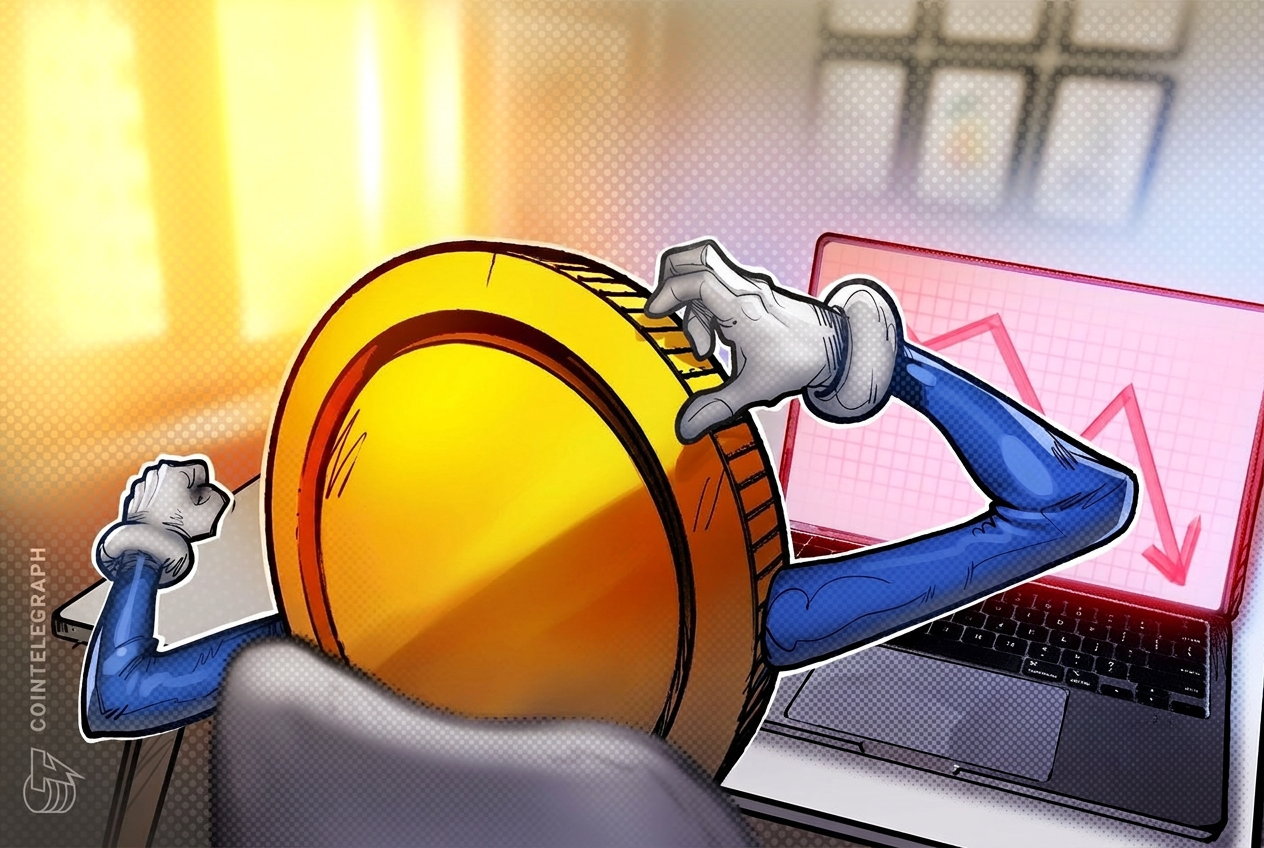
Monero falls from FOMO to 63% freefall – What’s next for XMR?

ambcryptoPublished on 2026-02-08Last updated on 2026-02-08

Abstract

Monero (XMR) experienced a significant decline, falling 63.7% from its all-time high of $798 in just 22 days, following a parabolic rally in January. The drop was largely influenced by Bitcoin's loss of bullish momentum and subsequent sell-off. Social media engagement indicated crowd FOMO, while technical indicators like the A/D indicator and moving averages signaled strong bearish pressure. Key support levels, such as the 78.6% Fibonacci retracement at $352, failed to hold, turning previous supports into supply zones. Traders should expect continued downtrends, with potential short-term bounces possibly retesting $390–$420 or $500 before further declines. The overall outlook remains bearish, and buying at current levels is considered highly risky.

Monero [XMR] had a parabolic rally in January, and just as it set a new all-time high at $798, Bitcoin [BTC] ran out of bullish momentum. The subsequent BTC sell-off led to a steep XMR correction of 63.7% in just 22 days.

The social media engagement on the privacy coin was remarkable, but AMBCrypto pointed out that this was a sign of “obvious crowd FOMO” and highlighted overheating alarms that the spot volume bubble map showed.

These warnings were followed by a steep correction just days later. The failure to defend the long-term trendline support meant that XMR was likely headed to $266 next. On Friday, the 6th of February, XMR reached a low of $276.

Monero bears reclaim key retracement levels

The A/D indicator made new multi-month lows to underline the depth of the selling pressure in the past three weeks. The steep correction and high volume explained the A/D indicator’s movement and showed that recovery was highly unlikely anytime soon.

The 20 and 50-day moving averages formed a bearish crossover after 4 months of a bullish trend. The DMI also signaled a strong downtrend in progress.

These were pretty obvious just looking at the recent drawdown. The bulls’ last spark of hope lay at $352, the 78.6% Fibonacci retracement level from the rally between $230 and $799.

Levels that once acted as support a few weeks ago have now flipped into firm supply zones. Selling pressure proved so strong that the $352 retest failed to produce any meaningful reaction.

What should traders expect?

Traders and investors should be prepared for the downtrend to continue.

It is possible that Monero would halt at certain price levels and form a range at moments when Bitcoin [BTC] and major altcoins see a price bounce in their longer-term downtrends.

XMR faces bearish retest zones

The run is clearly over. A Bitcoin bounce could take XMR higher. The liquidation heatmap showed that the $390-$420 and $500 levels were the next magnetic zones to watch. A retest of these areas could yield another bearish move.


Final Thoughts

  • Monero has had its parabolic rally and subsequent blow-off top, and has retraced 63% in just over three weeks.
  • Swing traders and investors would have to be a special kind of brave to buy here, but their portfolios might not thank them for it. Catching knives can be exciting, but also needlessly risky.

Disclaimer: The information presented does not constitute financial, investment, trading, or other types of advice and is solely the writer’s opinion.

Trending Cryptos

Related Questions

QWhat was the peak price of Monero (XMR) in January and how much did it corrected from that high?

AMonero reached a new all-time high of $798 in January and subsequently corrected by 63.7% in just 22 days.

QAccording to the article, what technical indicator signaled a strong downtrend for XMR after the correction?

AThe DMI (Directional Movement Index) signaled a strong downtrend in progress, and the 20 and 50-day moving averages formed a bearish crossover.

QWhat key Fibonacci retracement level was identified as the 'bulls' last spark of hope' for XMR?

AThe 78.6% Fibonacci retracement level at $352 was identified as the bulls' last spark of hope.

QWhat does the article suggest about the possibility of a recovery for XMR in the near term?

AThe article suggests that a recovery is highly unlikely anytime soon, as indicated by the A/D indicator making new multi-month lows and the high selling volume.

QWhat two price zones does the liquidation heatmap indicate as the next 'magnetic zones' to watch for a potential bearish retest?

AThe liquidation heatmap showed the $390-$420 and $500 levels as the next magnetic zones to watch for a potential bearish retest.

Related Reads

Vitalik's Algorithmic Stablecoin Vision: Interpreting the Mechanism and Challenges from an Options Perspective

Vitalik Buterin's recent algorithmic stablecoin proposal envisions using an option-like mechanism to create a stablecoin without the liquidation risks inherent in traditional collateralized debt position (CDP) models. The design splits one unit of ETH into two components: a 'stable' leg (P) that maintains value up to a certain strike price, and an 'upside' leg (N) that captures any appreciation above that price. Together, they always sum to one ETH, eliminating the need for debt or liquidation mechanisms. From an options perspective, the stable leg essentially functions as a synthetic, covered call position. However, significant challenges exist. For the stable asset to maintain its peg, it must continuously roll deep in-the-money call options, leading to potential rollover slippage, predictable trading paths vulnerable to front-running, and liquidity issues. Crucially, the system's scalability depends on a constant demand for the upside leg—a form of leveraged ETH long position without funding rates or liquidation risk. It's unclear if such persistent, specific demand will materialize from speculators or market makers who have simpler alternatives like perpetual swaps. The author, drawing from experience with Rysk, argues that DeFi options have struggled as standalone trading products due to complexity and fragmented liquidity. Their potential lies instead as foundational infrastructure underpinning more complex financial primitives like stablecoins, structured yields, or index products—transforming from a direct product into a core pricing and risk distribution engine for the next generation of on-chain finance.

marsbit1h ago

Vitalik's Algorithmic Stablecoin Vision: Interpreting the Mechanism and Challenges from an Options Perspective

marsbit1h ago

GPT-5.6 Countdown: Abandon the Illusion of a Single API, Computational Iteration Can't Outpace a Single Page of Compliance

In mid-June, three seemingly independent industry events—the compliance-driven throttling of Fable 5, the open-sourcing of GLM-5.2, and the leaked release timeline for GPT-5.6—are pushing the global AI industry toward a watershed moment. These shifts signal a fundamental restructuring of the industry's underlying logic. First, **"usability" has substantially overtaken "advanced capabilities"** as the primary weight, pushing the global large language model (LLM) supply chain into a "dual-track" phase of controlled closed-source and local open-source coexistence. Second, **the competitive moats of closed-source giants are shifting**. Their technical focus is moving from "language intelligence" toward "spatial intelligence (world models)"—a domain heavily reliant on computing power. Third, faced with常态化 transnational compliance risks, **a "model-agnostic" decoupled design has become a survival necessity for application-layer developers to maintain business continuity.** The article details how Anthropic's Fable 5, despite its advanced engineering feats, was restricted for non-U.S. citizens within 72 hours of launch, highlighting how geopolitical compliance can instantly limit even the most advanced models. In response, the open-source camp, exemplified by Zhipu AI's MIT-licensed GLM-5.2, is gaining market share by offering stable performance improvements and significant cost advantages (up to 70% savings for enterprises), while achieving full adaptation with domestic semiconductor platforms. Meanwhile, closed-source leaders like OpenAI are pivoting. The anticipated GPT-5.6 reportedly shifts focus from language to spatial intelligence and world models, aiming to rebuild a generational gap in areas like 3D understanding, simulation, and industrial design that demand immense compute. The core conclusion is that the LLM supply chain's logic has changed. Enterprises must now evaluate infrastructure based on a composite of technical performance and policy compliance. For developers, complete reliance on a single closed-source API poses unacceptable risk. Implementing a truly model-agnostic architecture—enabling swift switches to compliant, locally deployable open-source alternatives—is no longer just good practice but a fundamental baseline for business continuity.

marsbit3h ago

GPT-5.6 Countdown: Abandon the Illusion of a Single API, Computational Iteration Can't Outpace a Single Page of Compliance

marsbit3h ago

Is the 'Token Subsidy War' Among AI Giants Almost Over?

The article discusses the ongoing "token subsidy war" among AI giants like OpenAI and Anthropic, questioning whether it's nearing its end. It reveals that current AI subscription prices are heavily subsidized, with some plans offering tokens at up to 70 times the actual cost to attract and retain heavy users, especially developers and enterprises. This strategy mirrors past internet-era subsidy battles, but with a key difference: AI tokens lack "lock-in" effects. Unlike ride-hailing or food delivery apps, users can easily switch between AI providers as APIs become standardized, making it difficult for companies to raise prices post-subsidy. The piece highlights a structural asymmetry in the competition. Giants like Google, with massive advertising revenue, can afford to subsidize tokens indefinitely, akin to using "tokens as a weapon." In contrast, venture-backed companies like OpenAI and Anthropic face pressure to become profitable, especially as they approach IPO. The article cites Google Ventures founder Bill Maris, who suggests Google could slash token prices by 80%, putting immense pressure on competitors. Two potential endgames are presented: the "internet service" model (subsidize, monopolize, then raise prices) and the "utility" model (tokens become a standardized, low-margin commodity like electricity). Given the low switching costs, the latter seems more likely. The competition may not have a single winner but could instead accelerate AI's evolution into a foundational, infrastructure-level technology, akin to a public utility. For now, users continue to benefit from heavily subsidized token costs.

marsbit4h ago

Is the 'Token Subsidy War' Among AI Giants Almost Over?

marsbit4h ago

Trading

Spot
Futures

Hot Articles

How to Buy XMR

Welcome to HTX.com! We've made purchasing Monero (XMR) simple and convenient. Follow our step-by-step guide to embark on your crypto journey.Step 1: Create Your HTX AccountUse your email or phone number to sign up for a free account on HTX. Experience a hassle-free registration journey and unlock all features.Get My AccountStep 2: Go to Buy Crypto and Choose Your Payment MethodCredit/Debit Card: Use your Visa or Mastercard to buy Monero (XMR) instantly.Balance: Use funds from your HTX account balance to trade seamlessly.Third Parties: We've added popular payment methods such as Google Pay and Apple Pay to enhance convenience.P2P: Trade directly with other users on HTX.Over-the-Counter (OTC): We offer tailor-made services and competitive exchange rates for traders.Step 3: Store Your Monero (XMR)After purchasing your Monero (XMR), store it in your HTX account. Alternatively, you can send it elsewhere via blockchain transfer or use it to trade other cryptocurrencies.Step 4: Trade Monero (XMR)Easily trade Monero (XMR) on HTX's spot market. Simply access your account, select your trading pair, execute your trades, and monitor in real-time. We offer a user-friendly experience for both beginners and seasoned traders.

4.8k Total ViewsPublished 2024.03.29Updated 2026.06.02

How to Buy XMR

Discussions

Welcome to the HTX Community. Here, you can stay informed about the latest platform developments and gain access to professional market insights. Users' opinions on the price of XMR (XMR) are presented below.

活动图片