ETC Proof of Work Course: 35. POW Must Be Attackable to be Secure

项目方ETC(Ethereum Classic)Published on 2024-07-31Last updated on 2025-11-10

Ethereum Classic Blog

ETC Proof of Work Course: 35. POW Must Be Attackable to be Secure

Donald McIntyre
Education, Series

You can listen to or watch this video here:

banner

In the previous class, 34, we talked about the activity that produces finality, and security in general, in POW blockchains such as ETC, which is mining.

We explained the metrics that make ETC a great business opportunity for cryptocurrency miners around the world.

In this class, 35, we will explain why proof of work (POW) blockchains must be attackable to be secure.

The Bias to Add Subjectivity to Blockchains
1

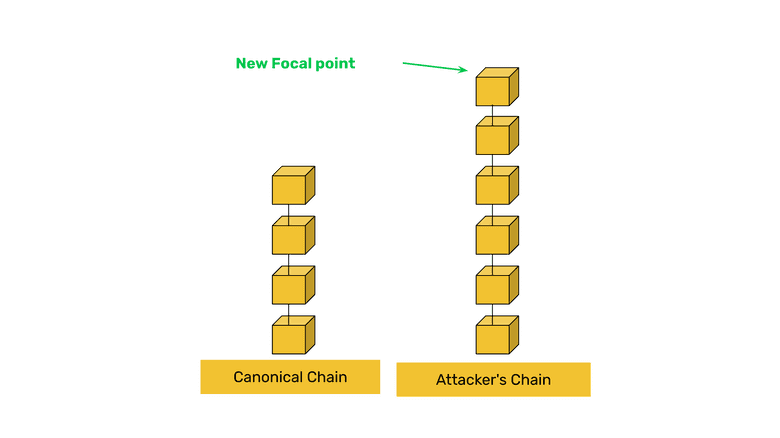
51% attacks on POW blockchains are actions were dishonest actors accumulate more than 50% of the mining power in a blockchain and use it to delete past transactions in the ledger. The purpose of deleting transactions is to steal property from their victims.

51% attacks are a known attack vector in POW blockchains, but it is a feature, not a bug of these systems.

People think that because POW blockchains can be attacked if bad actors control more than 50% of mining that it is necessary to add subjective contraptions to reject alternative blocks or chains that are proposed to replace the canonical chain.

Examples: Checkpointing and MESS

For example, if a POW network is working on block 100,000 and, suddenly, blocks 99,000 through 100,000 are reorganized by an attacker to replace or delete transactions from the recent past, then new rules such as checkpointing or to demand exponentially more hash power to reorganize blocks should be added to prevent these reorganizations.

Checkpointing predetermines certain block numbers in the past beyond which network nodes will not accept any reorganizations.

A system such as MESS (Modified Exponential Subjective Scoring) makes the nodes reject any reorganization of the chain if they have less than a certain hash power invested in it.

But Weak Subjectivity Is Bad

However, if this were done it would put in the hands of humans the decision of which is the correct chain to follow, and the whole decentralization of the blockchain accomplished by the simple verification of the work done, where anyone around the world can join and leave whenever they please with no permission nor checking with anyone else, would be thrown away just to prevent 51% attacks.

The original intent of using POW as a consensus mechanism was to eliminate any subjectivity precisely to enable complete decentralization of the system.

If nodes who are joining or exiting and joining again the network had to be checking with other nodes which is the correct blockchain based on arbitrary metrics and markers rather than on sheer computing power, then the figure of the “trusted third party” would be reintroduced into the system all over again!

And 51% Attacks Are Not That Important Anyway

It is not worth introducing trust into POW blockchains just to prevent 51% attacks as these are not that severe anyway.

51% attacks are very narrow attacks, very unlikely, have very few victims, and victims have other ways of protecting themselves, such as waiting for the correct number of block confirmations when receiving coins.

This is why it is not a good idea to add subjective rules to POW blockchains, and why they HAVE TO BE ATTACKABLE TO ACTUALLY BE SECURE, not the other way around.


Thank you for reading this article!

To learn more about ETC please go to: https://ethereumclassic.org

Trending Cryptos

Related Reads

Vitalik's Algorithmic Stablecoin Vision: Interpreting the Mechanism and Challenges from an Options Perspective

Vitalik Buterin's recent algorithmic stablecoin proposal envisions using an option-like mechanism to create a stablecoin without the liquidation risks inherent in traditional collateralized debt position (CDP) models. The design splits one unit of ETH into two components: a 'stable' leg (P) that maintains value up to a certain strike price, and an 'upside' leg (N) that captures any appreciation above that price. Together, they always sum to one ETH, eliminating the need for debt or liquidation mechanisms. From an options perspective, the stable leg essentially functions as a synthetic, covered call position. However, significant challenges exist. For the stable asset to maintain its peg, it must continuously roll deep in-the-money call options, leading to potential rollover slippage, predictable trading paths vulnerable to front-running, and liquidity issues. Crucially, the system's scalability depends on a constant demand for the upside leg—a form of leveraged ETH long position without funding rates or liquidation risk. It's unclear if such persistent, specific demand will materialize from speculators or market makers who have simpler alternatives like perpetual swaps. The author, drawing from experience with Rysk, argues that DeFi options have struggled as standalone trading products due to complexity and fragmented liquidity. Their potential lies instead as foundational infrastructure underpinning more complex financial primitives like stablecoins, structured yields, or index products—transforming from a direct product into a core pricing and risk distribution engine for the next generation of on-chain finance.

marsbit1h ago

Vitalik's Algorithmic Stablecoin Vision: Interpreting the Mechanism and Challenges from an Options Perspective

marsbit1h ago

GPT-5.6 Countdown: Abandon the Illusion of a Single API, Computational Iteration Can't Outpace a Single Page of Compliance

In mid-June, three seemingly independent industry events—the compliance-driven throttling of Fable 5, the open-sourcing of GLM-5.2, and the leaked release timeline for GPT-5.6—are pushing the global AI industry toward a watershed moment. These shifts signal a fundamental restructuring of the industry's underlying logic. First, **"usability" has substantially overtaken "advanced capabilities"** as the primary weight, pushing the global large language model (LLM) supply chain into a "dual-track" phase of controlled closed-source and local open-source coexistence. Second, **the competitive moats of closed-source giants are shifting**. Their technical focus is moving from "language intelligence" toward "spatial intelligence (world models)"—a domain heavily reliant on computing power. Third, faced with常态化 transnational compliance risks, **a "model-agnostic" decoupled design has become a survival necessity for application-layer developers to maintain business continuity.** The article details how Anthropic's Fable 5, despite its advanced engineering feats, was restricted for non-U.S. citizens within 72 hours of launch, highlighting how geopolitical compliance can instantly limit even the most advanced models. In response, the open-source camp, exemplified by Zhipu AI's MIT-licensed GLM-5.2, is gaining market share by offering stable performance improvements and significant cost advantages (up to 70% savings for enterprises), while achieving full adaptation with domestic semiconductor platforms. Meanwhile, closed-source leaders like OpenAI are pivoting. The anticipated GPT-5.6 reportedly shifts focus from language to spatial intelligence and world models, aiming to rebuild a generational gap in areas like 3D understanding, simulation, and industrial design that demand immense compute. The core conclusion is that the LLM supply chain's logic has changed. Enterprises must now evaluate infrastructure based on a composite of technical performance and policy compliance. For developers, complete reliance on a single closed-source API poses unacceptable risk. Implementing a truly model-agnostic architecture—enabling swift switches to compliant, locally deployable open-source alternatives—is no longer just good practice but a fundamental baseline for business continuity.

marsbit3h ago

GPT-5.6 Countdown: Abandon the Illusion of a Single API, Computational Iteration Can't Outpace a Single Page of Compliance

marsbit3h ago

Is the 'Token Subsidy War' Among AI Giants Almost Over?

The article discusses the ongoing "token subsidy war" among AI giants like OpenAI and Anthropic, questioning whether it's nearing its end. It reveals that current AI subscription prices are heavily subsidized, with some plans offering tokens at up to 70 times the actual cost to attract and retain heavy users, especially developers and enterprises. This strategy mirrors past internet-era subsidy battles, but with a key difference: AI tokens lack "lock-in" effects. Unlike ride-hailing or food delivery apps, users can easily switch between AI providers as APIs become standardized, making it difficult for companies to raise prices post-subsidy. The piece highlights a structural asymmetry in the competition. Giants like Google, with massive advertising revenue, can afford to subsidize tokens indefinitely, akin to using "tokens as a weapon." In contrast, venture-backed companies like OpenAI and Anthropic face pressure to become profitable, especially as they approach IPO. The article cites Google Ventures founder Bill Maris, who suggests Google could slash token prices by 80%, putting immense pressure on competitors. Two potential endgames are presented: the "internet service" model (subsidize, monopolize, then raise prices) and the "utility" model (tokens become a standardized, low-margin commodity like electricity). Given the low switching costs, the latter seems more likely. The competition may not have a single winner but could instead accelerate AI's evolution into a foundational, infrastructure-level technology, akin to a public utility. For now, users continue to benefit from heavily subsidized token costs.

marsbit4h ago

Is the 'Token Subsidy War' Among AI Giants Almost Over?

marsbit4h ago

Trading

Spot
Futures

Hot Articles

How to Buy ETC

Welcome to HTX.com! We've made purchasing Ethereum Classic (ETC) simple and convenient. Follow our step-by-step guide to embark on your crypto journey.Step 1: Create Your HTX AccountUse your email or phone number to sign up for a free account on HTX. Experience a hassle-free registration journey and unlock all features.Get My AccountStep 2: Go to Buy Crypto and Choose Your Payment MethodCredit/Debit Card: Use your Visa or Mastercard to buy Ethereum Classic (ETC) instantly.Balance: Use funds from your HTX account balance to trade seamlessly.Third Parties: We've added popular payment methods such as Google Pay and Apple Pay to enhance convenience.P2P: Trade directly with other users on HTX.Over-the-Counter (OTC): We offer tailor-made services and competitive exchange rates for traders.Step 3: Store Your Ethereum Classic (ETC)After purchasing your Ethereum Classic (ETC), store it in your HTX account. Alternatively, you can send it elsewhere via blockchain transfer or use it to trade other cryptocurrencies.Step 4: Trade Ethereum Classic (ETC)Easily trade Ethereum Classic (ETC) on HTX's spot market. Simply access your account, select your trading pair, execute your trades, and monitor in real-time. We offer a user-friendly experience for both beginners and seasoned traders.

4.3k Total ViewsPublished 2024.03.29Updated 2026.06.02

How to Buy ETC

Discussions

Welcome to the HTX Community. Here, you can stay informed about the latest platform developments and gain access to professional market insights. Users' opinions on the price of ETC (ETC) are presented below.

活动图片